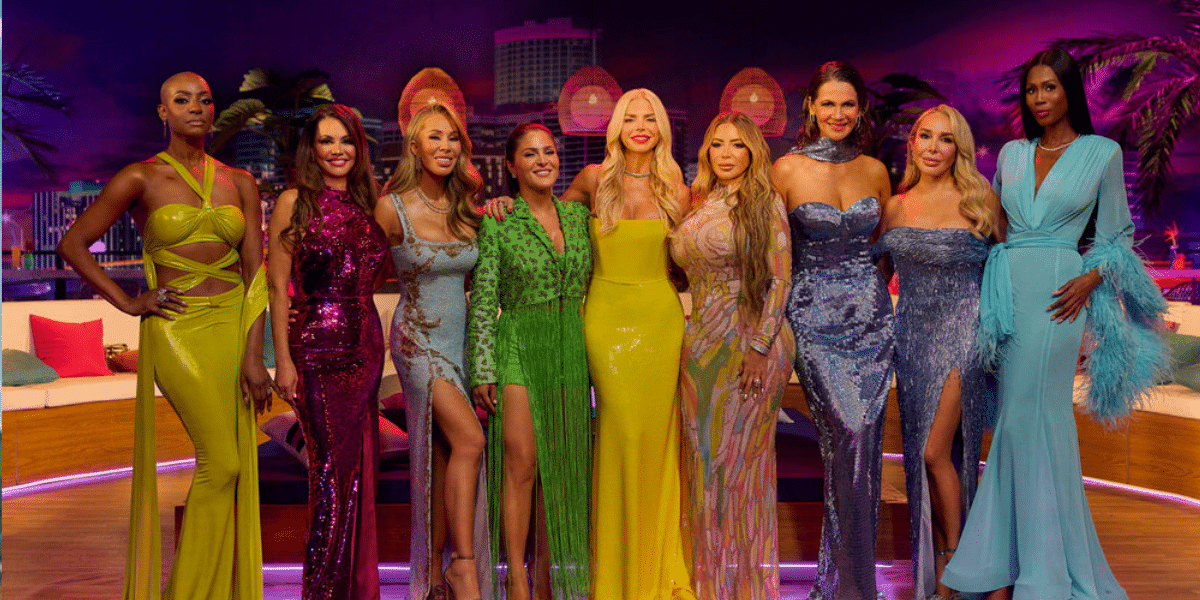
For years, The Real Housewives of Miami has done something no other franchise has managed to replicate: it makes Latina identity feel real on screen. Not curated. Not simplified. Not reduced to something easily digestible. So the decision to pause RHOM doesn’t just feel like a programming shift. It feels like a betrayal.
While other franchises rely on increasingly predictable formulas, RHOM builds something far harder to manufacture: cultural texture. The code-switching between English and Spanish isn’t performative. The dynamics aren’t just social, they’re shaped by immigration, family, class, and deeply rooted cultural expectations. These women aren’t playing a version of Latina identity for the audience. They’re living it.
That realism shows up most clearly in the fluidity of language. In RHOM, code-switching carries the intimacy of the kitchen, the family table, the spaces where culture is lived rather than explained. When the women move between English and Spanish, they’re not just changing vocabulary. They’re moving between emotional registers, memories, and ways of being that cannot always be cleanly translated.
With stars like Marysol Patton and Dr. Nicole Martin, the cast mirrors Miami itself: Cubans, Brazilians, Haitians – not a singular identity, but a layered one. That diversity isn’t aesthetic. It’s the reason The Real Housewives of Miami resonates.
RHOM also understands something fundamental about Latin culture: the collective matters as much as the individual. Unlike New York or Orange County, where the drama often isolates each woman inside her own world, Miami’s conflicts are multigenerational. Mothers like the legendary Mama Elsa, children, inherited immigration stories, these are not side plots. They are the show’s emotional DNA.
Of course, there’s tension within this representation of Latina Bravolebrities. Is Bravo genuinely evolving in how it portrays Latinas or simply repackaging familiar stereotypes in more polished ways? The Real Housewives of Miami doesn’t give us flawless role models. But it does offer honest complexity, and that’s rarer.
There’s still an expectation that Latinas should be warm, agreeable, and easy to embrace. RHOM disrupts that. It gives us women who are not always likable, soft, or easily understood, and that’s exactly why it matters.
The cast never functions as a single narrative. They operate as a spectrum.
Alexia Nepola embodies legacy and survival. Marysol Patton carries cultural memory with irreverence. Dr. Nicole Martin represents a modern Latina archetype rarely centered in reality TV: highly educated, accomplished, and emotionally grounded. Guerdy Abraira expands the frame as an Afro-Latina with Haitian roots. Adriana de Moura, as a multilingual, emotionally unpredictable Brazilian, resists simplification altogether.
The Real Housewives of Miami didn’t offer a single version of Latina identity. It insisted on multiplicity.
Which is why its pause feels so revealing, especially when franchises like RHONY and RHOC continue to get opportunities to reset and recalibrate, even as audiences grow increasingly disengaged. Miami doesn’t need that kind of intervention. It already has what others are still trying to create: cultural relevance that doesn’t feel manufactured.
There’s a larger pattern here. Latina visibility is often embraced when it feels vibrant, appealing, and easy to consume. But RHOM wasn’t always easy. It shows contradictions. Ambition. Ego. Vulnerability. Complexity. It shows women who cannot be reduced to a single tone.
For many viewers, The Real Housewives of Miami isn’t just another franchise. It is recognition. And RHOM proved that Latina stories don’t need to be simplified to resonate. The real question is whether networks are willing to fully commit to that, or only engage when it feels safe.
Bravo apparently decided that The Real Housewives of Miami have become inconvenient – instead, they should be welcoming the complexity.
