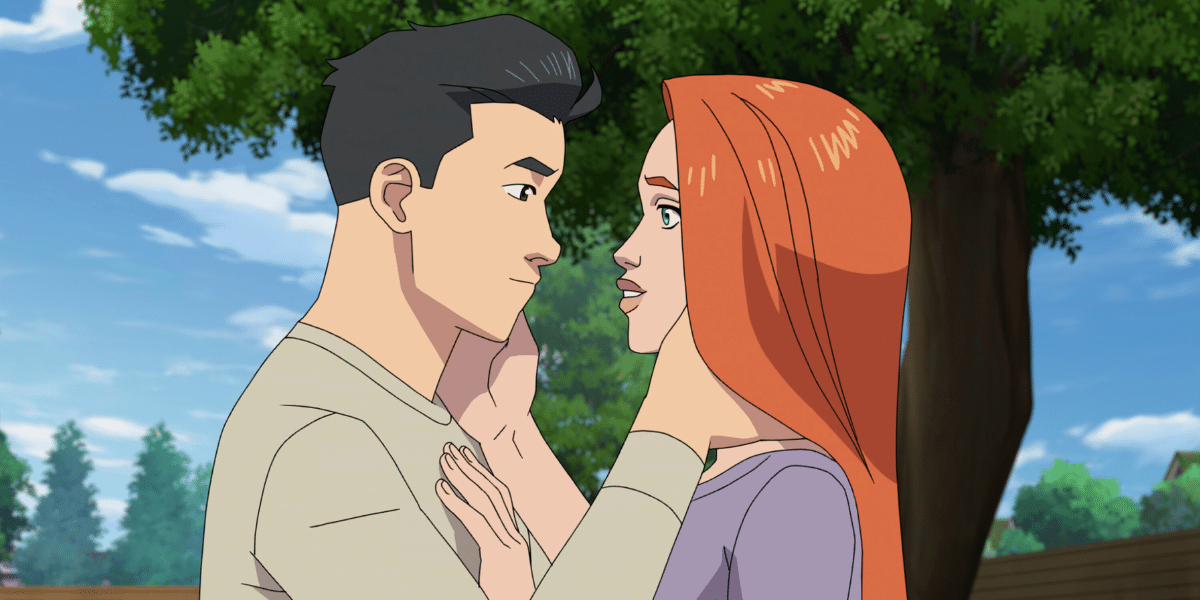
With a core message about the power of resilience, the importance of change, and the dangers of conservatism, Invincible entertains and empowers with each passing episode. The blood-drenched world of Mark Grayson, aka Invincible (Steven Yeun), is hardly a place I expected to find gender inequality. I figured these heroes and villains would be too caught up in keeping Earth in one piece to be sexist.
For the most part, that’s true. Invincible gives us powerful women in many forms. Some subvert the expectations imposed upon traditional roles. Debbie Grayson (Sandra Oh) is one of the best on-screen mothers I’ve ever seen. She’s tough, sharply intelligent, and has a life outside of parenting. The animated series also gives us women as mighty heroes, complex antagonists, and even all-out villains. In season four, Volcanikka (Indira Varma) is a diabolical, lava-wielding force of destruction. So many superhero films and TV shows are unwilling to let women take on such roles, but Invincible dives in headfirst.
It’s clear the writers want to meaningfully represent women in the superhero space. That’s why I’m so confused and disheartened by the way they portray Atom Eve (Gillian Jacobs), the main character’s endgame love interest.
Atom Eve starts off as a deeply complex character with a twisted origin, broken past, and challenging present. Equipped with the power to rearrange matter, she is a force to be reckoned with, even as she deals with more human issues. Her abusive father refuses to accept her heroic identity, her mother complacently allows his torment, her love life is in shambles, and on top of it all, she’s desperate to figure out who she is. She’s growing into her responsibilities and building out her individuality. She’s healing from her childhood and paving a path to adulthood.
Sadly, Atom Eve is only allowed to be complex until entering a romantic dynamic with Mark. She gets stuck, waiting in the wings as his first relationship falls apart. After they start dating, all of her development becomes a hazy precursor to a present in which she must be one thing: Mark’s superpowered girlfriend.
The logic of her abilities falters beneath the weight of the Prime Video show’s requirements. If the plot needs her to save someone, she’s strong. If it needs her to be saved, she’s weak. If Eve must be brutalized and then rescued by Mark to motivate him, turn him into the hero he’s meant to be, that’s exactly what happens.
The Atom Eve special builds out her powers with the kind of specificity I’d expect from speculative fiction. They aren’t always consistent, and they’re far from perfect, but Invincible isn’t hard sci-fi. I can tolerate faulty powers and thin explanations for how they fluctuate when it suits. I can’t tolerate a woman developed as a superhero who turns into a damsel whenever her boyfriend needs an incentive.
Eve’s powers aren’t the only thing that deteriorates after she is paired off with Mark. Her personality becomes a hollow shell of what it once was. Most of her dialogue centers around asking Mark if he’s okay, if he needs something, or if there’s any kind of support she can provide. She becomes his embodied emotional support system and little else. Every now and then, her issues crop up, but only when it serves Mark’s development, not Eve’s.
Their entire relationship is built on three things: the fact that they can relate on the basis of being super, Eve’s role as Mark’s comforting companion, and sex. Eve is literally reduced to a soft landing place for Mark after he’s done fighting a war, taking out alien invaders, and so on.
In a show that actively criticizes narrow, conservative ways of thinking, it’s particularly disappointing to see the central romantic relationship recreating the gender norms that have caged women for centuries.
Mark Grayson is the hero. He gets to live an exciting life, face incredible challenges, and grow into the most sprawling and complex version of himself. I love Mark Grayson, and have resonated with him more than anyone else in the story.
As a woman who dreams of finding true love someday, Eve’s path terrifies me. I don’t want to believe that love, for a woman, means the gradual obliteration of my identity. I don’t want to believe partnership will, inevitably, erode my own aspirations and goals. When it happens to Eve in Invincible, it’s subtle, and for that reason, it’s even more frightening.
In my heart, I know this isn’t the kind of message the writers want to send. Animation is expensive, their timelines are tight, and they’re working from comic books as their origin material. It’s likely that the show’s team stunts Eve’s development to prioritize their lead, who is not supposed to be sexist.
Still, the story that made it to the screen is retrograde. As it stands, Mark and Eve aren’t an example of balanced, wholesome love that defeats the odds of a dangerous universe. They are an unwilling cautionary tale. Women are taught to dismantle themselves in partnerships, to lose our identity to attain the title of girlfriend or wife, and Invincible reinforces that narrative.
The series dims Eve’s light in service of her man and asks her – and us – to swallow her reduction like it’s nothing. It is not.
