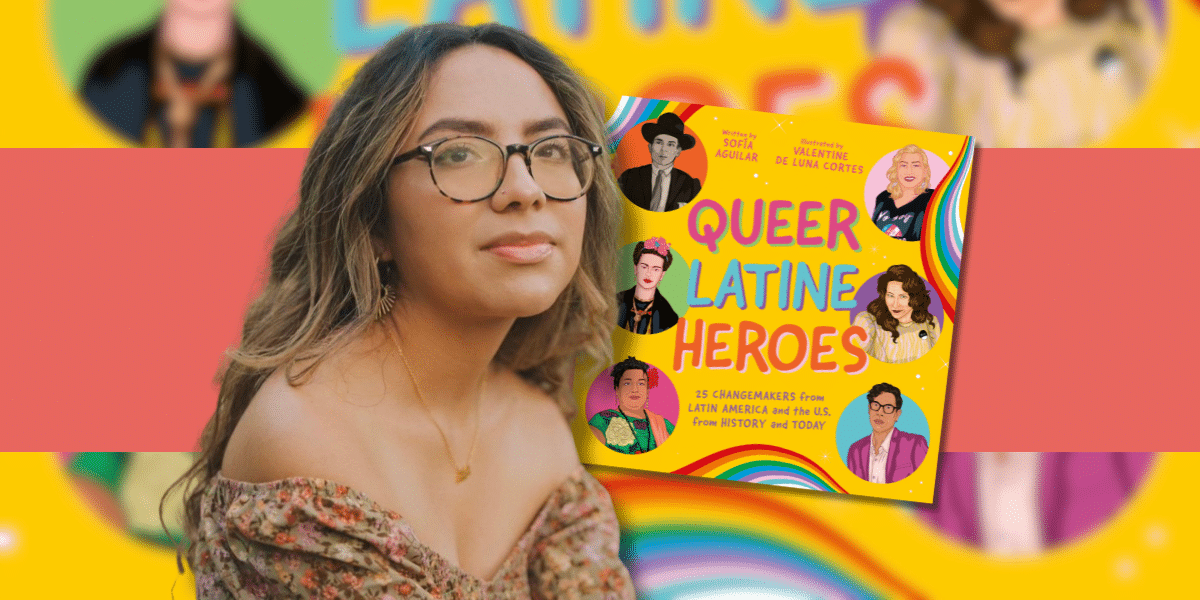
When your family immigrates from another country, especially one that lacks opportunity or access, you are often the first to achieve things other people take for granted. I am the first-gen daughter of a Mexican father and Mexican American mother. I’m the first to graduate with a bachelor’s degree and later, a master’s. To self-publish a collection of poetry. To publish a children’s book in Queer Latine Heroes. Perhaps I should be accustomed to this feeling because, in a certain way, it’s a good thing, opening doors and laying a strong foundation for others to follow.
On the other hand, I don’t think it’s something I’ll ever get used to. Outside of any honor that might be associated with it, being the first to do anything implies a history of barriers, oppression, and systems built to keep our communities from accomplishing the same achievement earlier or more easily.
When my publisher reached out about me writing my debut children’s picture book Queer Latine Heroes, I was ecstatic. I had never written a book for children before, and I was excited to rise to the challenge. Not to mention the importance of the topic, which was close and personal to my heart.
When I started to put together the proposal, I began searching for what the industry calls “comps” or comparisons, titles that are similar to your own. Publishers use them to see how well books in your genre, age group, or topic have sold or been reviewed. After a few days of research, it became obvious that there was no other book like mine on the market. There were plenty of picture books that were similar structurally, organized as a collection of short biographies or profiles about historical and contemporary figures. There were several about Latines and about queer people, but no one had yet to focus on the complex, fascinating intersections between the two identities. Intersections I know are real because I embody them, as do many of my loved ones and people I respect. They are how I move through the world authentically. And yet it was staring me in the face – the fact that nothing like this had ever been published before for readers of any age, let alone for children.
It was a problem for a lot of reasons. Not only did I not have comps, but I also had no blueprint, nothing to compare it to. I had plenty of research papers and articles for sources, but there was no book similar to mine that I could base my own work on. I’ve never believed writing is a solo endeavor – no matter the project, you build upon prior generations’ work. But for the first time in my life, I felt like I was truly on my own.
Thankfully, my publisher had faith in me. After they approved my proposal, I had full control over which queer Latine figures to include. My research and curation process was all my own. I had my choice of illustrators and cover art. They treated like an expert, as I was the only queer Latine writer in the room and the only person deeply connected to the material.
At times, it was freeing not to be micromanaged the way I’ve heard other authors talk about in horror stories. But I also felt the pressure to get it right the first time around – including Latines from across races and nationalities, revising sentences with a fine-toothed comb, rewriting glossary definitions at the back of the book until the words blurred and stopped becoming real.
Rightly, the marketing team and I used my book’s firstness as an enticing draw in the promotional materials. But I also can’t help but think about every queer Latine writer before me who was close to embarking on a project like this, only to be told that it wouldn’t sell. That it was too controversial or divisive. That it didn’t matter.
Throughout history, our communities have faced undeniable and often unspeakable violence, oppression, and discrimination, and I can’t imagine what our writers, historians, artists, and documentarians may have faced. What they lost or sacrificed during their efforts to preserve our collective memories and remember our trailblazing leaders.
In the weeks since Queer Latine Heroes came out, I have been lucky to receive an outpouring of support and love from family, friends, and readers. However, I’ve also seen libraries attempt to censor my book by classifying it as adult nonfiction instead of children’s. Certain bookstores are hesitant to stock it or invite me to speak. And I get the impression that school visits, even in my home state of California, will not be easy to arrange. Between ICE raids, anti-trans bills, and the normalization of queerphobic behavior, it has never been harder for our communities.
A single book alone cannot change our country’s trajectory. But I’m hopeful that the visibility and representation my book brings is an impactful step forward. I hope it ignites conversations about what it means to be queer and Latine, and leads to greater acceptance. That it gives children permission to explore their identities without pressure, judgement, or shame. I want this book to only be the beginning. Not just the first, but one of many. That it may lead to us reclaiming our power as queer Latines and achieving the liberation our ancestors dreamed of.

Queer Latine Heroes is currently available to order from major retailers and independent bookstores near you.
