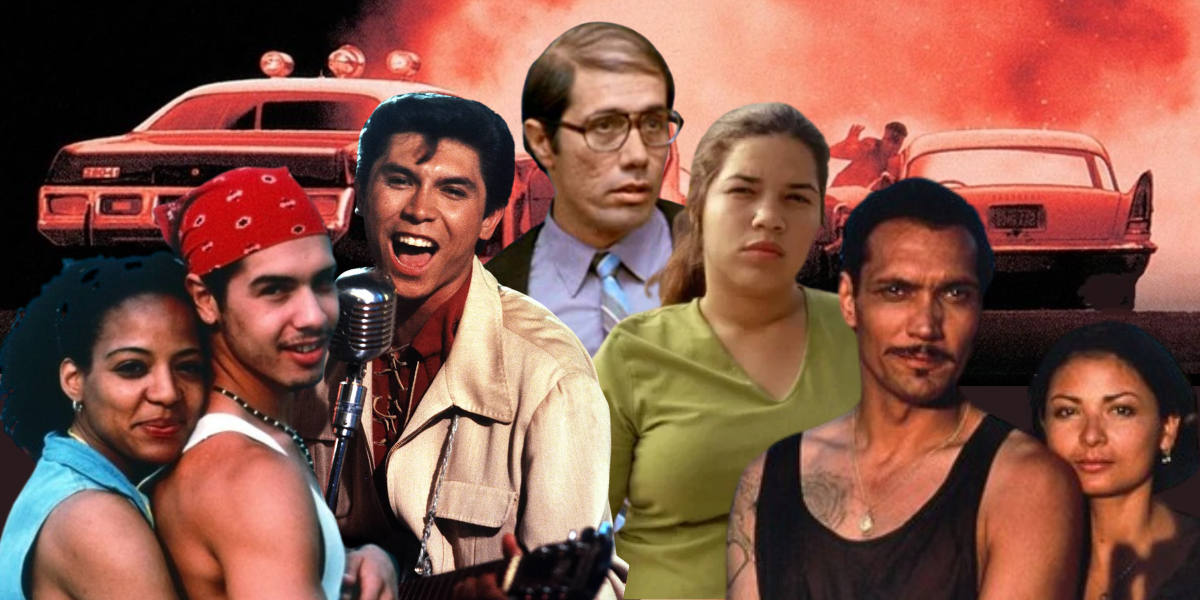
Sometime between the late 1980s and early 2000s, the film industry seemingly discovered the bankability of the Latinx demographic. Beginning with La Bamba in 1987, based on the short life and death of musician Richie Valens, and ending with 2002’s Real Women Have Curves, introducing the world to America Ferrera (our very own Barbie), the period offered our community visibility and finally some complexity in Hollywood’s blockbusters. Reinforcing stereotypes while simultaneously making us proud to see ourselves on screen, the old Latinx films of my youth are riddled with violent, tragic, doomed characters, juxtaposed with the dream of upward mobility through education or talent. You know, like in 1988’s Stand and Deliver or 1997’s Selena, an example of the melancholy of what could’ve been and transcendence via Jennifer Lopez’s career after portraying the titular role.
My paternal grandparents were born in Puerto Rico and never really learned English, while I never put any real effort into learning Spanish. It’s gross to acknowledge, but true: growing up, I found a way to be both externally proud of being a Latina and deeply ashamed. Part of the problem was definitely that the overall media landscape told me it was horrifying to be anything other than white. I waved the flags at all the parades, but stayed quiet when I heard nonchalant, everyday racist remarks. Much further into adulthood than I’d like to admit, I didn’t know there was something wrong with the media, not me.
There were a handful of movies my cousins and I rotated through as kids that made us feel a part of the culture. Mi Vida Loca, I Like It Like That, and Blood In, Blood Out, a three-hour movie about gang affiliation, incarceration, loyalty, and survival. While these films finally had people who looked like us, they made sure to give a very specific, stereotyped portrayal of what it means to be Latinx. At least Benjamin Bratt broke out after being one of the three stars in Blood In, Blood Out. He even dated Julia Roberts and got her to do an episode of Law & Order in 1999. We were all so proud.
Randomly, between 1994 and 1997, my cousins and I would shout “Magdalena!” at each other. In a reference to the movie I Like It Like That, probably our most rewatched film at the time. Everyone I knew who saw the movie was immediately in love with Jon Seda’s Chino. As a kid, there was no hotter man than Chino (Seda also portrayed Selena Quintanilla’s husband Chris in Selena). Before I Like It Like That, all my previous celebrity crushes were white guys.
Mi Familia and Real Women Have Curves scratch the same itch in my brain. Something about the family narratives feels cozy. While Mi Familia focuses on the complications of assimilation, Real Women Have Curves introduces the idea that maybe heroin chic isn’t the only path for a woman to walk, which was a pretty big breakthrough in 2002, when the movie was released. Body positivity wasn’t even a seedling of an idea back then.
The brightest superstar of the era is hands down Mr. Edward James Olmos with lead roles in Mi Familia, Stand and Deliver, and American Me, a movie he also directed. With his portrayal of the real Jaime Escalante, a Los Angeles teacher, in Stand and Deliver, Olmos garnered an Academy Award nomination. As an overachiever in school, the film spoke to me on a molecular level. The message that education is aspirational and accessible is obviously more complicated, but for a brief moment in time, Stand and Deliver gave us a vision of a different set of possibilities for ourselves.
Over twenty years later, we’ve finally seen some Latinx actors escape stereotypes, no longer stuck in dehumanizing caricatures of what our identity means. Actors like Jenna Ortega, Aubrey Plaza, and Oscar Isaac get to play nuanced Latinx characters, and it’s such a relief. I wish folks like Diego Luna and Pedro Pascal didn’t have to start off playing cartel members to break through, but at least they made it.
These old Latinx films may not have been perfect in their portrayals, but they laid the groundwork for more opportunities in cinema. While many reinforced the narratives of gangs, crime, and disinterest in education, the imagery was there. Even if we didn’t want to be the characters, we finally saw people who looked like us on the big screen. They inched open the doors to Hollywood. Now, we have the responsibility to keep nudging it, so more Latinx people can proudly saunter through – hopefully, one day, unaware it was ever closed.
