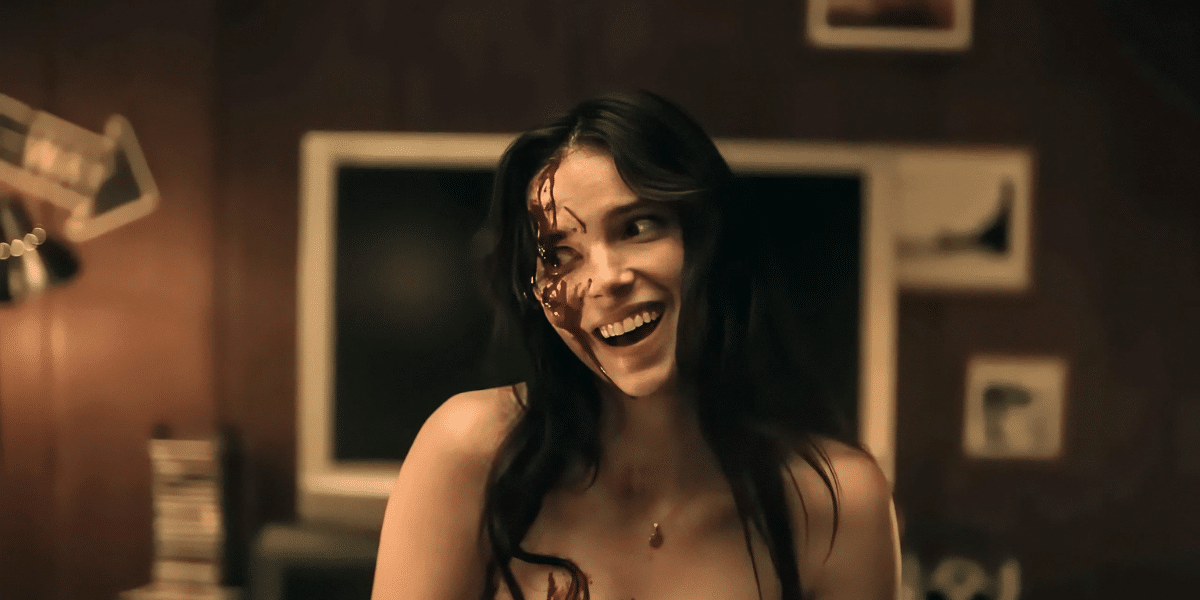
About midway through Curry Barker’s runaway hit, Obsession, Nikki (Inde Navarrette) is watching her friend Bear (Michael Johnson) sleep. She’s under the influence of his love-spell-gone-awry wish. Through two pinpricks of light, like cat’s eyes, peeking out from the dark, we can see the hunger, the pain, and the confusion of her situation ripple through Nikki’s expressions. She oscillates between love and fear, her dreams haunting her. “Go back to sleep,” she eventually hisses, and then sobs about how strong her (artificial) love for Bear is.
It’s a moment that filled my theater with uneasy laughter and queasy declarations from men in the rows behind me. “I would have just slapped her,” one guy joked, his buddy agreeing with him through stifled chuckles. These obtuse assholes don’t realize that Nikki has no control over her situation – and they’re not the only ones.
“Obsession not even scary if u dated a crazy Latina that’s just real life,” one tweet reads. This attitude is not only virulently misogynistic, it’s also willfully ignorant. Obsession is subverting the whole “tóxica” (or “crazy girlfriend”) trope. The only reason Nikki is acting “crazy” is that the entity inhabiting her body is fighting against the real Nikki’s desire to get out, to breathe, to be her own person again. Nikki’s the victim of something women have been experiencing since the dawn of time, and women of color especially so: the burden of men’s perceptions.
After all, the popular and racist imagination assigns certain characteristics to the tóxica archetype. Possessive, jealous, and overbearing, the tóxica’s love threatens to ensnare the object of her affections via an emotionally volatile – dare I say “spicy” – relationship. Her mind has no rational thought and all that is left in its place is raw emotion, threatening to spill out and consume everything it touches like lava leaving the mouth of a volcano.
During the now-infamous dinner date scene, where Bear confronts Nikki’s potential lie about her father having cancer, Navarrette plays Nikki’s possession deftly. She switches between deeply ingrained infatuation and unhinged fury on the turn of a dime – all soft declarations of love and devotion at first and then sobbing about Bear ruining their date with his questions. On its face, it’s a total tóxica moment. But in the film’s context, the entity is simply doing what Bear asked for: devotion without boundaries (and the real Nikki has no say in it at all).
And then there’s the house party when unbridled jealousy curdles the atmosphere. Everyone is sitting around Ian’s (Cooper Tomlinson) house, drinking and playing games. While playing Jenga, Bear pulls a wooden piece that reads “Kiss the person to your left.” Sarah (Megan Lawless), not Nikki, is to Bear’s left, but Nikki physically moves Sarah out of the way so she can get Bear’s kisses.
The scene escalates until Nikki suddenly has a moment of clarity and acts out by gouging herself with a broken bottle. It’s a clear delineation between the wish-infected Nikki and the real one: the real Nikki is so pained that she will do anything to escape the prison of embodying Bear’s fantasies. This is made explicit later when the real Nikki’s voice slips out and begs Bear to kill her as a form of escape. Navarrette’s voice is at once whispery and full of despair. He refuses, and Nikki is trapped in the prison of this man’s desires.
Through the cutting performance of Navarrette and the film’s clear subversion of the tóxica trope, Obsession is more than the jokes and memes people are making online. If audiences look deeper, they will find a movie that refuses to make the woman at its center the villain of its story. Instead, it’s Bear’s desire for Nikki’s uncompromising love – and his willingness to trample her free will – that’s the real problem. Men take note. This joke is on you.
