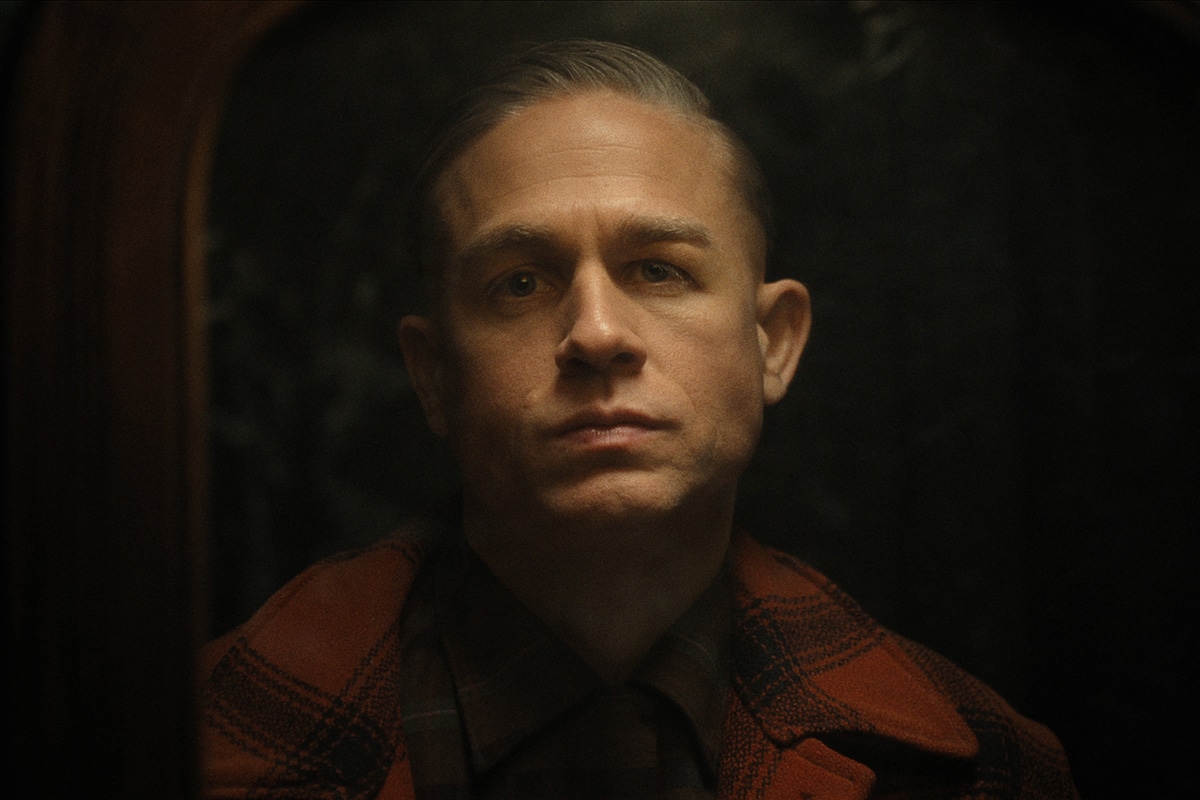
Critics and home viewers alike are clutching their pearls – and probably their remote controls – over Ryan Murphy’s Monster: The Ed Gein Story, the third installment in his true-crime-meets-spectacle anthology. The reviews are almost as bloody as the show itself, panning its meta commentary, tangled subplots, overlong runtime, excessive gore, and, of course, Murphy’s creative disregard for factual accuracy. But at this point, shouldn’t we all know better?
Instead of another docudrama trudging through the familiar crime-scene clichés, Murphy offers an unholy hybrid: part historical fantasia, part cinematic séance. His Gein, played with unsettling nuance by Charlie Hunnam, is not just a murderer or a body snatcher but a living echo chamber of American horror. Psycho (1960), The Texas Chain Saw Massacre (1974), and The Silence of the Lambs (1991) all owe a debt to Gein’s crimes, and Murphy knows it. Rather than shy away from that cultural legacy, he makes it the spine of his narrative. Each episode folds Gein’s story into the mythology of these films, blurring the line between who Gein was and what America made of him.
That’s where the controversy lies – and, arguably, the Netflix show’s brilliance.
We’ve come to expect Murphy’s signature blend of camp, horror, and operatic melodrama, yet somehow critics still seem surprised when he turns real-world trauma into his aesthetic playground. Monster: The Ed Gein Story is not a documentary – it’s an art installation masquerading as television, a fever dream projected in high definition, stitched together like one of Gein’s own grotesque creations. It is, in short, an artist at play. And like any art worth its salt (or blood), it provokes.
What fascinated me most is how Murphy uses Gein’s schizophrenia not as an exploitative device but as a narrative lens. The show moves in and out of his psychosis with a fluidity that feels both terrifying and tender. We are inside his delusions, wandering through the warped domestic spaces of his mind, where motherly devotion and murderous obsession coexist. The transitions between sanity and hallucination are seamless, often indistinguishable in a choice that unsettles but also humanizes. Murphy doesn’t ask us to sympathize – he asks us to witness.
Hunnam’s performance anchors the chaos. For viewers still picturing him as Jax Teller from Sons of Anarchy, his transformation is jarring. Gone are the swagger and smirk. In their place, there’s a hollow-eyed man dissolving under the weight of his own mind. I was reminded of Donnie Wahlberg’s brief but haunting turn in The Sixth Sense – Monster: The Ed Gein Story is a similar exercise in vanishing ego. Hunnam strips himself of vanity, of the heartthrob persona audiences cling to, and surrenders completely to Murphy’s bleak vision. It’s a career-risking performance, and it pays off. You can almost hear the collective gasp of viewers mourning the loss of their biker-boy crush, replaced instead by the unsettling intimacy with madness.
Murphy’s direction is as theatrical as ever, a symphony of rot and ritual. He shoots the Wisconsin farmlands like haunted cathedrals, portraying cornfields as graveyards, kitchens as crime scenes, bodies as art materials. His camera lingers on decay with a painter’s patience, transforming gore into a kind of religious iconography. Every splash of blood feels deliberate, not gratuitous – it’s punctuation, not spectacle. The viscera is there to remind us that Gein’s inner world had real-world victims, that the fantasy and the flesh are inseparable, that gore is the price of entry into his mind.
Still, the ethical debate looms large: Should we keep mythologizing killers? Is this aestheticization of horror itself a form of cultural sickness? Murphy seems to anticipate the critique and folds it into the narrative. His Monster series is, at heart, a meta-experiment on American voyeurism, on our obsession with turning tragedy into entertainment. Each season asks: Why can’t we look away? With Gein, that question cuts even deeper because his crimes were, quite literally, about the body – its boundaries, its desecration, its reassembly. Murphy forces us to confront the uncomfortable fact that, in consuming stories like this, we too participate in the cycle of exploitation.
And yet, for all its grotesquerie, the series is strangely beautiful. There are moments when the violence pauses long enough for melancholy to seep through: a young Ed tending to his mother, a radio humming in an empty room, the eerie silence after a scream. These moments pull the narrative back from excess, grounding it in grief and isolation. Murphy’s genius has always been his ability to find beauty in monstrosity, to make us feel the horror not just as shock but as sorrow.
To watch The Ed Gein Story is to enter a hall of mirrors. You see Gein, but you also see Hitchcock’s Norman Bates, Tobe Hooper’s Leatherface, Jonathan Demme’s Buffalo Bill – and behind them all, you see us, the audience, hungry for another retelling. The show is both critique and confession, art and indictment. It’s a true-crime thriller that eats its own genre alive.
So, let’s be clear: if you’re tuning in hoping for a new revelation about Gein’s crimes, you’ll leave disappointed. But if you walk into this series the way you’d enter an avant-garde gallery – ready to be disturbed, disoriented, maybe even disgusted – you’ll find something transcendent. With this show, Murphy isn’t offering answers. He’s holding up a mirror smeared with blood and asking what we see.
Monster: The Ed Gein Story is not for the faint of heart or for those who insist that art remain tasteful. It’s for those willing to admit that horror has always been America’s favorite genre because it’s the one that tells the truth about us. The gore, the glamour, the moral grayness, they’re all part of the same national mythology.
Monster: The Ed Gein Story is a symphony of insanity, artifice, and obsession. And like any great symphony, not everyone can handle what the music reveals about them.
