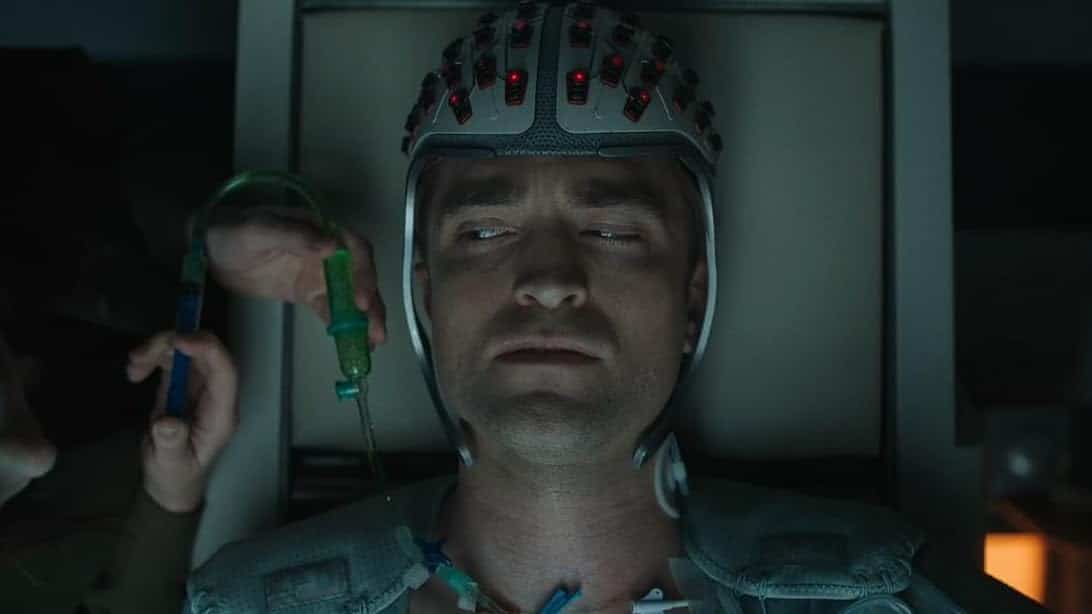
By the time Mickey 17 finishes rearranging your insides, you’re left with a familiar ache – the quiet recognition that the film isn’t speculative fiction so much as a documentary shot five minutes into the future. It doesn’t ask you to imagine a world radically different from your own, it simply removes the remaining filters. Directed by Bong Joon-ho, Mickey 17 is less interested in dazzling you with technology than in exposing the moral rot already embedded in systems we’ve normalized. It is funny, bleak, and uncomfortably tender, a film that laughs with you just long enough to make sure you’re paying attention when the blade drops.
At its core, Mickey 17 follows Mickey Barnes, played with unnerving precision by Robert Pattinson, an “expendable” whose job description requires him to die repeatedly for the benefit of an interstellar colony. Mickey is cloned over and over again – each version retaining memories of the last – tasked with testing medications, performing lethal labor, and absorbing risks no one with actual power is willing to take. When one Mickey dies, they print another. The system does not mourn him. It simply reloads. Bong frames this premise not as a distant sci-fi conceit but as an extension of contemporary labor logic: when workers are cheapened, bodies become resources, and when bodies become resources, humanity becomes optional.
The brilliance of the film lies in how plainly it presents this horror. There are no grand speeches announcing dystopia. There is paperwork, protocols, and efficiency. Mickey’s suffering isn’t sadistic, it’s bureaucratic. That distinction matters. Mickey 17 understands that modern cruelty rarely announces itself with villainous flair – it arrives wearing the language of productivity, innovation, and progress. This is capitalism after empathy has been fully automated out of the equation.
Pattinson’s performance is the film’s emotional engine, and it may be one of the most technically demanding roles of his career. In playing Mickey, he shows us the slow erosion of a self across iterations. Each version of Mickey feels subtly altered, one more aggressive, another softer, another eerily detached. Watching him interact with his own copies becomes a study in what happens when identity is infinitely reproducible but spiritually finite. The film evokes inevitable comparisons to Multiplicity, particularly Michael Keaton’s famously degraded clones, The Doug’s. But where that film mined comedy, Mickey 17 mines existential dread.
What makes Mickey 17 especially devastating is how clearly it mirrors the emotional reality of contemporary life. Many viewers will recognize Mickey’s exhaustion, not because they are cloned laborers on distant planets, but because they, too, live in systems that treat them as replaceable. The film understands that expendability is not just a material condition – it is a psychological one. It seeps into how people value themselves, how much pain they tolerate, how often they convince themselves that survival is the same thing as dignity.
If Pattinson gives the film its fractured soul, Mark Ruffalo provides its grotesque grin. As billionaire tech mogul Kenneth Marshall, Ruffalo delivers a performance so convincingly repellent it feels almost transgressive. This is not the warm, principled Ruffalo audiences are accustomed to seeing. Gone is the thoughtful activist with the moral center. Here, he embodies the manic entitlement of the tech elite with chilling ease. Marshall believes deeply in sacrifice, innovation, and destiny, as long as he never has to be the one sacrificed. Ruffalo’s genius lies in refusing to soften this man. He doesn’t ask for sympathy. He lets Marshall stand as the logical outcome of a system that rewards ambition unmoored from accountability. You don’t just dislike Marshall – you recognize him.
Naomi Ackie’s Nasha Barridge is the film’s moral counterweight, and Mickey 17 is remarkably clear-eyed about why. Ackie plays Nasha as a leader who listens, observes, and acts not impulsively, but decisively. She is exceptional because she is competent in a system that punishes competence when it doesn’t come wrapped in dominance. The film makes a quiet but pointed argument here: progress stalls not because solutions are unavailable, but because power refuses to trust those who already understand the cost of its failures. Nasha does not save the world through spectacle. She saves it through attention, care, and ethical clarity. The film knows exactly what it’s saying when it allows a Black woman to anchor its vision of survival – and it does so without apology or sentimentality.
The supporting cast deepens the film’s unsettling realism. Anamaria Vartolomei’s Kai Katz embodies the cold calm of procedural compliance, reminding us that systems persist not only because of villains but because of people who find safety in rules. Steven Yeun’s Timo brings humor and nervous energy, a character constantly negotiating for some semblance of power and upper mobility. Measured and impenetrable, Toni Collette’s Ylfa feels less like a person than a policy given flesh. Together, they form a social ecosystem that feels disturbingly functional, an environment where cruelty doesn’t need to be enforced because it has already been normalized.
Stylistically, Bong Joon-ho continues to refuse easy categorization. Mickey 17 is funny in the way despair often is sharp, absurd, and slightly hysterical. Bong understands that laughter is not a distraction from horror but one of its most reliable accomplices. The film’s genre-bending tone mirrors its thematic concern: when everything is blended together – comedy, tragedy, labor, death – it becomes harder to draw ethical lines. That confusion is the point.
What ultimately makes Mickey 17 feel urgent rather than merely clever is its refusal to offer comfort. It does not reassure us that the system can be fixed with better leadership alone. It does not suggest that suffering is redemptive. Instead, it asks a far more uncomfortable question: what are we willing to accept as normal? What version of ourselves are we quietly cloning into existence when we treat people as economically, socially, and emotionally disposable?
Mickey 17 doesn’t predict the future. It documents the present with just enough exaggeration to make denial impossible. In doing so, it joins the small but vital lineage of science fiction that understands its real subject is not technology, but power. And when the credits roll, the question it leaves behind is not whether Mickey will survive, but whether we will continue to live as if expendability is the price of progress – or finally refuse the bargain.
