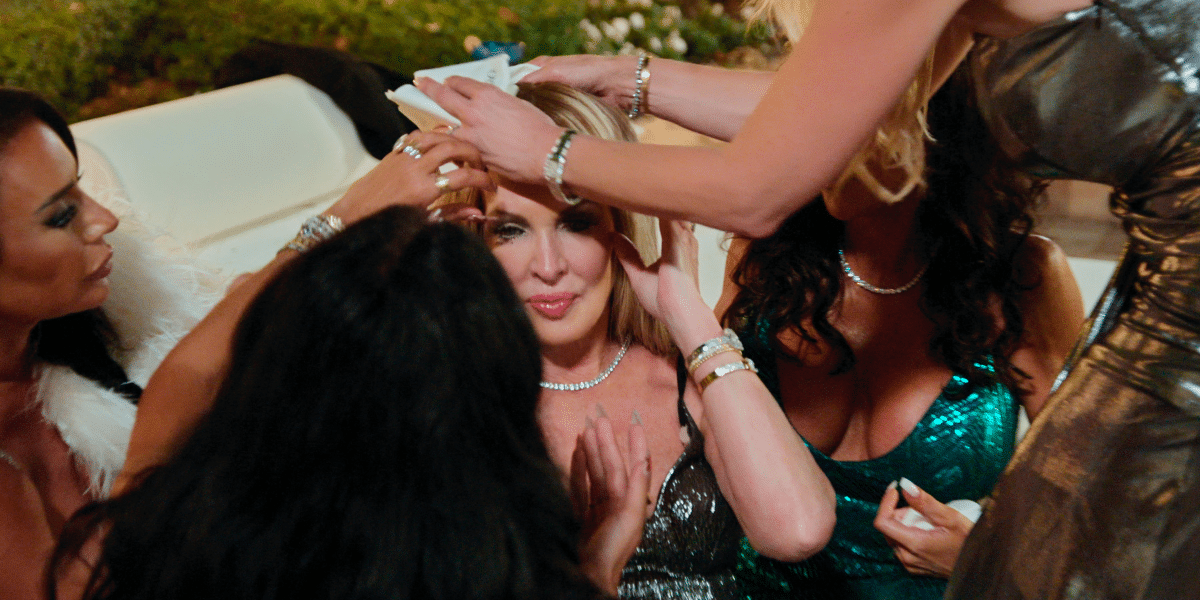
I have heard about Mar-A-Lago face for years. Whispered. Mocked. Meme-ified. But nothing – and I mean nothing – fully prepared me for seeing it en masse until I watched Members Only: Palm Beach. This show doesn’t just confirm that Mar-A-Lago face is real – it proves it is expensive, is aggressively intentional, and apparently requires a level of upkeep that rivals a luxury yacht.
Let’s get this out of the way early: if I have to hear “Mar-A-Lago” one more time, I may actually scream. The show treats the name like a holy incantation: say it often enough and perhaps wealth, relevance, and eternal youth will rain down upon you. It’s less a location and more a lifestyle keyword, SEO-optimized directly into the cast’s personalities.
And yet… I watched. All of it.
How did I end up here, you ask? Simple. I am a Real Housewives–obsessed gremlin of a human being. I love watching women with obscene amounts of money argue about who is nicer, who is more loyal, and who committed the ultimate sin of social betrayal – talking shit at the wrong lunch table. It brings me a deeply unwell amount of joy. I never said I was perfect.
So when Netflix dropped Members Only: Palm Beach, a knockoff Real Housewives cousin with a country-club trust fund and a superiority complex, I figured: why not? Which is ironic, considering I’m absolutely certain not a single woman on this show owns a knockoff anything.
The premise is straightforward: a group of women navigating the elite social ecosystem of Palm Beach, Florida — a place where old money, new money, and deeply insecure money collide over champagne flutes and passive-aggressive compliments. The series premiered in late December 2025 and follows cast members like Hilary Musser, Rosalyn Yellin, Maria Cozamanis, Ro-Mina Ustayev, and Taja Abitbol as they jockey for status inside an insular, members-only world where access is everything and authenticity is optional.
Netflix wants us to believe this is a sociological peek behind the hedges, an exploration of power dynamics, legacy, and hierarchy among women who exist in rarefied air. And to be fair, there is something fascinating here. But let’s not pretend this is subtle. This is not anthropology. This is just packaged consumerism with a Palm Beach zip code.
The show is clearly aiming for Real Housewives energy, but without the self-awareness that makes those franchises work. Housewives succeeds because it understands the absurdity of wealth and leans into camp. Members Only: Palm Beach takes itself seriously, so the comedy is unintentional.
Everything about the series is hyper-controlled. The faces are tight. The bodies are sculpted. The outfits scream money but whisper insecurity. These women don’t just want to be admired – they want to be recognized by the right people, in the right rooms, under the right chandeliers. It’s not enough to be rich. You have to be verified rich.
And the cost of that verification is… a lot. Financially, yes. Emotionally? Also yes. Spiritually? Oh, absolutely.
What struck me most is how utterly void of real connection this world feels. The friendships are transactional. The kindness is conditional. Every compliment sounds like it was workshopped with a PR team. It’s Florida at its most distilled – vapid, sun-bleached, and hollowed out by excess. Watching it felt like revisiting everything I remember leaving the Sunshine State for.
At times, the show feels so stuffed with dollar bills it might as well be a g-string on the floor of Tootsie’s.
The cast dynamics hinge on the eternal Palm Beach tension between old money and new money. Old money wants quiet power. New money wants visibility. Both want control. And neither wants to be questioned. The women perform femininity as a polished, pleasant, and weaponized strategy. Conflict never explodes. It simmers. Insults arrive wrapped in smiles. Aggression wears linen.
And then there’s the aesthetic. The face of it all. Everyone looks… awake. Aggressively awake. Like sleep is for the poor and blinking is optional. There is a point where filler stops being enhancement and becomes a lifestyle choice. This show crosses that point early and often.
Netflix clearly believes the audience wants glamour porn, yachts, private clubs, champagne brunches, gated communities. And sure, there’s a voyeuristic thrill in watching people spend money like it’s Monopoly cash. But after a while, it stops being aspirational and starts feeling deeply sad. Because beneath the luxury is an exhausting obsession with relevance.
The series occasionally gestures toward deeper themes of power, gender, legacy but rarely commits. When it does brush up against something interesting, it quickly retreats back to surface drama: Who wasn’t invited. Who spoke out of turn. Who doesn’t belong. The social policing is relentless.
And yet… I kept watching.
Because for all its flaws, Members Only: Palm Beach is accidentally revealing. It exposes how wealth doesn’t insulate people from insecurity – it just gives insecurity better lighting. It shows how exclusivity breeds paranoia. How access becomes identity. How proximity to power can hollow people out if there’s nothing else there.
This isn’t a show about Palm Beach so much as it is a show about what happens when status replaces substance. When being seen matters more than being known. When the performance of perfection becomes a full-time job.
Is it the 900th knockoff of a genre built on excessive consumption and emotional dysfunction? Yes. Is it original? Not really. Is it good television? That depends on your tolerance for secondhand embarrassment and your appreciation for chaos wrapped in Chanel.
But as a cultural artifact, as a snapshot of late-stage American wealth culture, it’s fascinating. Disturbing. Ridiculous. And weirdly honest in its dishonesty.
Members Only: Palm Beach doesn’t reinvent reality TV. It doesn’t even improve it. What it does do is remind us that money can buy access, but it cannot buy ease. And that sometimes, the most exclusive rooms are also the loneliest.
Would I recommend it? Begrudgingly, yes, especially if you’re already fluent in Housewives chaos. Just be warned: by the end, you may find yourself grateful for your own messy, imperfect, real life.
And if I hear “Mar-A-Lago” one more time?
I’m billing Netflix for my migraine Botox treatments.
