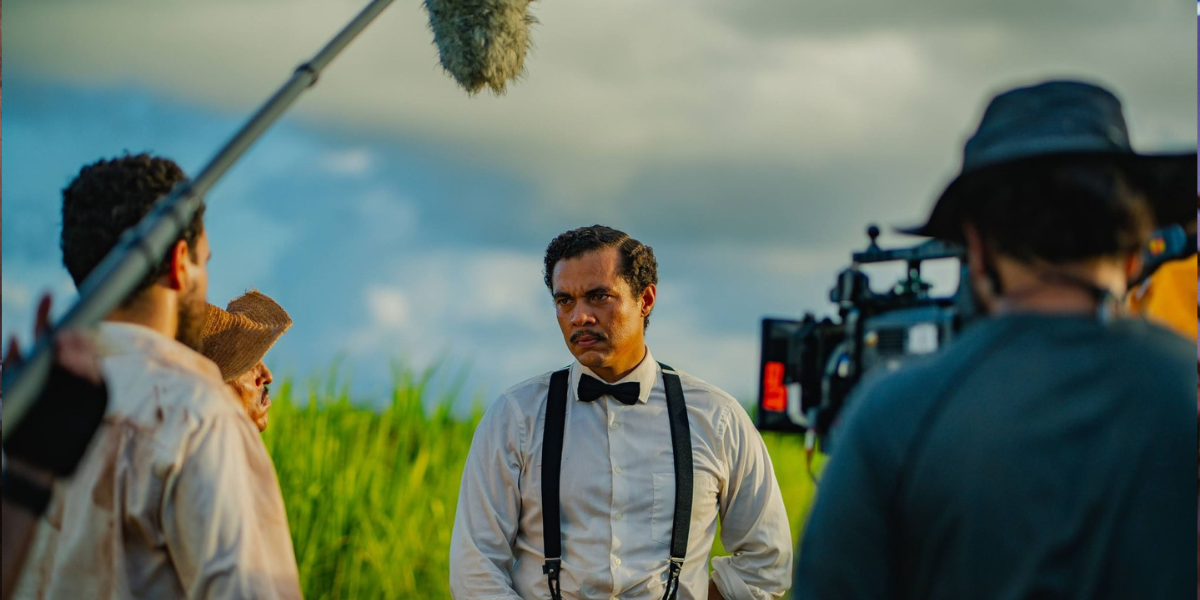
Kristian Mercado’s Mataron a Pedro carries the weight of history, memory, and Puerto Rican colonization into LALIFF. Premiering at the Los Angeles Latino International Film Festival (LALIFF) on May 28, 2026 at the TCL Chinese Theater, the 17-minute short film dives into the life and political struggle of Puerto Rican nationalist leader Pedro Albizu Campos and the colonial tensions that continue to shape Puerto Rico today.
I have been waiting for this one for a while. I remember when the project was crowdfunding and I could sense the importance of what Mercado and his team were trying to build. Not simply another historical short, but a cinematic confrontation with one of the most mythologized and politically complicated figures in the island’s history. For many Puerto Ricans, myself included, Albizu Campos exists somewhere between revolutionary, martyr, intellectual, and warning. His story has often been reduced into fragments but Mataron a Pedro is determined to place audiences inside the emotional and political chaos surrounding him.
Mataron a Pedro follows “a Harvard-educated Afro Puerto Rican lawyer” who returns home during the labor uprisings of the 1930s and risks “everything, including his freedom, his family, and his life” while standing with striking workers against colonial power.
What immediately stands out about the project is its refusal to flatten Albizu Campos into pure iconography. In his director’s statement, Mercado explains that while he shows “sweeping epic moments where the sugar cane workers strike in the backdrop of a burning field in a plantation,” he is equally interested in “seeing a husband and father put his life on the line to defend his people.” That tension is central to the film’s emotional core.
Puerto Rican revolutionaries are often discussed through abstraction: nationalism, independence, resistance, militancy. But Mercado seems far more interested in the human cost beneath those words. The quiet moments. The burden of leadership. The impossible balancing act between family and political struggle. The film moves between intimate domestic scenes and large-scale labor unrest, contrasting colonial authority with the poverty and desperation facing workers across the island.
Mercado writes that he wanted audiences to feel “that they’ve stepped into a wild moment in history,” an era marked by “wide starvation and poverty across the world.” Yet what makes the project feel especially urgent is that the questions surrounding Albizu Campos remain. “We wanted to explore the question: for whom has democracy been crafted for in America?”
The debates surrounding U.S. intervention, colonial dependency, labor exploitation, statehood, migration, and Puerto Rican sovereignty continue to shape political life on the island and throughout the diaspora. In 2026, Mataron a Pedro feels alarmingly current. The film shines a harsh light on the unresolved colonial tensions, political fractures, and questions of sovereignty that continue to define Puerto Rico’s relationship with the United States.
The film’s cast and crew only deepen that significance. Puerto Rican actor Ismael Cruz Córdova steps into the role of Albizu Campos, bringing tremendous emotional and political weight to a figure many Puerto Ricans grow up hearing about long before fully understanding him. Opposite him, Peruvian actress and activist Juana Burga portrays Laura Meneses, Albizu’s wife, grounding the story not only in revolution but partnership and sacrifice.
Visually, the film also carries serious artistic firepower behind the camera. Cinematographer Diana Matos, whose previous work includes Miguel Wants to Fight, The Money Game, and The Farewell, shot the project entirely in Puerto Rico. That authenticity matters, especially in an industry that has repeatedly used Puerto Rico as a backdrop while refusing to meaningfully invest in the island itself or involve Puerto Rican voices in telling its stories.
Too often, Hollywood wants the aesthetic of Puerto Rico without the people, history, politics, or labor attached to it. Productions recreate the island elsewhere, flatten Puerto Rican identity into stereotype, or extract cultural imagery while excluding the communities shaped by the realities they portray. But in Mataron a Pedro, Puerto Rico is active within the story itself: scarred by colonialism, shaped by resistance, and inseparable from the political and emotional realities surrounding Pedro Albizu Campos.
And perhaps most importantly, this was a people-powered production. Supported by organizations including Latino Public Broadcasting, PBS, the Jerome Foundation, and nearly $40,000 raised directly through crowdfunding, Mataron a Pedro exists because people believed this story deserved to be told.
That matters right now. Especially at a moment when Puerto Rico is so often reduced to tourism campaigns, disaster headlines, tax haven conversations, or simplified political talking points stripped of historical memory. Films like Mataron a Pedro remind audiences that Puerto Rico’s current political condition did not emerge from nowhere. It was built through generations of resistance, repression, sacrifice, and unfinished struggle.
Mataron a Pedro is less the retelling of history and more the reopening of a conversation Puerto Rico has never truly gotten a chance to finish.
