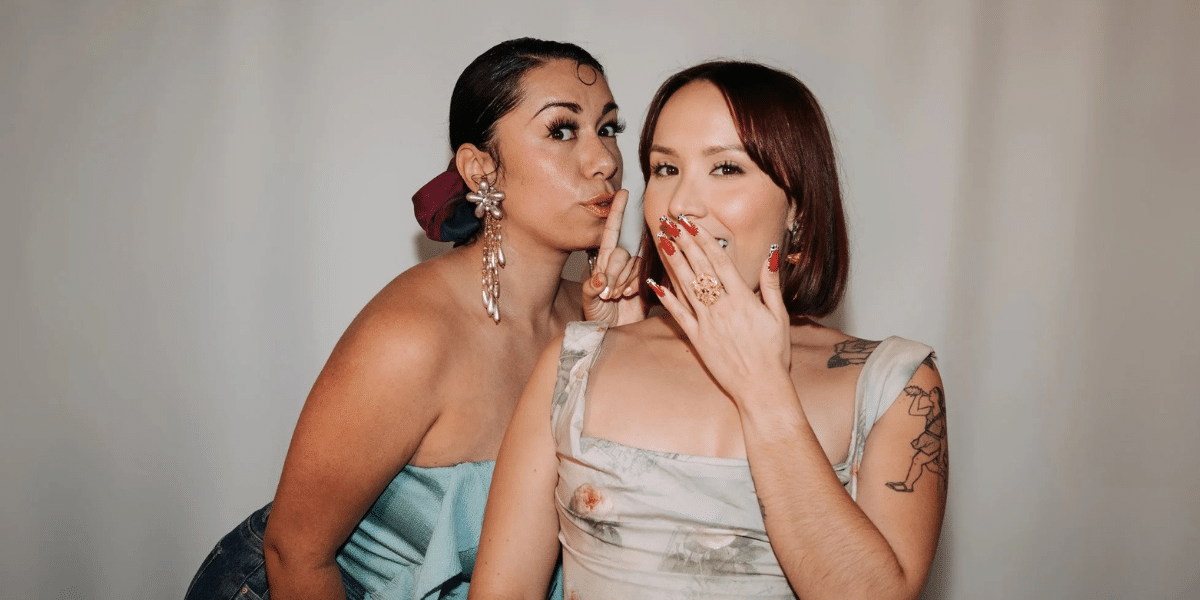
The first time I listened to Locatora Radio, it didn’t sound like a regular podcast. It was intimate and irreverent yet grounded in history. It felt intentional. And that intention is what makes the podcast part of something much larger than itself.
Created in 2016 by two SoCal-based Latinas known as Diosa Femme and Mala Muñoz, Locatora Radio: A Radiophonic Novela emerged from a simple but urgent need: to create space for Latinx femmes whose stories are often sidelined in mainstream media. The name itself is a deliberate feminization of the Spanish word locutor (radio host), a small but powerful linguistic shift.
Over the years, the show has explored identity, art, feminism, social justice, and culture through interviews and commentary that center lived experience. In 2022, it joined iHeartRadio’s My Cultura Podcast Network, a platform dedicated to elevating Latino voices in audio, a sign that the industry was beginning to recognize what listeners already knew: these stories matter.
And the audience is there. According to Edison Research’s 2024 “Latino Podcast Listener Report,” 43% of U.S. Latinos age 18+ are monthly podcast listeners, a 72% increase since 2020 (25%), with women now accounting for half of the U.S. monthly Latino listening population. This growth isn’t incidental. It reflects a community actively seeking spaces where culture, language, and identity are explored with nuance.
What makes Locatora Radio distinct is not simply that it exists, but how it exists. The podcast doesn’t translate culture for an outside audience – it goes inward and outward simultaneously. Conversations move fluidly between English and Spanish and between humor and critique. It models a kind of storytelling that feels communal rather than performative. The hosts are not explaining themselves, but rather building dialogue with us listeners, who already understand the stakes.
The broader industry is following suit. In October 2025, Telemundo Studios partnered with the University of Miami to launch what it described as the first Latino podcast incubator, designed to mentor and support emerging Latino creators. The initiative acknowledged a clear disparity: globally, there are four million shows, but fewer than 12% are in Spanish. At the same time, nearly half of Latinos in the U.S. listen to podcasts, and many consume content bilingually. The gap between demand and production has created both a challenge and an opportunity – one that Latina creators have already been navigating independently.
That tension between underrepresentation and innovation is where cultural power lies. For years, our characters in film and television were often flattened into familiar archetypes: the fiery romantic lead, the mystical guide, the overly sexualized mujer, the loyal sidekick. Audio, however, offers something different. Without the constraints of visual stereotype, podcasts allow voice itself to carry authority. Tone, cadence, storytelling, and rhythm all become tools of agency.
In that sense, Locatora Radio is not just part of a media trend – it is part of a generational shift in authorship. Younger audiences are no longer satisfied with symbolic representation. They are gravitating toward creators who control their narratives from production to distribution. Social media has further expanded that ecosystem, allowing podcasts to live beyond audio platforms in interactive digital communities.
What emerges from this moment is not simply more content, but a redefinition of who gets to frame cultural discourse. Latina podcasters are demonstrating that media does not need to be filtered through institutional gatekeepers to have an impact. Shows like Locatora Radio, Latina to Latina, Anything for Selena, Wine & Chisme, and Yo Quiero Dinero are building audiences that value stories rooted in intersectional identity, heritage, and contemporary political realities, proving that specificity can resonate broadly.
Locatora Radio stands as one example, but it gestures toward something larger: a future in which Latina voices are not an afterthought in media conversations but architects of them. In a landscape still negotiating the meaning of diversity, podcasts have become one of the most democratic forms of storytelling. And Latina creators are using that democracy to build something enduring — narratives shaped by community, sustained by authenticity, and defined on their own terms.
That shift is not fleeting – it is reshaping what the next generation of media sounds like.
