Every year, without fail, the holidays are the same: my tías and my mom make enough food to feed our whole family for three days straight (recalentado is a time-honored tradition we take seriously, after all). There’s a bit of small talk and catching up with everyone we haven’t seen in a while, there’s a quick, uncomfortable remark from the Very Nosy Tía that always has something “funny” to say, but we all quickly brush off “¡Ay, estás más cachetona!” We all sit down to plates that are served generously, and wine glasses are filled modestly, if we want to avoid Abuela Rosa’s stares. Then, another comment: “Should you be having seconds?” followed by judgy looks. Here we go again… I’m no stranger to my body being picked apart by my tías, parents, grandparents, and strangers alike. For the most part, I used to stay silent and found refuge in my safe space – Latina body positive books.
The comments started as nicknames and mean little jokes that hid behind the excuse of affection. I was taught from a young age to hate my body and to think of “gorda” as a bad word I should avoid at all costs. And for a while, I tried to be what was expected of me, resorting to some extremely unhealthy practices. And when I did, I got praised for losing weight and supposedly caring about my health — oh, the irony.
It took years to heal and come to terms with the fact that hurtful comments, unsolicited advice, and remarks about my body are not valid demonstrations of love. I’ve gotten better at dealing with it all, but I still struggle. Now, as an adult, I talk back, refusing to accept thinly-veiled abuse as love – and my family has mostly stopped making these comments. Thanks to my books and the many fat Latinas I follow on social media, I finally understand that the guilt that filled my gut (no pun intended) was not mine — it was others’ insecurities being projected onto me.
In (Como Ser Una) Gorda Libre, Miriam Lara-Mejía asks the question, “How different would the world be if we just accepted that fat bodies exist and are normal?” Throughout the audio book, she shares personal experiences, talks with experts, and challenges the misconceptions about fatness and fat bodies.
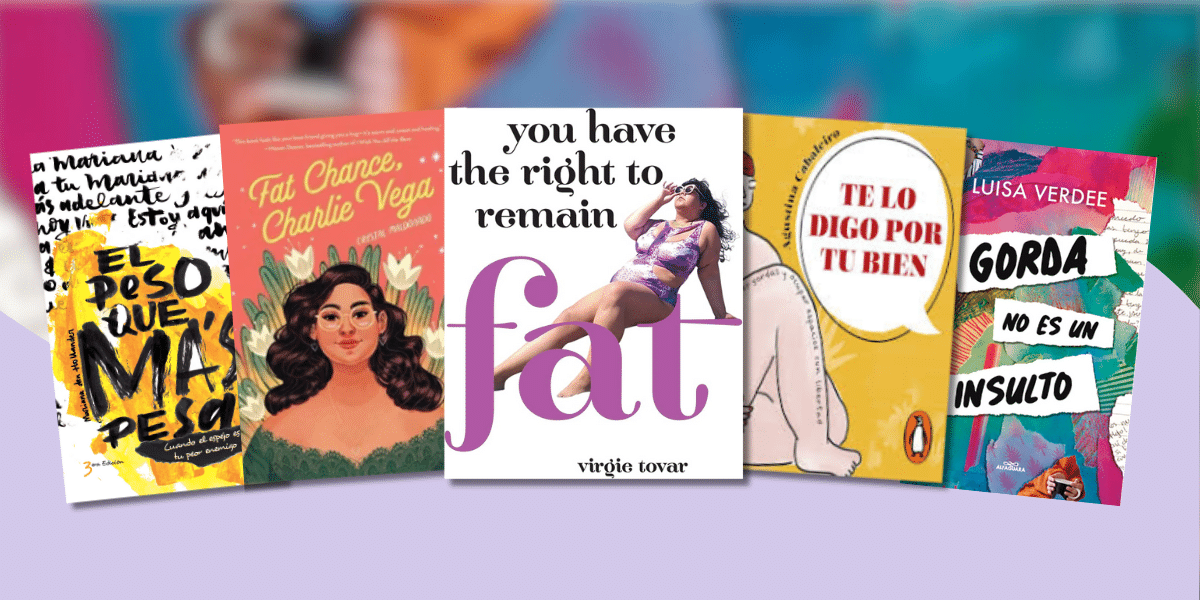
Mariana Den Hollander, a Costa Rican author and speaker, shares her struggles post-bariatric surgery (a surgery that has been romanticized by both the general public and my family as of late) in her books El Peso que Más Pesa and La Cirugía que Más Pesa
In Fat Chance, Charlie Vega, Crystal Maldonado addresses the fear many fat women have of not being romantically seen. When Charlie finds out her crush only asked her out after her (slim, popular) bestie, Amelia, she starts spiraling. To make matters worse, when she goes to her mother for comfort, all she gets are a bunch of weight-loss shakes.
Model and activist Agustina Cabaleiro opens her book, Te Lo Digo Por Tu Bien, by recalling the first time she was ever called fat: in kindergarten. While things seemed to come easily for others, her fat body seemed to be hindering her success. Clothes, sex, love, friendships, and even something as simple as a visit to the dentist were all plagued by unsolicited health advice and comments about her body, always with the excuse “te lo digo por tu bien.”
For essayist, activist, and TEDx speaker, Virgie Tovar, the discrimination she’s experienced because of the size of her body has been far more detrimental to her well-being than any “lesson” she could have learned about race, gender, and health. In You Have the Right to Remain Fat, Tovar argues that society’s standards for body size are unattainable through simple dieting, mainly because capitalism puts profit over people, seeking to make money off of our insecurities rather than teach us how to deal with them in a healthy, productive way.
Gorda No Es un Insulto follows Ámbar, a teenager who is starting to realize the impossible demands society places on young women regarding their bodies. Written by Luisa Verdee, the novel explores the use of the word “fat” as an insult (and not just what it really is: another word in the dictionary) and its many euphemisms – “voluptuous” being a recurring one in Ámbar’s life.
I owe much of my confidence and strength to other fat and ex-fat Latinas, who openly shared their struggles for me (and others like me) to learn from. There is power in community, and for the first time, thanks to the Latina body positive space, I felt empowered to just exist and stop being at war with myself.
I filled my Instagram feed with creators like Miriam Lara-Mejía, Mariana Den Hollander, Arhe Molina, and Agustina Cabaleiro, and my Kindle with their books. I find strength in their strength and solace in knowing that not only had my pain once been theirs, too, but that there is a way out. That’s what the authors of Latina body positive books taught me. In a way, I also owe much of my career to them. These women inspired me to share my own struggles and to be unapologetic about the way my body looks, with its many fluctuations.
I can only hope their words (and maybe mine, to some extent) help Latinas everywhere feel a little less alone and a lot more empowered in the same way they helped me. And maybe, just maybe, enjoying the holidays (and the food!) and dealing with the inevitable comments, nicknames, and stares from our tías and abuelas will feel a little less heavy.
