
There are people who discovered Star Trek casually. Then there are those of us who grew up with it humming in the background like a moral engine. In my house, that engine was loud. I’d be halfway through Buffy the Vampire Slayer when my father would appear like a Starfleet officer enforcing protocol: “Change the channel, Captain Janeway is on.” And just like that, I was orbiting Voyager.
Somewhere between warp drives and courtroom episodes about sentient rights, I fell in love with Trek’s central promise: the future can be argued into something better. I’ve watched every series, every episode, every strange moral thought experiment. And I’m not exaggerating when I say that growing up inside Trek’s ethical framework probably shaped my obsession with social justice systems and why people trust institutions… or don’t.
Which is exactly why Star Trek: Starfleet Academy matters to me. Not because it’s another Trek entry. But because it opens the door to a conversation the franchise has been circling for sixty years. A conversation about Klingons, racial capitalism, and representation that complicates Trek’s utopian mythology. It’s the Trek reckoning we desperately needed.
The Klingon Problem Trek Never Quite Named
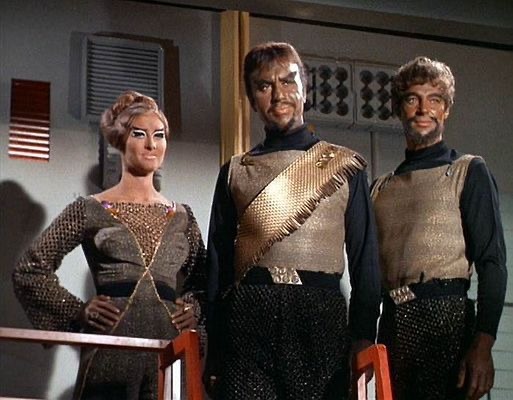
Recently, Klingons came up in class. Another student argued that Star Trek deserves praise because Klingons created opportunities for Black actors.
It’s a familiar defense. Trek as progressive pioneer. And yes, the franchise absolutely pushed boundaries with characters like Uhura and the famous interracial kiss between Nichelle Nichols and William Shatner. Those moments mattered. They still do.
But representation is not just about presence. It’s about coding.
For decades, Trek has written Klingons as hyperviolent, emotionally volatile, honor-obsessed warriors. They are routinely frame them as savage, brutal, or culturally primitive in contrast to Starfleet’s rational diplomacy. The franchise may not have intended Klingons as allegorical racial villains, but media does not exist outside cultural context.
And then there’s the visual history.
White actors with darkened skin, exaggerated features, and aggressive tendencies place Klingons uncomfortably close to a lineage of racial caricature that American media has never fully reckoned with. The franchise later diversified casting, but the foundational imagery lingers.
This is where racial capitalism enters the conversation.
Klingons became beloved fan icons while simultaneously embodying profitable stereotypes. The franchise monetized spectacle and aggression in ways that mirrored how American media historically commodifies racialized bodies.
That tension has always been Trek’s contradiction: a franchise committed to utopian ideals, yet built within an entertainment economy that reproduces the very power dynamics it imagines overcoming.
B’Elanna Torres and the Politics of “Half”
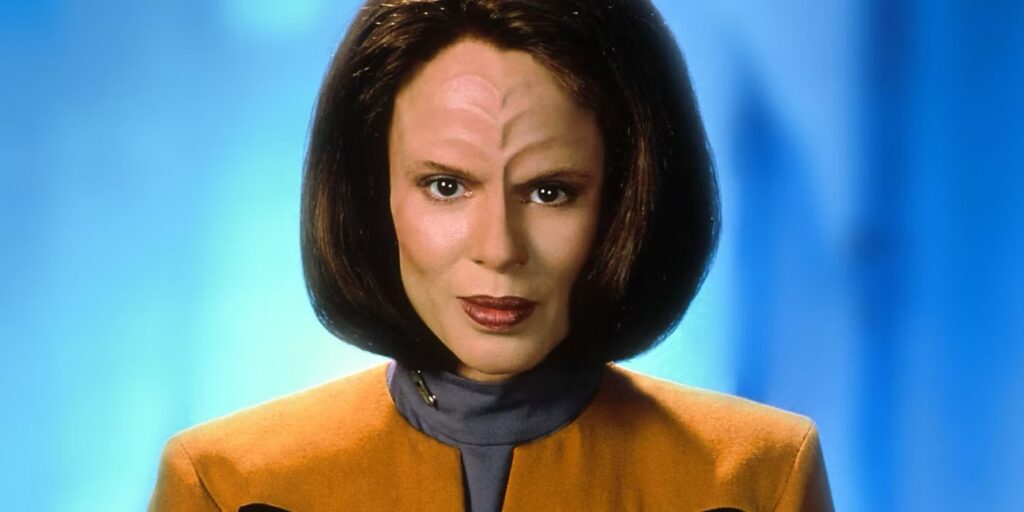
This contradiction becomes painfully visible in the character of B’Elanna Torres, played by Roxann Dawson in Voyager.
B’Elanna is half Klingon, half human. And for seasons, her emotional arc hinges on that duality. Her anger, volatility, and aggression are Klingon traits that need management. Her moments of patience, empathy, and restraint are her human side breaking through.
That narrative structure is not neutral.
It suggests that Klingon identity is something to be moderated, civilized, or softened through proximity to humanity – which reads like proximity to whiteness. B’Elanna is allowed tenderness, but only insofar as it is separated from her Klingon heritage.
Trek likely intended B’Elanna’s arc as a meditation on belonging. But intention does not erase implication. The character reinforces a hierarchy where Klingon-coded traits are problems to solve rather than identities to inhabit fully.
For a franchise that prides itself on diversity, this has been a profound blind spot.
Why Jay-Den Kraag Matters

This is why Karim Diané’s Jay-Den Kraag in Starfleet Academy feels genuinely significant.
Jay-Den is a Klingon cadet who rejects violence not because he is mixed, but because he chooses another path within his culture. He questions tradition without abandoning identity. He embodies internal diversity rather than assimilation.
That distinction is everything.
For the first time, a Klingon is not violent by default or redeemed through proximity to humanity. Jay-Den exists as a Klingon whose moral compass expands the definition of Klingonhood itself. The show is not erasing cultural history. It’s acknowledging that no culture – fictional or otherwise – is monolithic.
That reframing breaks a decades-long shorthand equating Klingon identity with brutality. It’s a quiet but radical move. And it signals a Trek willing to interrogate its own legacy rather than simply celebrate it.
It took sixty years to get here. That deserves applause and scrutiny in equal measure.
Trek’s Utopia, Finally Under Examination
What makes Starfleet Academy compelling is not just its Klingon arc. It’s the broader willingness to question institutional myth. Caleb Mir’s distrust of Starfleet mirrors a contemporary skepticism toward systems that promise protection while causing harm. The Academy becomes less a dream school and more a negotiation of power, trust, and belonging. That thematic shift feels aligned with the Klingon conversation. Both arcs ask the same question: who defines acceptable identity inside a system built on ideals?
Trek has always imagined itself as a blueprint for a better future. But utopia without interrogation is propaganda. Starfleet Academy suggests that Trek’s next evolution is not abandoning optimism. It’s stress-testing it.
Five episodes in, the show feels playful, self-aware, and surprisingly brave in the conversations it invites. Nostalgia is present, but it doesn’t dominate. The cadets aren’t just training to be officers. They’re negotiating what it means to inherit an institution with contradictions.
For those of us raised on warp cores and ethical debates disguised as sci-fi, this feels like Trek growing up alongside us. The future, as Trek has always promised, is something we argue into existence. And sometimes that argument starts by admitting the past wasn’t as clean as we pretended it was.
The cadets are learning that.
And so are we.
