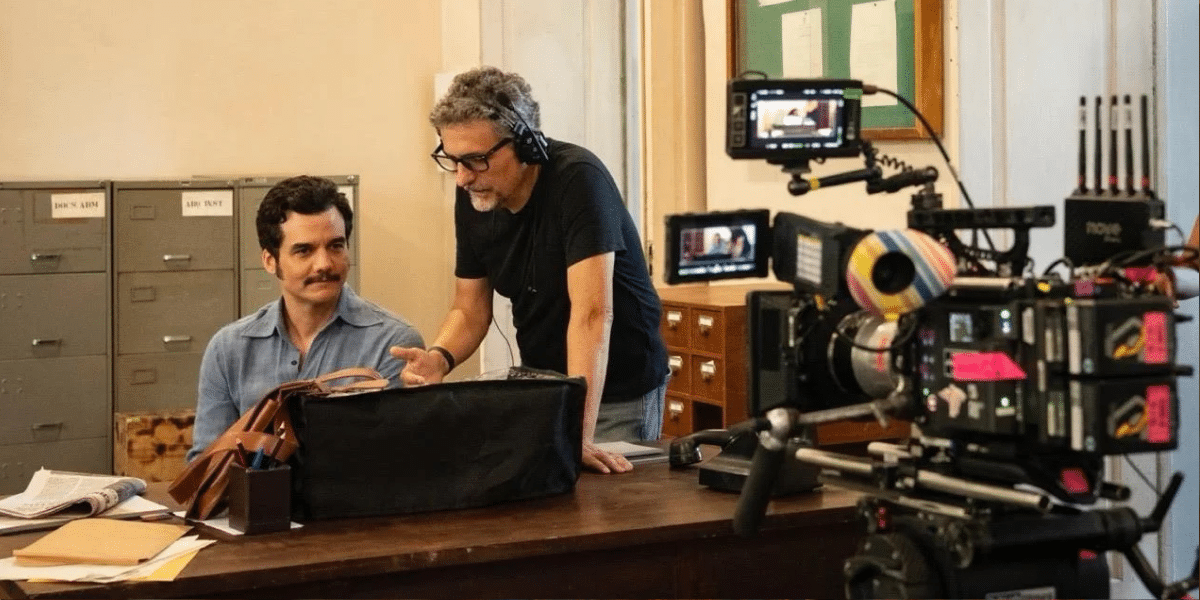
In a world of prequels, sequels, and remakes, Kleber Mendonca Filho goes a different direction. His stories are specific, bending genre to his will, unbothered to explain any local reference or in-joke. And that’s precisely why he became one of the most internationally acclaimed Brazilian filmmakers of our generation.
The mentality of prioritizing the viewing experience of those closest to him is most evident in his latest project, The Secret Agent (2025), where all of his quirks culminate in a film that is not only full of Brazilianess, but also of his birth city, Recife, the capital of Pernambuco.
But if you take a look back on his filmography, the same principle applies. In his earliest short films, he interviews a film projectionist from Recife or recreates an urban legend common in Brazilian schools in the 70s.
His first feature, Neighboring Sounds (2012), follows the everyday life of a typical, middle-class street in Recife, and not so coincidentally, the same street Filho grew up in. Aquarius (2016) depicts a widower fighting against a real estate company that wants to demolish her home – the last old building in Av. Boa Viagem, Recife.
With Bacurau (2019), a sci-fi/western, set in the deep sertão of Pernambuco, he lands his first Cannes statue, the Grand Prix.
So, the question remains: how do these films, so unbothered to please a mass audience, still manage to do so? I’d say that Kleber Mendonca Filho’s films are, in fact, very international. But not in an explicit way.
When people say a film has “international potential,” what they usually mean is that the film is accessible to English-speaking audiences, aka it’s in English. Now, I think English-speaking audiences are capable of enjoying foreign art. And, as someone who grew up in Brazil surrounded by US media, I guarantee that the language doesn’t matter as much as the actual story.
And here’s where I believe Kleber Mendonca Filho’s films take a first step into being international: he is a master genre storyteller.
Take Recife Frio (2009) – after a meteorite crashes on the beaches of Recife, the once tropical capital starts to experience low temperatures, and the city’s whole culture begins to shift. It’s a short mockumentary, and most of it’s not even in Brazilian Portuguese, but narrated in Spanish by a reporter from Buenos Aires, Pablo Hundertwasser (André Schaffer).
The short film incorporates sci-fi tropes, allowing audiences who might not understand the languages spoken or culture presented to hook into familiar storytelling techniques and so slowly connect with the unfamiliar elements. Yes, Filho uses genre wisely, spinning fantastical elements to tell a story that explores a deeper message.
In his book The Anatomy of Genre (2022), John Truby explains that “Genres are the Platonic forms, the structures beneath the ‘shadows’ that truly explain our lives. Every story presents a particular challenge; the genre provides the structure for solving it.” Essentially, genres are often about universal human experiences – horror is about death, crime is about justice, etc. – and storytellers should use them to explore the many different facets these experiences can take.
Sequels and remakes aren’t nearly as useful, too often simply rehashing the same themes without adding anything new. What was once a laboratory for creativity has now become an office of predictability. The goal is to appeal to the widest, proven audience possible.
And this mentality is the biggest trap for modern filmmakers.
Reaching as many people as possible sounds tantalizing, after all, isn’t that what everyone wants? To be read, heard, and watched? Therefore, the logical way of approaching stories is to make them as broad and universal as possible. Right?
But that couldn’t be further from the truth.
Storytelling is paradoxical. It does not follow the “market’s logic” of wider appeal equals greater return. Actually, it’s usually the other way around: the more specific the story, the more universal your audience becomes. And there’s a reason for that.
Narratives are very rarely about the surface elements. Most of the time, they are metaphors for real-life experiences: a moment of grief, a time of change, a period of growth. And the thing about these moments is that, often, it’s not the big-picture event that sticks in our minds, but rather the mundane details.
High school memories often come as a blur to me. But I very clearly remember the day a friend got accepted to her top university choice, and my friends and I pranked her with red gouache paint – and how a little droplet stained the tiniest bit of the white collar of my black sweater. Every time, I look at that sweater, I remember that day.
This type of detail also powers fiction. Actually, the more you populate a narrative with specificity, the more believable it becomes. Humans are wired to connect with other humans, and humanity is mostly found in the details.
So, in a reality where the biggest entertainment company in the world has recently announced that they will launch yet another AI slop doom scrolling feed, having a filmmaker like Kleber Mendonca Filho make movies like The Secret Agent and Aquarius is powerful.
When I watch his movies, it doesn’t matter that I’ve never been to Recife or that I’ve never been a man on the run or a 65-year-old retired journalist. What matters is that Kleber Mendonca Filho breathes life into these people, giving them struggles that mirror my own and fights that inspire me to go on. That’s good storytelling.
