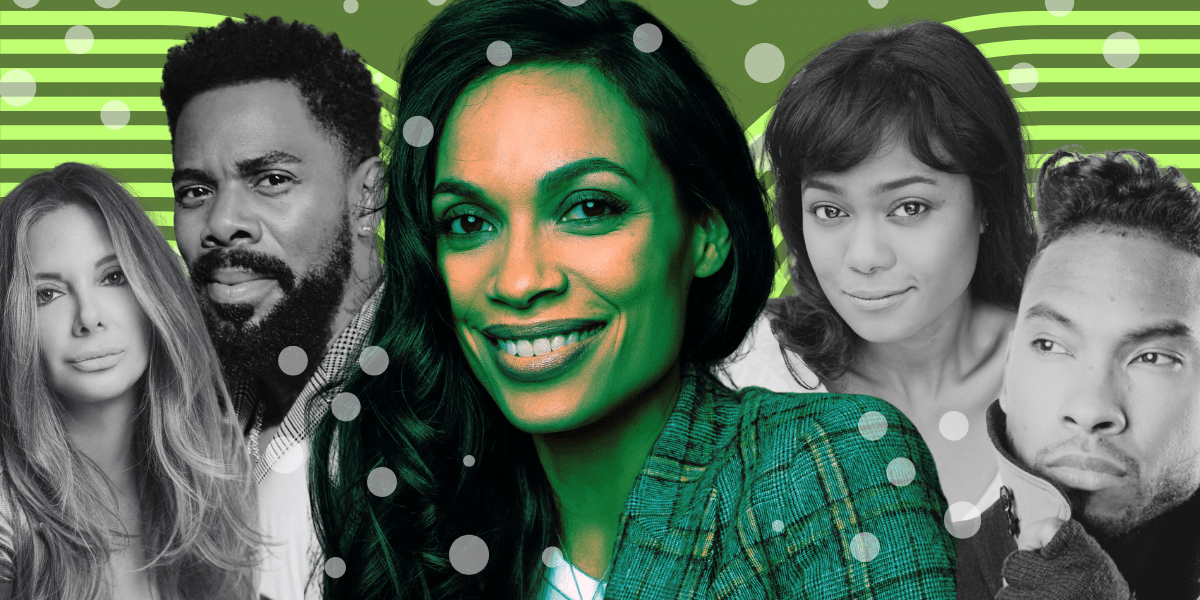
The experience of being Latina has always been complex. We struggle with the “ni de aqui, ni de alla” concept of not feeling Latina enough while also not feeling American enough. It’s a feeling that is exacerbated when you have a parent of a different ethnicity and/or race. When you are one of us “half Latinos,” you often experience that sense of not belonging among your own Latino family members.
It can feel like you exist in some sort of limbo, never feeling like you fully fit in. You may be criticized if you don’t speak Spanish or fit into a stereotypical mold of what you should look and act like. You may have to prove you’re Latino if you have a non-Spanish name. Or, you could be asked or expected to abandon your Latinidad in favor of other cultures and races, especially white/Anglo ones. As a “half Latino” myself – Colombian mother and Hungarian father – seeing other mixed Latinos like me discuss this dynamic is gold.
So check out these notable Latinos who are not only Latino enough but also expand our often-narrow perceptions of who gets to participate in our shared identity.
In Comedy and Content Creation
Comedy is a way to talk about important, often-controversial topics without getting shut down. You laugh while expanding your mind and hearing other perspectives and experiences. It makes sense, then, that comedy is a venting space for “half Latinos” who often get teased and misunderstood for just existing. You have comedians like Isabella Quiros, who shares in a set that she can’t talk with half of her own family, while Jon “Polar Bear” Gonzalez, the self-proclaimed “Whispanic,” gets laughs comparing the Mexican and white sides of his family.
When it comes to creating a much-needed space for “half Latinos” on platforms such as Instagram, Yanett Steven shows us the special experience of growing up half-Mexican, half-Scottish in the UK while switching seamlessly between legit Scottish and Mexican accents. You can catch Ana Saia singing in Spanish while simultaneously challenging the world on what a Latina is supposed to look like. And Al Madrigal takes the mixed-Latino representation to another level with his comedic documentary Half Like Me.
In Music
Music is another universal language that allows people a window into cultural identities and shared experiences. Who didn’t freak out when we found out that Christina Aguilera is Latina (Ecuadorian father; German, Irish, Welsh, and Dutch mother). She eventually came out with music in Spanish, which made us feel a bigger part of the pop landscape.
Then, there’s the singer Miguel, who we might associate with the song “Adorn,” but who dedicated “What’s Normal Anyway” to speaking up about his identity and the feeling of not fitting in.
And of course, we have to include Selena Gomez (half-Italian, half-Mexican). She was named for another Chicana – Selena Quintanilla Perez – and is a multi-hyphenate success story who is always close to her roots.
In Hollywood
And then there’s Hollywood. As John Leguizamo called out, for the large number of Latino audience members, there are few Latino faces looking back at us. We are grateful, however, for the Latinos – and “half Latinos” – who have made their mark in Tinseltown.
There is actress and singer Tatyana Ali, who starred as rich girl Ashley Banks in one of the biggest shows on ‘90s primetime television (The Fresh Prince of Bel-Air). She’s Afro-Panamanian and even has a Spanish-language song, titled “Los Peces en El Rio.”
Rosario Dawson, who is Puerto Rican and Afro-Cuban on her mother’s side, has repped for Latinas in “a galaxy far, far, away” (Star Wars) and superhero universes (including Sin City and as Marvel’s Claire Temple). But most importantly, she is grounded right here on Earth, doing activism and political work, including co-founding Voto Latino, a nonprofit empowering Latinos to get out and vote.
Before them, half-Bolivian, half-English Raquel Welch fought to keep her Latina name when Hollywood wanted the international sex symbol to have the more white-sounding “Debbie.” Half-Mexican actress Lynda Carter was the first to show us that Latinas can play superheroes (as the popular Wonder Woman). Cameron Diaz can appear like she is solely white, but proudly reps her Cuban side in interviews.
Colman Domingo is the first Afro-Latino to be nominated for a Best Actor Oscar, and the first actor, since Denzel Washington, to get back-to-back nods. He is the first Guatemalan to win an Emmy (his father is Belizean with ancestry in Guatemala and “all over Central America”), and the second Afro-Latino, after Jharrel Jerome, to win the award. He is consistently on best dressed lists, known for his bold, unique style and sartorial choices. Colman even co-hosted fashion’s biggest night – The Met Gala. And he is doing all this while also proudly speaking on being Afro-Latino of mixed heritage, taking up space, and triumphing in industries that have been late to recognize Black and Brown greatness.
Alex Meneses (half-Ukrainian, half-Mexican) is an actress and producer whose career has spanned over three decades, playing both Latina and non-Latina roles. She has mentioned that people don’t think she is Mexican, but Alex leaves no doubt that she is one of us when it comes to her work with Latinas Acting Up, an organization that claims space for Latinas in Hollywood.
Because Alex, Colman, Cameron, Tatyana, Selena, and all of us “half Latinos” know, it’s not about DNA percentages, what we look like, or our names. If you’re Latino, you’re Latino, and being mixed with something else just proves how beautifully complex we are and how Latinidad is never as simple as checking a box.
