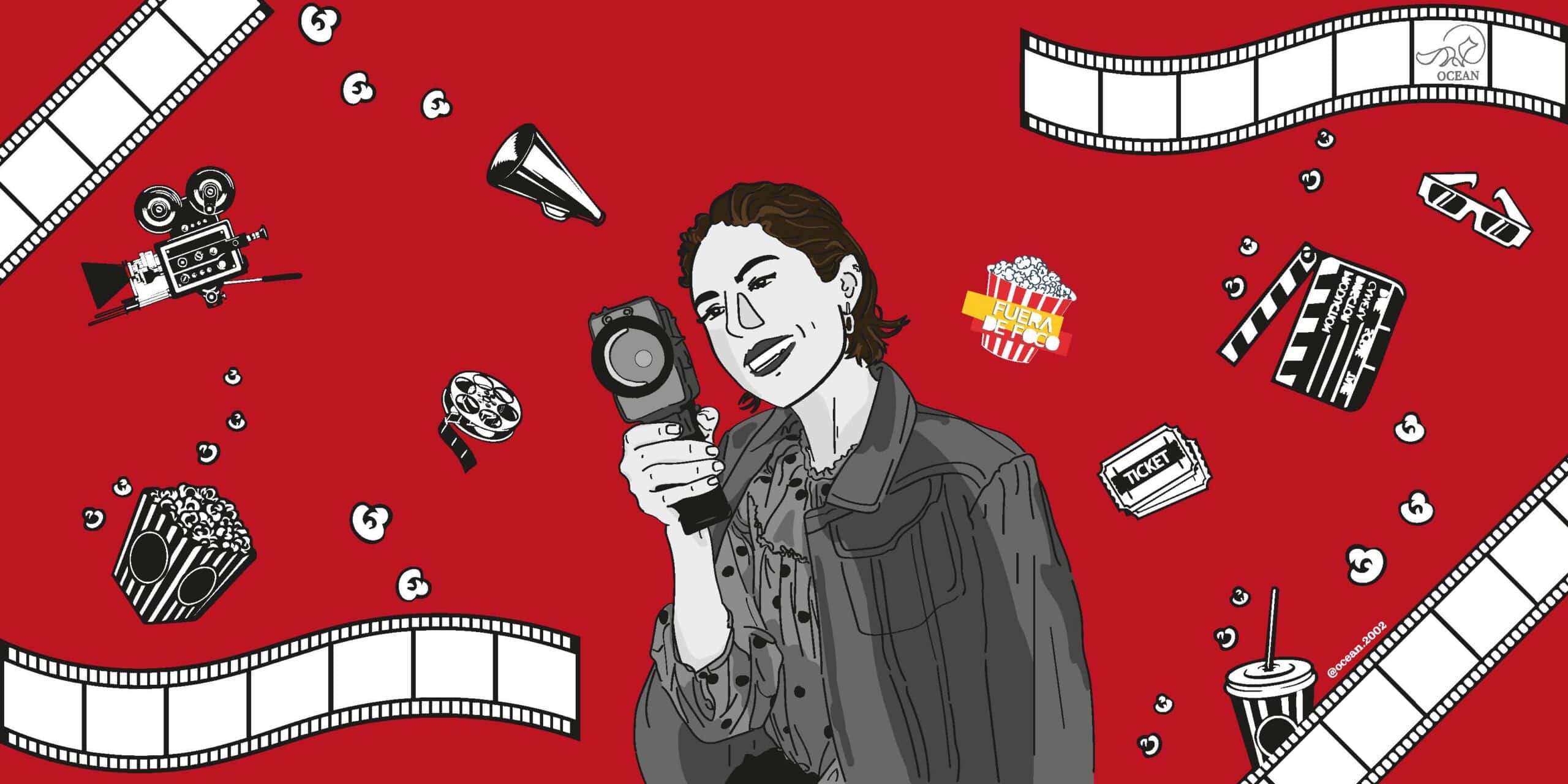
For nearly a decade, Mexican film critic and YouTuber Gaby Meza has been doing something deceptively radical: teaching more than 1.28 million subscribers how to think about movies. On an internet that rewards outrage and compression, she built a practice around attention. Over 1,000 videos later, her YouTube channel has become one of the most influential Spanish-language spaces for film criticism in the digital era. When I spoke with Meza for my platform VOCES, what struck me was not just her reach, but her discipline. Independent digital platforms are often dismissed as secondary to legacy media. In Latin America, they are often the opposite. They are infrastructure toward meaning. And Meza is one of the architects.
Gaby Meza grew up in Hermosillo, Sonora, geographically and culturally distant from the art-house circuits and repertory theaters that shape film discourse in Mexico City. Like many Mexican audience members, her early encounters with cinema were filtered largely through commercial releases and Hollywood imports. It wasn’t until she began formally studying film that she learned to reshape this landscape. What had once seemed like pure entertainment acquired texture and intention in school. She describes the experience as opening a “treasure chest,” a sudden recognition that color can function as argument, that framing encodes perspective, that narrative structure carries political weight. Film stopped being something to watch and became something to read.
“I wanted to share what I was suddenly able to see,” she told me. Her desire (to translate perception rather than hoard it) became the animating principle of her channel. Her authority emerges from her memory of what it feels like not yet to possess the vocabulary, to sense meaning without fully grasping its mechanics. She brings viewers into the act of interpretation itself, narrating the analytical moves as she makes them, so that the process becomes visible rather than mystified.
She moves fluidly between major Hollywood releases and independent or international films, declining the familiar hierarchy that treats “high” culture as inherently superior to the popular, and in doing so reframes cinema as a continuum rather than a ranking system. Her tone is informative, building layers of understanding rather than tearing down taste. Instead of telling viewers what to think, she asks them to examine how they felt – why a particular scene moved them. Was it the performance, editing, sound design, or some quieter formal choice working beneath the surface? And in that questioning, she redirects attention from reaction to construction.
The result is criticism that functions as literacy training, an invitation to see form where one might have only registered emotion. Her method closely mirrors the encoding/decoding model articulated by cultural theorist Stuart Hall. He argues that meaning is not sealed within a text but negotiated between its producers and audiences. By helping viewers name and navigate that negotiation, she strengthens interpretive habits that travel well beyond cinema. You can use them to parse political rhetoric, see through advertising logic, and deconstruct the curated performances of social media.
This kind of media literacy is not ornamental. It is a civic good
Film criticism has long been shaped by male voices across newspapers, academic institutions, and digital platforms. That pattern informs who is presumed authoritative in evaluative or technical cultural fields. Meza is candid about the additional scrutiny she encounters as a woman working within that space, noting simply, “It’s harder to earn trust.” But her presence subtly recalibrates expectations, so authority need not depend on aggression and seriousness need not abandon emotional intelligence. For female audiences across Mexico, Argentina, Colombia, Spain, and the broader diaspora, her example is not merely symbolic but formative, offering a lived demonstration of what intellectual confidence can look like without mimicking traditionally masculine performance.
For Meza, film is a psychic trigger, capable of surfacing unarticulated emotions. She speaks frequently about catharsis. about viewers who find themselves crying in theaters without fully understanding their reactions Further influenced by psychoanalytic thought, she approaches cinema as a medium that reveals latent tensions rather than simply telling stories. Even those who consider themselves emotionally self-contained, she observes, can be unsettled by a narrative, by a viewing experience that turns into a form of collective processing. In that sense, cinema operates as a space where we negotiate grief, memory, social tension, and belonging in public.
And her channel foregrounds films representing migration, racism, gendered marginalization, and questions of inclusion, bringing those conversations in Spanish at a scale that traditional criticism does not achieve. When more than a million subscribers encounter sustained discussions of representation, authorship, and power in accessible language, the cumulative effect is not rhetorical flourish but measurable cultural impact.
Scale aside, Gaby Meza distinguishes herself through the steadiness of her method, the intellectual transparency with which she narrates her analytical process, and the deliberate turning of her audience to depth rather than provocation. At a moment when digital culture prizes immediacy and hot takes over patience, Meza has made endurance her quiet counterargument, building a body of work that asks viewers not simply to react but to remain with an idea long enough for it to take shape.
In expanding both the form and the constituency of cultural analysis, Gaby Meza has redrawn the contours of authority for a LATAM generation.
