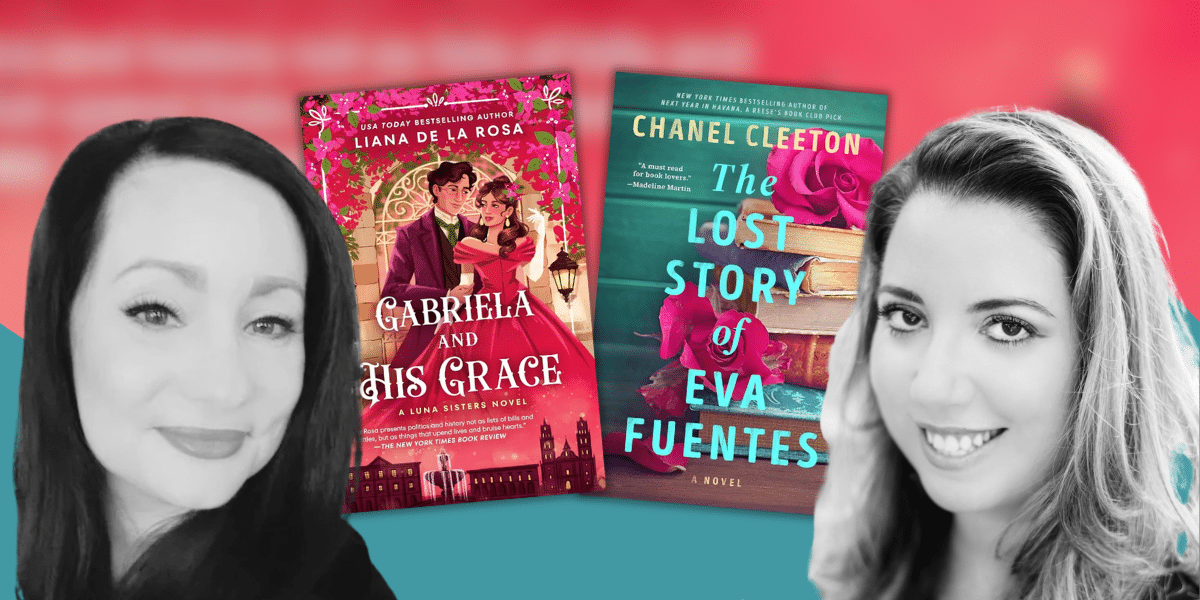
My favorite thing about summer break used to be summer reading lists – yes, I was that kid. Even after I finished school and summer break was no longer a thing for me, I’d look forward to making a list of books I’d read at the beach (or more realistically, what books I’d read in bits and pieces when work was slow). I’ve kept that tradition alive and well through the years, buying a ton of books that would get me from June to August. This year, however, I knew I’d spend days stuck at airports, so I saved the best – two upcoming novels by Latina authors – and honestly can’t decide which one I loved more.
Gabriela and His Grace (hitting bookstores August 26) follows Gabriela Luna, a Mexican Purépecha socialite who is forced to flee her homeland during the French occupation and Reforma period in México. The youngest of three sisters and the only single one, she yearns for her chaotic Mexican homeland and decides to come back without her parents’ permission.
Being back in Mexico, though, will mean her father (whose preferred love language is pointing out all the flaws he can find in a daughter who is a younger, female version of him) will try to marry her off to the highest bidder. But she has better things to occupy her time (and her mind) with: politics, women’s rights and health… And yes, one of those things is also Sebastian Brooks, Duke of Whitfield, a close friend of her brother-in-law and the man who has been tasked with escorting her back to Mexico. The issue? They both can’t stand each other.
In true enemies-to-lovers’ fashion, Gaby and Sebastian spend the three-week journey from London to Altamira learning to tolerate and even enjoy each other’s company. Liana De la Rosa manages to make the reader fall in love with and hate both Gaby and the Duke, allowing us to feel their frustration, pain, anxiety, anger… but also their excitement and the giddiness that comes with realizing you just might’ve found your person.
There’s more to the book than just a love story, too. Gabriela and His Grace (as well as De la Rosa’s previous two books in the Luna Sisters series) give us a peek into the world of Mexican Dollar Princesses from the French Occupation/Reforma time period — stories that we rarely get to see in the media but that very much existed. The stories of women who, yes, were incredibly wealthy, but also used their wealth, status, and privilege to champion women’s rights at a time when women having rights wasn’t really a thing. Fans of shows like Bridgerton, The Buccaneers, Gilded Age, and Downton Abbey will be immediately drawn to De la Rosa’s storytelling, as Gaby’s experience is not unlike Cora’s, Nan’s, or Gladys’.
My one critique about Gabriela and His Grace is its use of Spanish throughout. As a native Spanish speaker, I often found it makes little to no sense within the context of the story. It was almost as if the Luna women weren’t native speakers (which they’re supposed to be). The message gets through, of course, but I found myself being momentarily kicked out of the fantasy. Moments like Gaby telling her brother-in-law, Cat Dawson, “señor, hable español muy bueno” when a native speaker would say “Señor, habla usted muy buen español,” or Mrs. Luna saying “Ana looks orgulloso” were few but still noticeable enough.
Perfect Spanish or not, the novel was one I couldn’t put down. A headstrong, opinionated Mexican woman who goes against society’s expectations, and marries for love instead of power (and also looks incredible in red)? Yeah, I’m sold.
And speaking of headstrong women, I’m also recommending The Lost Story of Eva Fuentes (out September 30, 2025), Chanel Cleeton’s latest novel. In it, she explores the stories of three women in different eras.
There’s Margo Reynolds, an American expat who’s hired to source a century-old book in London in 2024. The catch? There’s only one copy of the book in existence. Margo eagerly accepts the challenge, but she soon realizes she might be in way over her head, as there are others interested in the book – some that might put her life in danger.
Pilar Castillo is a Cuban librarian from La Habana and a member of the Cuban resistance in 1966. Her life is filled with grief and anger over the loss of her husband, a member of the resistance who was imprisoned and killed for going against Fidel Castro’s regime. After a neighbor hands her a mysterious book for safekeeping, she finds comfort in its pages as she endures life under Castro’s totalitarian, repressive rule.
Finally, we have Eva Fuentes, a Cuban teacher who, in the summer of 1900, who is given the opportunity to travel to the States as part of Harvard’s cultural exchange program. During her stay, her life is turned upside down, as she experiences both love and heartbreak, which together change the course of her life and inspire her novel.
At first glance, the stories of Margo, Pilar, and Eva might seem to have little in common, but Cleeton masterfully moves through timelines, making it easy to follow all of them and also understand how one needs the other. Much like in her previous work, the time jumps in Cleeton’s novel help send a clear message: our stories are always intertwined and those who came before us are part of our story, whether we are aware of it or not. The Lost Story of Eva Fuentes feels especially relevant now, at a time when book bans and censorship are a reality once again. Cleeton’s latest work celebrates literature and the power it has to connect the lives and stories of people whose paths would have otherwise not crossed. The novel perfectly establishes how one novel can join people hundreds of years apart.
History has a way of repeating itself, and we can learn from how those who came before us made it through. Both Gabriela and His Grace and The Lost Story of Eva Fuentes provide some much-needed comfort, a reminder that the only way out is through, and also affirmation that there is an end to the madness. If Gabriela, Pilar, and Eva can do it, then maybe so can we.
