The second season of Prime Video’s Fallout asks a big question: Is anyone completely good or absolutely evil? In fiction, it is easy to identify flat characters – the immaculate hero, whose actions always serve a greater good, and the antagonist, reduced to an almost theatrical evil. Fallout breaks from this pattern and avoids caricatures to explore what lies behind each decision.
In the Fallout universe, humanity struggles to recover – if that term is still applicable – after a nuclear war devastated the planet and reduced civilization to rubble. On the surface, people learned to survive radiation, adapting to a relentless environment. Underground, however, inhabitants live in vaults, descendants of a society stuck in the values of the past, isolated from the collapse. Adding to this already fragmented map is a third presence, less innocent and considerably more dangerous, those who concentrate power, understanding the workings of this broken balance. And so we delve deeper into human nature.
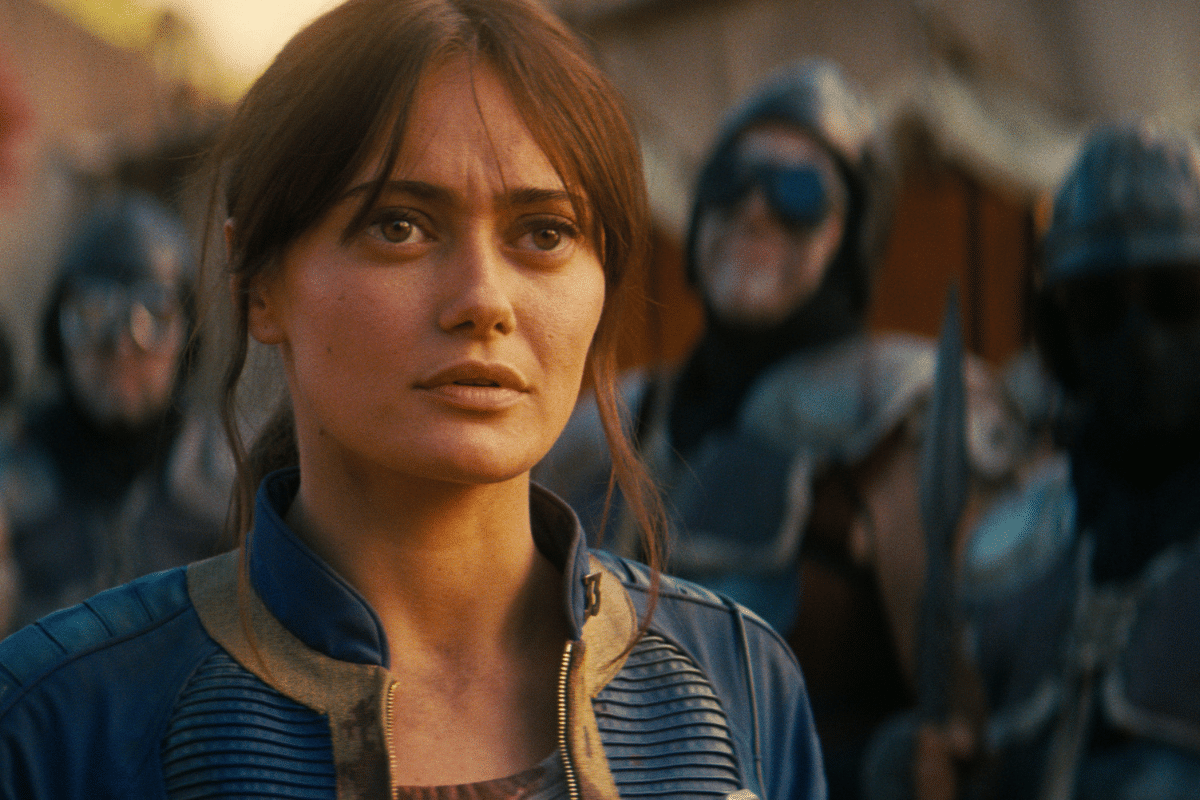
The tour begins with Lucy MacLean (Ella Purnell, Yellowjackets), who sets out on her own hero’s journey when she leaves Vault 33 in the first season to find her father. In the second season, she must confront that she no longer knows exactly who she is. Her innocence is behind her; the young woman who emerged into the outside world no longer exists. Even so, Lucy stubbornly clings to the values she was taught. But when being kind puts your life in danger, would you continue to be kind? She must answer that question as she keeps searching for her dad, no longer intending to rescue him, but to make him pay for his actions.
At the same time, the Ghoul (Walton Goggins, The White Lotus) seems to have left behind any trace of humanity. He hasn’t been Cooper Howard for a long time. However, after decades of loneliness, he finds again in Lucy someone to protect and, perhaps, to call a friend. So his armor begins to crack, slowly. The process, however, is far from linear as the past insists on returning. He can’t forget the events of two hundred years ago that dragged him into the epicenter of a nuclear war he never wanted to be part of. It’s an open wound that conditions every decision he makes.
Then there’s Maximus (Aaron Moten, Mozart in the Jungle). Raised with affection and then marked by tragedy, he seems destined to be pushed, paradoxically, toward the right path by these blows of fate. Even when he must get his hands dirty and deeply doubt himself, his steps end up aligning with a compass, though not always a well-calibrated one.
Of course, there are characters who lean more clearly toward one extreme or the other, good or evil, as in real life. Fallout accurately depicts how some people are driven by ambition, control, and the satisfaction that comes from subjugating others. Through them, the series makes it clear that some actions are just wrong, the culmination of a person’s darkest side. Think seeing a nuclear event as not just tragedy, but also an opportunity. Behind this logic stands Vault-Tec and other corporations whose true scope Fallout is slowly revealing.
The show’s psychopathic and sociopathic profiles broaden its portrait of human nature. It is true that the world can’t be reduced to a right-or-wrong dichotomy: there are shades of gray and an even wider range of nuances. However, while some characters move ambiguously across that spectrum, others remain firmly anchored at one of its extremes. Although we would like those in power to lean toward the lighter shades, Fallout presents a much more uncomfortable reality. In this alternative Earth, many leaders unashamedly inhabit the darker colors.
Among them is Hank MacLean (Kyle MacLachlan, Sex and the City), who views living beings as nothing more than material for his experiments. But, thankfully his son, Norm MacLean (played by Colombian-American actor Moisés Arias, The King of Staten Island) thinks differently. When Norm figures out the scope of his father’s machinations, he must face a new reality: how can he accept that the person he admired most lacks any moral compass? The answer allows Norm to break the rules and begin to use the resources at his disposal to get to the truth. Norm’s path urges us to consider Hank’s origins. Are monsters born or made along the way?
In our world, where everyone seems to be fighting for their own interests, Fallout is a wake-up call. Lucy makes it clear: “If you think everyone else is the bad guy, chances are you are the bad guy.” Season two is a reflection on our own humanity and the moral justifications we construct to validate our actions. With this guiding force, the appearance of monsters and iconic characters from the video game, an expansion of the factions, and some long-awaited reunions, Fallout’s sophomore outing is a truly exciting watch.
