
A unicorn. A billionaire. A bloodbath. Sounds like a fever dream, right? But that’s exactly what you get in HBO Max’s and A24’s Death of a Unicorn, a glittery, gory satire that sinks its horn straight into the rotten heart of capitalist greed.
The setup is deceptively simple: A weekend retreat has deadly consequences when a father and daughter accidentally hit and kill a unicorn while en route to his billionaire big pharma boss’s home, who eventually seeks to exploit the creature’s miraculous curative properties to cure his cancer and exploit it for profit.
I watched it the way any chaotic creative would: curled up in bed with my partner, popcorn in hand, expectations low but curiosity high. As he muttered that it “felt like a well-filmed B movie,” I was already spiraling into obsession. Sure, it’s gory. Sure, it’s absurd. But buried in its blood-soaked chaos is an allegory for greed, power, and the metaphysical threads that bind us — and yes, art history literally becomes a character.
We stumbled on the movie almost by accident, looking for something entertaining before bed. What we got instead was a cosmic gut check dressed in horror drag. Watching it with my partner — who saw camp and carnage — I saw myth, metaphor, and meaning. That’s the beauty of watching stories together: they hit differently for everyone. This one hit me like a horn to the chest.
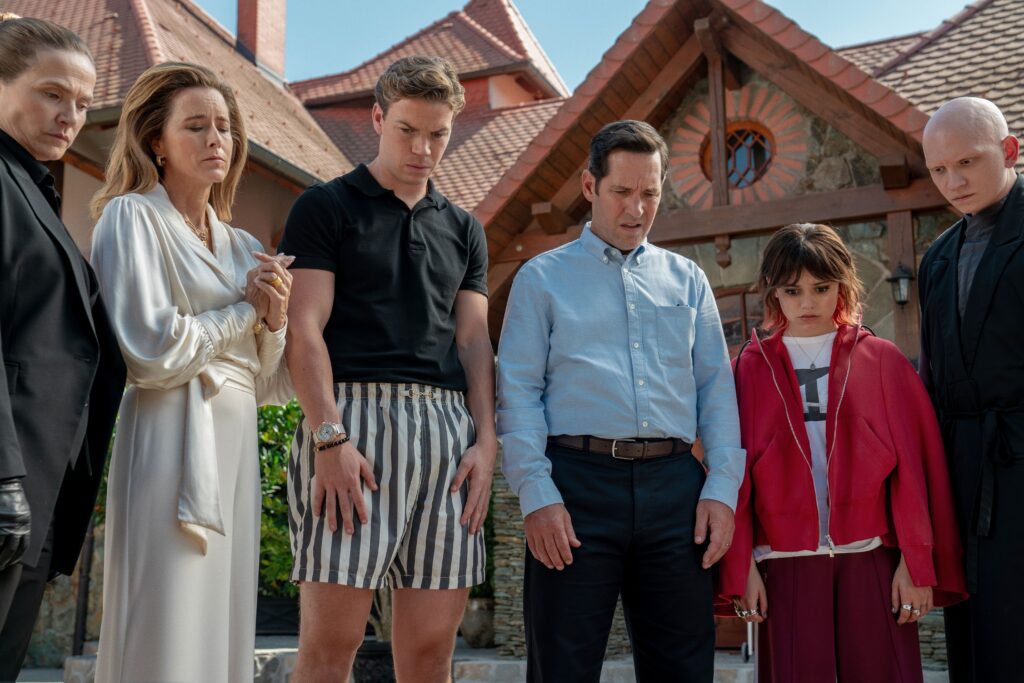
Let’s get one thing clear: Death of a Unicorn is not trying to be subtle. It’s a hot pink middle finger to corporate legacy, generational wealth, and the human need to commodify anything miraculous. Paul Rudd plays Elliot, a CEO-level doofus trying to impress his billionaire boss when he hits a unicorn with his car. Jenna Ortega plays Ridley, his daughter, who serves as the moral compass with a vape pen and a low tolerance for bullshit.
But here’s where the film caught me off guard: the art history subplot. Ridley, still grieving her late mother, stumbles upon old photos that trigger a visual memory — images that echo the famous Unicorn Tapestries, those medieval masterpieces depicting the unicorn as a hunted, sacrificed being. The way Ridley connects those visuals to their current predicament isn’t just clever — it’s emotional archaeology. Art becomes the guide, the decoder ring, the cosmic flashlight. It’s through art that Ridley begins to understand what’s really happening — and what’s at stake.
As an artist, I was obsessed. Art isn’t just referenced in this film; it’s activated. It acts as ancient memory, metaphysical GPS, and spiritual indictment. The unicorn isn’t just a myth — it’s a mirror. And the people holding that mirror? Spoiler: they don’t like what they see.
The gore? Oh, it’s there. This movie is not for the squeamish. But the violence never feels empty. Each over-the-top death scene is a lesson in excess — how far people will go when they believe they’re entitled to the miraculous. We consume what we fear, and we fear what we don’t understand.
Will Poulter’s character, Shepard Leopold, is a walking metaphor for unchecked greed. A billionaire heir who literally snorts powdered unicorn horn like it’s divine nose candy, he’s gifted with visions of genius but too consumed by power to understand them. It’s a perfect parody of Silicon Valley tech bros — high on potential, low on ethics. Even when the universe hands them enlightenment, they turn it into a product.
Jenna Ortega is the steady heartbeat of this madness. Her Ridley is the Gen Z heroine we need: sharp, skeptical, emotionally fractured but spiritually intact. Every time she hits that vape instead of lashing out at another condescending man in the room? Been there. Done that. She channels restrained rage into moral clarity, carrying the emotional weight of the story without ever turning into a trope.
But Death of a Unicorn isn’t just a satire. It’s a metaphysical fable. It whispers that maybe we’re connected in ways we can’t comprehend. That maybe unicorns aren’t real — but our hunger to possess wonder definitely is. And when something pure shows up, our instinct is to exploit it instead of protect it. That’s not fantasy. That’s history.
Think about it: if a platypus started curing cancer tomorrow, we’d have it under a microscope and on the stock market before it took a second breath. This film gets that. It understands our inability to coexist with magic. It paints a world where wonder can’t survive capitalism — and makes us sit with that reality, blood and all.
It also forces us to reckon with grief. Ridley’s journey isn’t just about the unicorn — it’s about her mother, her memories, and her desperate attempt to make meaning out of chaos. The art, the myth, the history — it’s all part of her trying to hold on to something real in a world that only values the profitable. That’s what got me. That’s what will stay with me.
So yeah, my partner still thinks it’s a B movie. But for me? Death of a Unicorn is an A+ spiritual horror-comedy wrapped in glitter and guts. It’s absurd, intelligent, and emotionally loaded. If you’re willing to look past the entrails, you’ll see the message pulsing underneath: greed will consume everything — beauty, wonder, even the miraculous.
And that, my friends, is no fantasy.
