In November 2024, the first season of Como Agua Para Chocolate (Like Water for Chocolate) revived the legendary drama of the De la Garza family, placing it back in the limelight. Praised by Decider as “a feast for the senses” and by TIME as “a larger-than-life historical epic of love and lust,” HBO’s sensual adaptation made history as the streamer’s most-watched Latin American project worldwide. A milestone that undoubtedly underscores the power of our local narratives in the international market. Finally, season two of Como Agua Para Chocolate is here.
Inspired by Laura Esquivel‘s masterpiece, the series follows young lovers Tita De la Garza (Azul Guaita) and Pedro Múzquiz (Andrés Baida), whose romance is truncated by a bitter family tradition: She’s barred from marrying. As the youngest daughter, she must stay at home and look after her mother, the relentless Mamá Elena (Irene Azuela). It’s no surprise that, with a skillful combination of magical realism, political tensions, romantic love, and exquisite Mexican flavors, the series has sparked a global sensation.
Now, the long-awaited second and final season of the Mexican drama concludes the story of its unfortunate lovers. At the center of it all is Tita, becoming her own person, which fortunately means much more screen time for Guaita’s captivating performance. Directed by Julián de Tavira, the new episodes are immediately appealing, feel a bit more mature and complex than the first installment’s. “This will be a season of change and growth for many of our characters, particularly Tita,” said executive producer Salma Hayek Pinault to WBD. “This will be an intense journey, full of dramatic but also romantic, magical events.”
Maintaining the format of its initial release, this season consists of six episodes that will air weekly every Sunday until March 22. Saying goodbye to a good story is never easy, but this farewell is a visual and emotional feast that no one should miss. Tita still has a long way to go in this final stretch.
How Does Como Agua Para Chocolate Season Two End?
The first season of Como Agua Para Chocolate explores Tita’s life and her desire to break free from the chains of family tradition through cooking. When we last left her, her world was shaken by her mother’s fierce hatred, her forbidden passion for Pedro, the outbreak of the Mexican Revolution, and a period of profound mourning.
The second season of the adaptation picks up right where the first left off. While Piedras Negras suffers the worst drought in its history, Tita remains deeply torn by loss and grief. “Tita cried so much, she ran out of tears. So she kept crying, until she dried up inside,” the narrator warns us, immediately hinting at the essence of this final installment, in which the aridity of the landscape is nothing more than a reflection of a woman who finds neither comfort nor hope.
As if these intimate tensions aren’t enough, hostility continues to intensify on the military front. Felipe Múzquiz (Ari Brickman) becomes a ruthless general. Thanks to the final installment’s commitment to its characters, the military drama has the necessary emotional depth, all the way until the end.
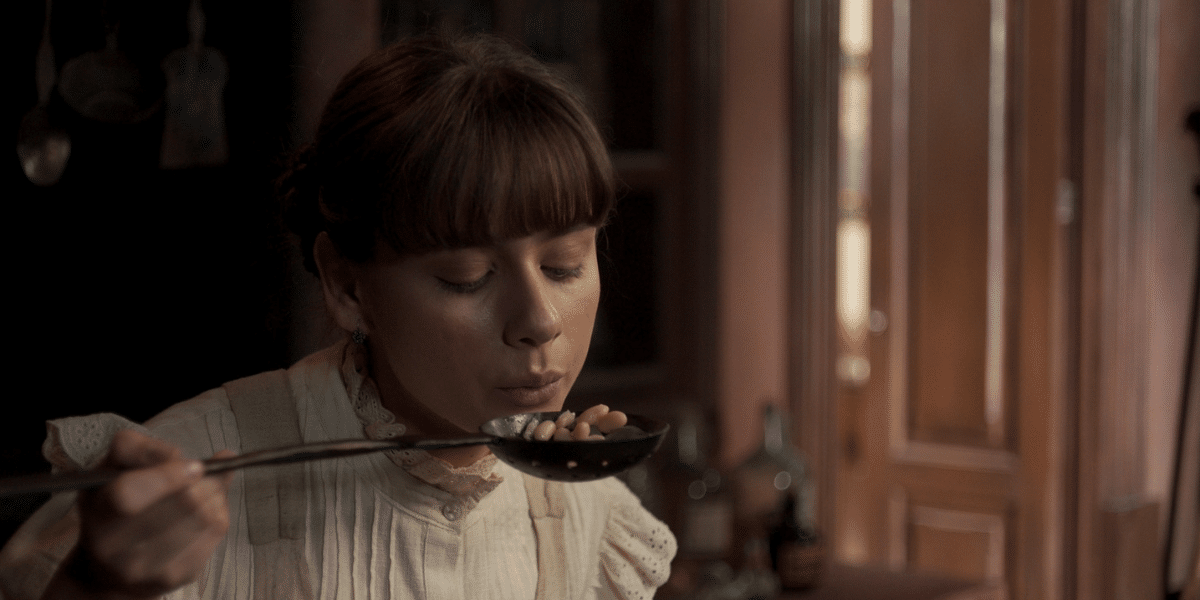
True to the novel, the series progresses with Tita preparing unforgettable local dishes that reinforce the emotional charge of the story. If the first installment captivated us with a young woman who pours her innocence and feelings into incendiary recipes, the concluding set of episodes delves into a more conscious alchemy. Tita’s kitchen is no longer just a refuge for repressed passion, but a space for much broader emotional resurgence. Como Agua Para Chocolate may be set in the past, but its commentary on human resilience and cooking as a means of expression and resistance has lost none of its relevance.
Como Agua Para Chocolate season two once again reflects on the suffocating weight of family impositions and the importance of vigorously defending personal autonomy. Beyond its slow-burning romance, the series reminds us that sometimes the most arduous journey is not the one that takes us to a new, different, or remote place, but the one that allows us to inhabit the space where we are fully at peace with who we are.
So, Should I Watch it?
Judging by the first three episodes (of a six-part series), the final chapter of Como Agua Para Chocolate remains an exhilarating spectacle, rich in detail and visually stunning.
Both installments show great reverence for the original material, taking their time to ensure that the conclusion feels deserved and satisfying. Die-hard fans of Laura Esquivel will not be disappointed with the way the plot has been reimagined, nor with the added moments of invention. It is a pleasure to see how the adaptation presents the book’s great moments, making them even more memorable.
If the first installment positioned Como Agua Para Chocolate as one of the best contemporary Latin American adaptations, this second season reinforces that legacy.
