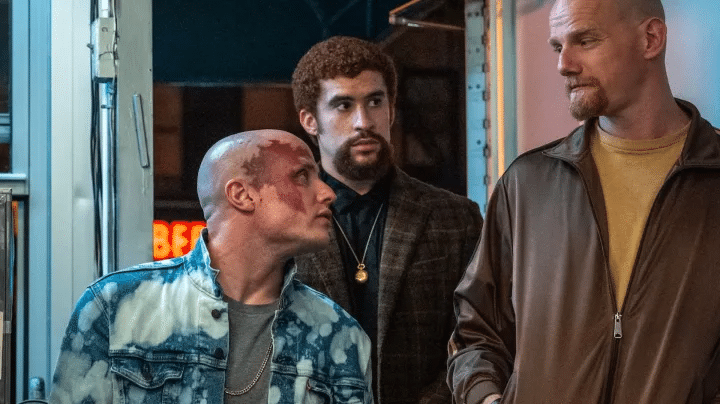
Before the world knew him as Bad Bunny, before the Grammys, before the sold-out stadiums, Benito Antonio Martínez Ocasio – El Conejo Malo – was just a kid uploading tracks to SoundCloud at ungodly hours of the night. That same kid is now on a Hollywood set, starring in Caught Stealing, a gritty thriller directed by one of the most influential film directors of our era. Colorado, a Boricua gangster, marks Bad Bunny’s first serious shot as a leading man in a film.
And here’s the question that lingers: Is Bad Bunny’s Hollywood debut a breakthrough moment for Latinx representation, or is it simply Hollywood doing what it always does – cashing in on a new “trend,” while leaving the deeper issues of race, gender, and identity untouched?
Bad Bunny’s public image has always been larger than music. From the start, he didn’t just drop songs – he disrupted expectations and Hollywood took notice. His first flirtations with film weren’t lead roles but cameos in Fast & Furious 9 and as the assassin Wolf in Bullet Train, a character built more for spectacle than depth. Then came buzz around a Marvel spin-off (El Muerto, now reportedly shelved), which signaled studios were eager to harness his fandom.
With Caught Stealing, Benito steps into something more substantial: a dramatic role in a crime thriller, far from the neon lights of reggaetón. The marketing already frames him less as a novelty and more as a serious player. But is Hollywood really opening the door for him… or just rolling out a one-time red carpet because they know his global fanbase guarantees attention?
Here’s where history matters. Hollywood has a long pattern of celebrating Latinx stars only when they’re profitable. Jennifer Lopez got her start playing Selena, but quickly found herself typecast as the romantic interest. Gael García Bernal wowed critics with Amores Perros and Y Tu Mamá También, but his Hollywood trajectory often kept him on the fringes. Even actors like Eva Longoria or John Leguizamo, beloved in their own rights, often fought uphill battles for meaningful roles.
Bad Bunny, though, arrives from a different angle. He doesn’t enter as a struggling actor hustling for recognition. He entered as a billion-stream artist – él es fino, hace trap de galería. We’re talking about a man who has changed the music industry. In other words: he’s not waiting for Hollywood to discover him. Hollywood is scrambling to catch him.
That’s the power of marketability. But does marketability equal representation? Or is it just another exception, a shiny veneer that masks the fact that most Latinx actors – especially those without Benito’s fame – still struggle to get in the room?
This is where the politics of who gets screen time get thorny. Bad Bunny is not your cookie-cutter male celebrity. He’s toyed with gender norms in his fashion and performances, he’s kissed men on live TV, he’s shown a different way to embody Latinx masculinity. That matters.
But at the same time, he benefits from being a cisgender, light-skinned, conventionally attractive man. Hollywood is more comfortable handing him a starring role than it is with Latinx women, Afro-Latinx actors, queer or nonbinary talent. Just look at the numbers: the USC Annenberg Inclusion Initiative found that in 2024, only 5% of speaking roles in top films went to Latinx characters and women, and Afro-Latinx performers were vastly underrepresented within that slice.
So yes, Benito’s rise is exciting. It’s good to catch him in Caught Stealing. But we can’t ignore that the system continues to elevate a certain kind of Latinx image while sidelining others. Is that progress or just selective inclusion?
On social media, the reaction has been a mix of euphoria and side-eye. Fans are ecstatic – me included – to see their superstar break another barrier, another “we made it” moment for the diaspora. Memes, edits, and fancams flood TikTok and Instagram the moment his Hollywood news drops.
But alongside the celebration is a cautious skepticism. Latinx audiences know the pattern: one superstar breaks through, Hollywood pats itself on the back, and systemic inequities remain. Some cheer that Benito is “opening doors,” while others wonder if this is just another room where only one kind of Latinx gets invited.
Still, the cultural weight is undeniable. For a Puerto Rican kid who once uploaded SoundCloud tracks in the middle of the night to now headline Darren Aronofsky’s newest film? That says something powerful about Latinx visibility, even if it’s complicated.
So does Bad Bunny in Caught Stealing mark a real turning point? The honest answer: it’s too soon to tell. Real progress would mean more than one superstar leading a thriller. It would mean Latinx women, Afro-Latinx, queer, and nonbinary talent getting the same shot. It would mean studios investing in Latinx stories, directors, and producers, not just Latinx faces that sell tickets.
Bad Bunny’s Hollywood ascent is historic, yes. But the bigger story is whether his presence becomes a crack in the wall or just another glossy poster on it. Maybe the real shift won’t come from Hollywood finally “allowing” more Latinx stars a seat at the table, but from Benito himself. Maybe this is the opening for him not just to act, but to produce, to shape stories, to build the kind of representation on screen that he’s already pushed forward in music. Because at the end of the day, as he already said, “La vida es una movie, soy mi propio director.”
