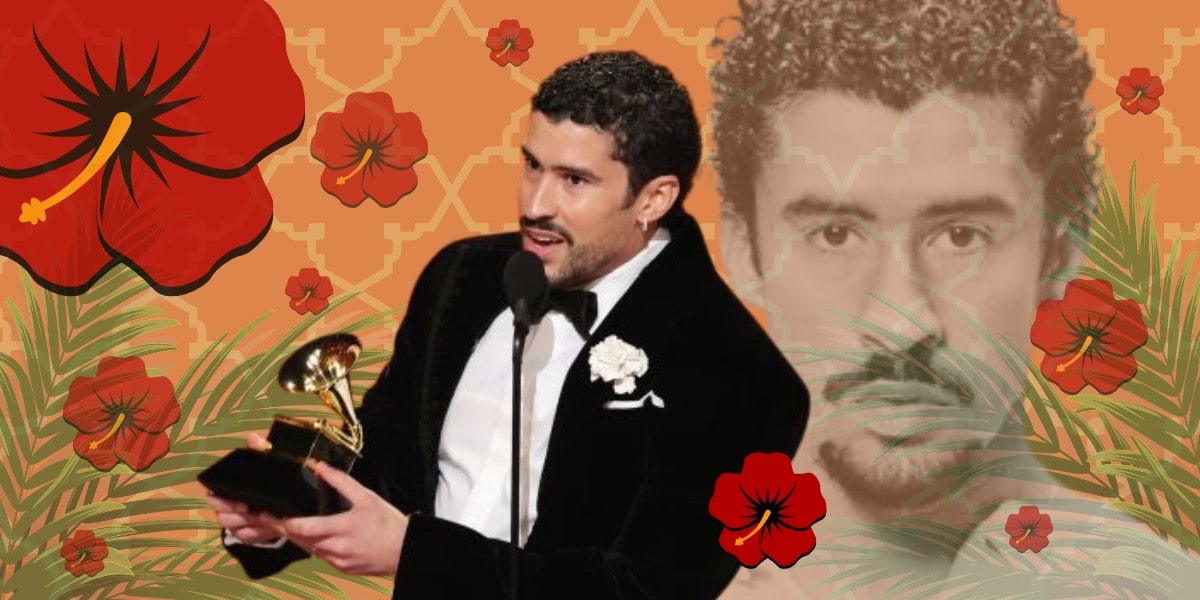
“I want to dedicate this award to all the people who had to leave their homeland, their country, to follow their dreams.” That was the only line Bad Bunny spoke in English when he accepted Album of the Year at the Grammys.
He delivered everything else in Spanish. No translation. Just Spanish, broadcast live on one of the most-watched television events of the year.
That choice was strategic.
In Spanish, Bad Bunny spoke about his roots, his gratitude, and his journey. In English, he addressed migration – a subject that feels charged, urgent, and impossible to separate from politics right now in the United States. By choosing English for that single line, he ensured the message landed exactly where it needed to land, while still centering Spanish as the language of the moment.
That’s why this victory is bigger than Bad Bunny himself. It belongs to the Spanish-speaking diaspora and to everyone affected by ICE’s reign of terror. What makes it even more striking is that he’d been here before – nominated for Un Verano Sin Ti – and he didn’t win. This year, he did. And it happened at the exact moment it was meant to.
The Grammys aren’t just a music award show. They’re television. They’re spectacle: live reactions, outrageous outfits, and moments that don’t end when the broadcast cuts to black. Millions watch live and millions more catch clipped videos on TikTok, Instagram, X, morning shows, and the news the next day.
“Music’s biggest night” is also when artists have the most eyes on them, when the spotlight is unavoidable. And this year, that spotlight came just two days after the general strike against ICE. The timing mattered. What was happening outside the venue was still fresh in people’s minds, still unresolved.
Seeing artists from different backgrounds using their moments to speak up against dehumanization is validating. It felt like unity. But for many Latinos, the attention was all on one person.
Bad Bunny standing on that stage, unabashedly speaking Spanish, disrupted how live television usually works. This time, Spanish wasn’t framed as a problem (remember “Speaking in non-English” from years before?) or a barrier to overcome. It simply existed. For Spanish-speaking viewers, that visibility is deeply emotional.
Earlier in the night, when Bad Bunny won Best Música Urbana, he did something different. He delivered that speech entirely in English. At first, it was confusing. He’s always been vocal about his Spanish-speaking roots. English is something he’s only been learning more seriously in recent years. So why’d he do that?
Because that speech wasn’t for Latinos, it was for gringos.
In that moment, he spoke about how hate only grows when it’s met with more hate, and how love is ultimately more powerful. He echoed a sentiment famously expressed by Martin Luther King Jr., “Darkness cannot drive out darkness; only light can do that.” His message was clear, and he delivered it in a language that ensured it couldn’t be ignored by the people who most needed to hear it.
For racialized people, Bad Bunny’s idea isn’t new. Historically, we’re taught to endure disrespect with grace. To be the “bigger person.” To not stoop to their level. It’s the same lesson many of us heard growing up, “No te pongas a su altura.” And it’s good for Bad Bunny to remind white folks at the Grammys that they can and should lead with love too.
That said, it’s hard not to think about the country right now as divided into two realities. In politics, in media, in daily life. One that seeks to exclude and erase, and another that continues to celebrate the contributions of the very people being targeted.
There’s something almost poetic about that contradiction. While systems are built to push certain communities out, the biggest stages are centering, applauding, and recognizing those same communities. Art is reflecting the divide and, at times, quietly pushing back against it.
Bad Bunny at this year’s Grammys sat right in that tension. But it pushed back loudly.
Progress is like that. It comes in different volumes. Sometimes it’s slow, uneven, and later than it should be.
But it still arrives.
