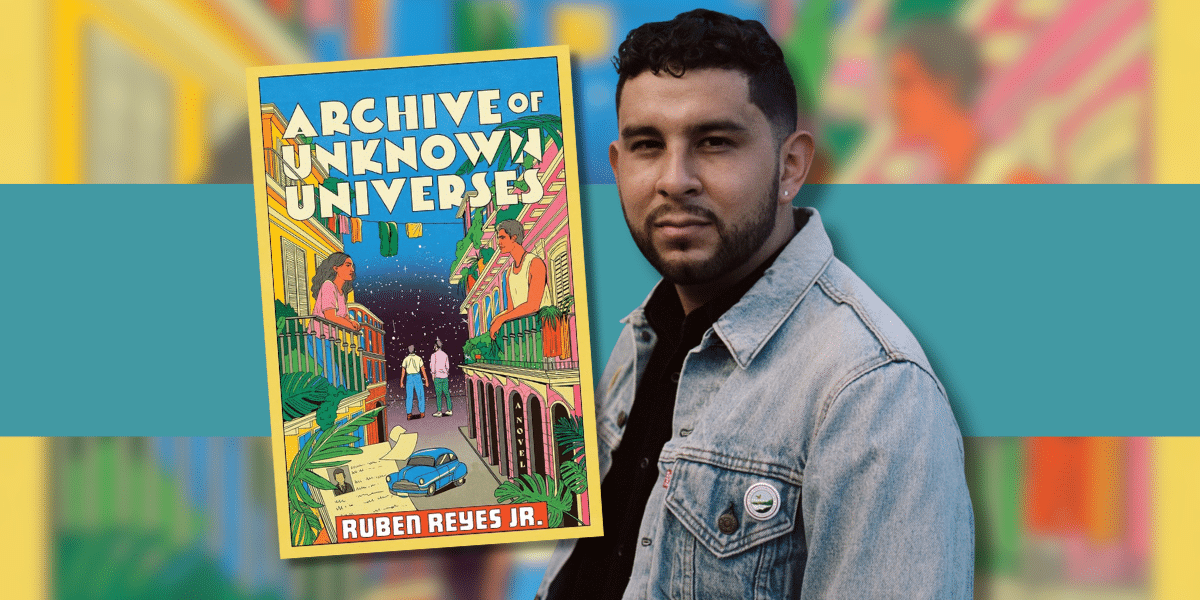
I expected the new novel, Archive of Unknown Universes, to teach me more about the Salvadoran Civil War. I didn’t expect it to be such a provocative, entertaining book – and my idea of a perfect beach read.
Most Americans know El Salvador from its notorious prison, thanks to the Trump administration deporting Venezuelan migrants there in defiance of judges’ orders. The voices of ordinary Salvadorans are missing from the news, and so many non-Salvis may not understand a lot about the country, including why current dictator Nayib Bukele is popular. In contrast, Archive of Unknown Universes invites readers to learn from the perspective of regular folks there, as it’s told through the eyes of the two local couples at different points in time, trying to figure out love.
I could call the debut novel of New York-based author Ruben Reyes Jr. historical fiction, but there are elements of speculation and science fiction too. This mix allows Reyes to tackle questions that ordinary historical fiction might struggle to address. And his background as the son of two Salvadoran immigrants who returned to El Salvador in 2018 to do his research, makes him the perfect author to bring this story to life.
I recommend Archive of Unknown Universes to anyone who enjoys a good story about the complications of interrupted love, what could have been, and the role that silence plays in the stories we tell. But whether it’s a beach read for you depends on a few factors.
Archive of Unknown Universes flips between 2018 and 1978-79, aka right before the civil war begins. In the later time period, Luis and Ana, both Harvard students and the children of Salvadoran immigrants, travel to Cuba for Ana’s research. Their relationship is tense to start, and Ana only invites her boyfriend because her protective mother does not want her to travel to Cuba alone.
The relationship between Rafael and Neto, whom we meet in 1978, has the tenderness that Ana and Luis lack. But while Ana and Luis cohabitate freely, Rafael and Neto must hide their relationship from the homophobia that permeates El Salvador. As background, know that more than 1,200 Salvadoran members of the LGBTQ community filed for asylum between 2007 and 2017.
Rafael and Neto find each other at a meeting of the People’s Revolutionary Army and maintain their relationship through letters, while Neto lives in El Salvador and Rafael works on revolution in Nicaragua.
What could have been if Rafael and Neto had found each other in another time or place? Archive of Unknown Universes asks this question directly, through a fictional technology called “The Defactor.” (This mechanism takes on the identity of various pop culture icons, which will delight anyone who listened to the radio during the 1990s and early 2000s.)
While the Defractor is only meant for research purposes, Harvard students often abuse this rule. Ana asks the Defractor to provide insight into her relationship with Luis, and she is thrown into a different reality in which she is connected to Luis through her new boyfriend.
In this alternate universe, the Salvadoran Civil War never happened. Instead, the People’s Liberation Army successfully overthrew the government in the “FMLN Revolution” (possibly a play on the FSLN Revolution that overthrew the government in Nicaragua). Details in the alternate universe lead the reader to believe that a left-wing government now rules El Salvador.
In the real world, the rebels in El Salvador failed, thanks at least in part to the military support provided by the United States. El Salvador was the largest recipient of US aid to Latin America in the 1980s, and 70 percent of this was spent on wartime materials such as weapons.
The aftermath of this conflict is rampant poverty. In El Salvador and other Central American nations, the average citizen eats less beef than a cat does in the United States, according to the book Harvest of Empire by Juan Gonzalez.
Poverty and violence have caused nearly two million Salvadorans to leave their country with most coming to the United States. Today, the U.S. has almost 2.5 million residents of Salvadoran ancestry, making them third among Latines, only to Mexicans and Puerto Ricans.
Reyes uses the families of Ana and Luis to show the impact of poverty and violence on ordinary Salvadorans. Luis’s mother, Elena can’t travel to Cuba freely like her son, the inference being that her legal status is shaky at best. We also learn how the overprotective nature of Ana’s mother, Felicia, might stem from her own traumatic experiences.
The novel resolves the stories of Ana, Luis, Neto, and Ernesto, but leaves the reader with unanswered questions. Any honest book that touches on trauma and displacement would do the same.
I could imagine myself sitting on a beach, pondering those questions while watching the waves ebb and flow. But someone with family roots in El Salvador or a survivor of the civil war themselves might not find reading this book relaxing. Regardless of the emotions this book produces, Reyes has made a worthwhile contribution to the literature of displacement.
