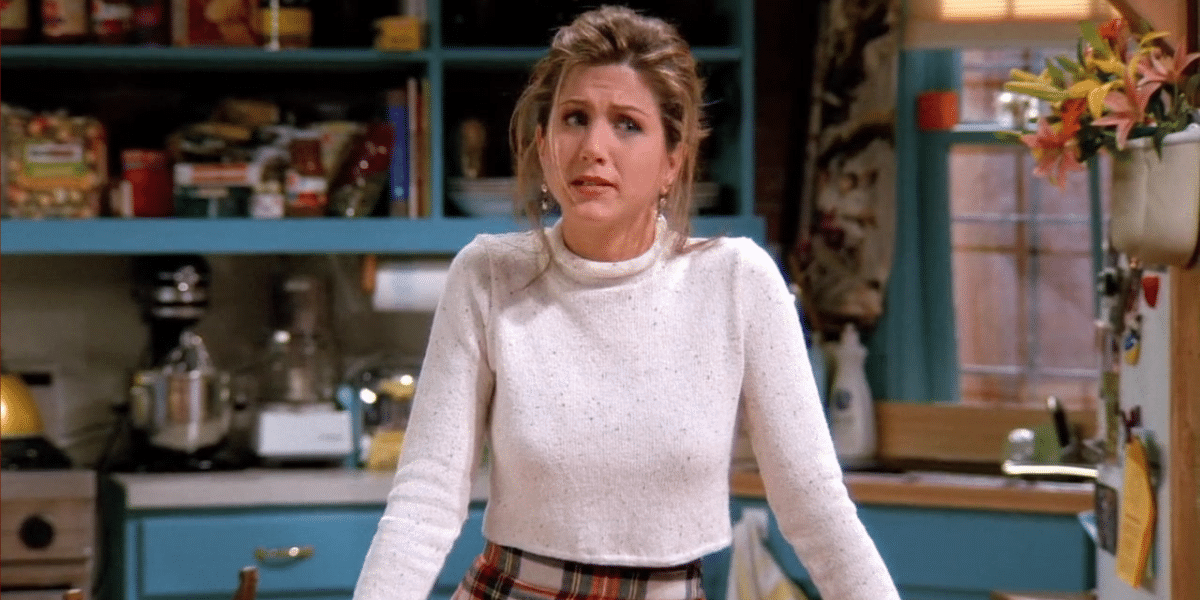
The other day, I finished Friends again. I’ve watched the show more times than I can count, but somehow, watching the finale this time – when there’s so much discourse around the tradwife movement – made me look at Rachel Green differently.
When we first meet her, she’s running away from a life that was planned for her. She walks into Central Perk in a wedding dress after deciding not to marry the man she is supposed to. She’s spent her entire life preparing to become someone’s wife, and in the pilot, she decides for the first time, she wants to figure out who she is without that role.
Over the course of ten seasons, we watch her do exactly that.
She starts out spoiled and dependent on her family. Then she gets a job as a waitress, begins working in fashion, moves into increasingly important positions, and eventually builds a career in an industry she genuinely loves. We see her become financially independent, develop professional confidence, and figure out what she actually wants from her life.
At one point, she talks excitedly about the possibility of going to Paris for Fashion Week. Eventually, that opportunity becomes much bigger: Louis Vuitton offers her a job in Paris, marking the culmination of the career she has spent years building.
And then she turns it down.
She gives it up to stay in New York with Ross and their daughter.
There are, of course, plenty of reasons why the writers might have ended the story this way. The audience wanted Rachel and Ross together. They had spent ten seasons building that relationship. Rachel was also a mother by this point, and choosing to stay close to her daughter’s father is hardly an unreasonable decision.
But what struck me this time was how familiar the structure felt.
A woman spends years building a fulfilling path for herself, and then, when the story reaches its emotional conclusion, she gives up her independence.
We’re supposed to see Rachel’s decision as a happy ending. But why does “the happy ending” for so many ambitious female characters involve giving something up?
Rachel Green is hardly the only woman whose story follows some version of this tradwife pattern. Television has spent decades giving women dreams, careers, creative ambitions, and identities of their own, only to gradually make those things secondary once marriage, pregnancy, or motherhood enters the picture.
But the more I thought about it, the more I realized that this pattern doesn’t look the same for every woman. Race and culture shape what women are expected to prioritize, what they are expected to sacrifice, and even what kind of sacrifice is considered virtuous.
For white women like Rachel, the narrative is often about discovering that you don’t need to become a wife in order to become an adult. Rachel’s journey begins with rejecting the life her family chose for her. Her independence is almost the point of the story.
For many women of color, especially Latina women, the relationship between womanhood and family can be much more complicated. Family is just one possible part of your identity – it’s the foundation. Being a good daughter, partner, wife, or mother means putting the family before yourself. You stay. You forgive. You sacrifice. You make things work. And that expectation can be so deeply normalized that it looks like a virtue.
Jane the Virgin offers a telling, cross-generation example. Jane grows up in a family where motherhood, family loyalty, and tradition are deeply intertwined with womanhood. Her grandmother, Alba follows and teaches that traditional (remember the crumbled flower scene?) while her mother, Xiomara, navigates motherhood alongside the dreams she put aside, including her ambitions as a singer. Jane inherits this devotion to her family while trying to build a life of her own as a writer.
What makes the show particularly interesting is that it doesn’t ultimately ask Jane to choose between the two. Her story is about trying to have both: to be deeply connected to her family as part of building her own identity.
The same tension appears differently for Black women. In This Is Us, Beth Pearson was a dancer with dreams of making it her career, but after her father’s death, she became the person her family needed her to be. Her story is not simply about a woman who “gave up” her dreams for motherhood. It is about how easily Black women – who are expected to be strong, responsible, and dependable – can become the people everyone else relies on while their own desires become negotiable.
That distinction matters. The expectation that women should sacrifice themselves for their families does not look identical across cultures. And questioning that expectation feels particularly relevant now, as we watch the growing popularity of the “tradwife” movement and a broader cultural nostalgia for more conservative ideas about gender and family.
To investigate, I started reading Yesteryear. The book satirizes a world that feels increasingly familiar: women influencers presenting an idealized version of traditional womanhood – cooking, cleaning, staying home, raising children, being devoted wives – while having resources that make their lifestyle look very different from what most women would experience.
The aesthetic is beautiful. The house is spotless. The children are dressed perfectly. Dinner is homemade. The husband comes home. Everything looks calm, intentional, almost nostalgic.
But what we don’t always see is the childcare, the domestic help, the financial security, or the business behind the content. Many of these women are not rejecting modern independence so much as turning an aesthetic version of domesticity into a career.
There is a contradiction here: many of the women who publicly advocate for a return to traditional gender roles are able to do so because women before them fought to create the freedom to choose differently. They can have businesses. They can make money from their homes. They can own property. They can access higher education. They can build massive online platforms. They can decide that they want to leave the workforce. They can publicly argue that women should return to the home.
All of those things require something that women in previous generations were not necessarily guaranteed: choice.
Rachel’s story begins with a question: What happens if I don’t want the life that has been chosen for me?
Her answer, over ten seasons, is that she can build something else. She can work. She can fail. She can discover a passion. She can become good at something. She can become a mother without completely disappearing into motherhood.
And then the finale gives us another question: What happens when the life you’ve built for yourself conflicts with the life you could have with someone you love?
Rachel chooses Ross.
Maybe that’s what she genuinely wanted. Maybe choosing to stay was the right decision for her. The problem isn’t that Rachel Green chooses her family and goes the tradwife route. The problem is that, in the stories we tell about women, choosing family over ambition is so often presented as the ultimate proof that she has finally found what matters.
That’s what the tradwives are arguing. But let’s be clear – they’re just throwing money at an old set of expectations, giving them better lighting, and calling it freedom. Their narrative is false, whether it’s on Instagram or Friends. Rachel Green deserves a real happy ending, outside of the tradwife frame. And so do we.
