If you look up the center of the Brazilian city of Goiânia on Google Maps today, you will see that 57th Street bears a grim reminder in its name: “Cesium 137.” This denomination marks the place where, on September 13, 1987, Brazil’s Emergencia Radioativa occurred.
With an intensity of level 5 on a scale where only Chornobyl and Fukushima have reached a 7, this tragic incident began to take shape two years earlier, when the Goiano Institute of Radiology closed, abandoning the building in legal limbo. In this bureaucratic vacuum, two young scavengers entered the ruins, removed a medical radiology device, and sold the parts to a local scrap dealer. Unbeknownst to them, they had in their hands the same component that, a year earlier, had contaminated Europe after the Chornobyl disaster. With it, the plunderers turned their families and loved ones into the first victims of a serious contamination that would take two weeks to be detected.
More than thirty-five years later, this story comes to the screen with Emergencia Radioativa (Radioactive Emergency), a new Netflix miniseries created by Gustavo Lipsztein and directed by Fernando Coimbra. Over the course of its five episodes, the production explores a crisis that few outside Brazil have heard of, but which marked a turning point in global radiation safety. The incident left persistant wound that continues to teach us harsh lessons.
What Is Emergencia Radioativa About?
Emergencia Radioativa recreates the 1987 Cesium-137 accident with surgical precision, revealing how a small crime paralyzed a capital and jeopardized the safety of an entire country. Above all, this miniseries captures the social, cultural, medical, and political challenges Brazil had to face to overcome the tragedy.
At the heart of this story is Antônia (played with overwhelming force by Ana Costa), the wife of the scrap dealer who acquired the capsule. Suspecting that the “blue glow” is causing her family’s strange ailments, she decides to take the remains of the artifact to the city’s Health Control. Through Antônia, the series pays tribute to Maria Gabriela Ferreira, the accidental heroine of Goiânia, whose courage not only exposed the contamination’s source but also prevented an incalculable disaster.
After she comes forward, we follow proactive nuclear physicist Márcio (Johnny Massaro) as he leads a crucial “contact tracing” effort to locate the affected areas and contain the radiation before it becomes irreversible. But after two weeks of silent contamination, the danger no longer lies solely in the capsule – it has permeated everyday life in the city. Scientifically, the danger in Goiânia multiplied because the material was a powder similar to common salt, sticking to skin and clothing, and making an invisible and massive threat.
Throughout its run, Emergencia Radioativa never loses sight of the human drama and heroism of the doctors, physicists, and emergency teams who, with minimal resources, risked everything for their community. It certainly illustrates the urgency of building solid bridges between cutting-edge science and everyday life. In this case, the truth is as simple as it is heartbreaking: basic knowledge about the radiological hazard symbol could have prevented the whole crisis.
While Chornobyl was a tragedy of engineering and state bureaucracy, Goiânia was one of poverty, misinformation, and institutional neglect. In the first case, protocols failed within a control room. In the second, protocols did not even exist for those who survived by scavenging for their livelihood.
Beyond historical reconstruction, the miniseries serves as a clear warning about radiation safety, emphasizing that it does not end when a switch is turned off or equipment is discarded. By delving into the risk of “orphan equipment,” the Brazilian production teaches us that these forgotten objects are time bombs that require strict maintenance. Without getting bogged down in technicalities, there is one key fact we must keep in mind: with a half-life of 30 years, Cesium-137 can turn a simple oversight into an irreparable disaster.
In the final episode, the Director of the National Nuclear Energy Commission (played by Paulo Gorgulho) sums up the moral essence of the tragedy before the court: “The Cesium leak occurred because everyone involved in handling the equipment failed in their responsibilities. Some out of convenience and others by mistake, like me.” And with this statement, Emergencia Radioativa leaves a strong testimony that, in an interconnected society, safety inevitably depends on shared knowledge and everyone’s ability to act on it. Government and institutions must ensure that technological progress does not advance faster than safety protocols and education.
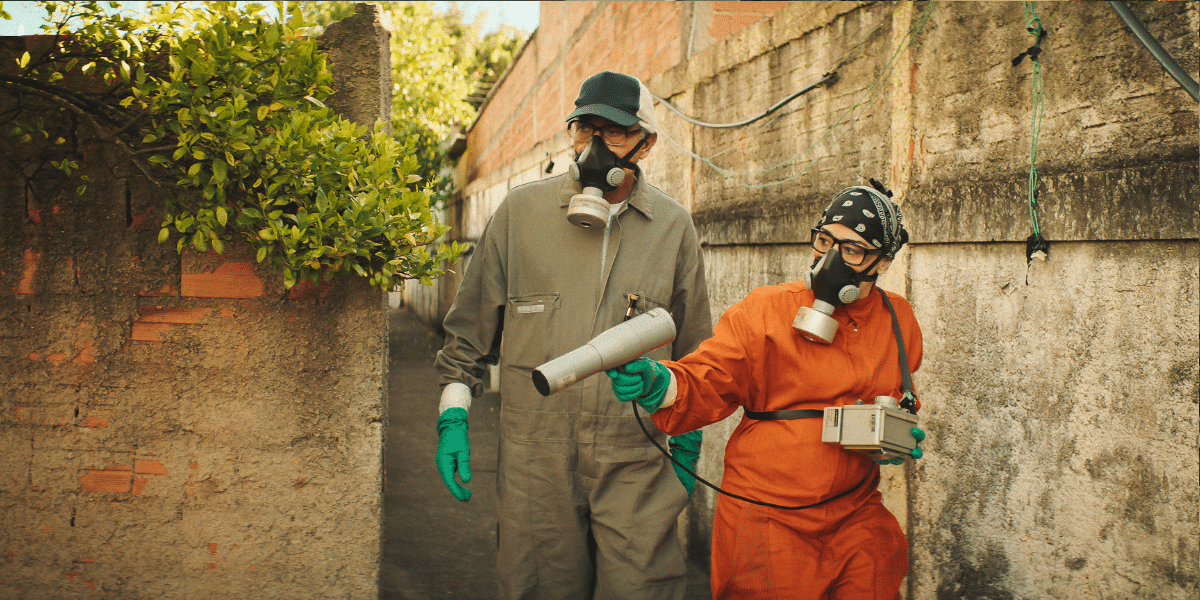
It is also of note that Emergencia Radioativa’s recreation of 1980s Goiânia is breathtakingly accurate. From the ruins of the old Radiotherapy Institute to the cordoned-off area on 57th Street to an Olympic Stadium transformed into a mass quarantine zone, the series embraces a powerful realism that pulls us out of the comfort of our sofas and transports us to the epicenter of the crisis. This obsession with detail etches scenes into our minds and makes us suspect that danger is closer than we want to accept.
So, Should I Watch It?
Watching Emergencia Radioativa may be a somewhat painful experience, but it is a necessary pain. As shocking as it is instructive, this Brazilian production is worth every second. It is not a simple exercise in historical memory, but a tribute to the resilience of Goiânia – to its victims, doctors and rescuers, and those survivors who continue to deal with the stigma of contamination today.
Watching it hurts, yes, but as Emergencia Radioativa teaches, empathy and knowledge can make all the difference.
