Long before anyone called it P FKN R, resistance has lived in Puerto Ricans. We’ve been rebelling since the Taíno stood against the Spanish invasion more than 500 years ago.
The Puerto Rican flag itself, a blue triangle surrounded by red and white stripes, has been a symbol of resistance since the 19th century. Its presence threatened colonial officials so much that the U.S. government banned its display for more than a decade.
Most Americans might not know this long history, but they’ve likely heard of the latest face of Puerto Rican resistance, reggaeton artist Bad Bunny.
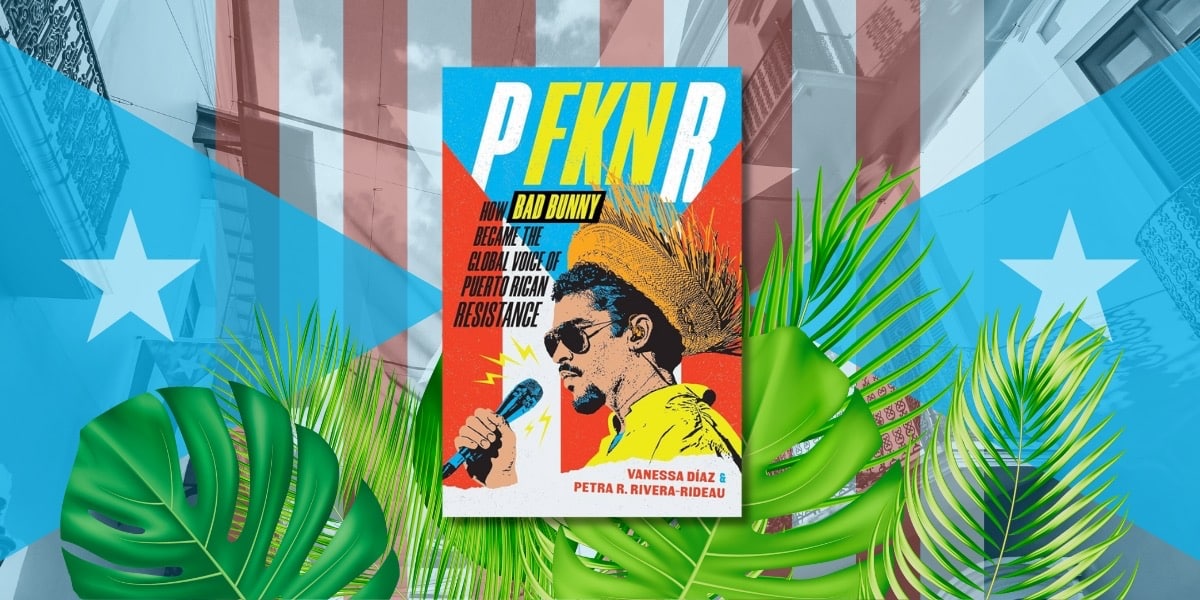
Professors Vanessa Díaz and Petra R. Rivera-Rideau have recently released a new book, P FKN R: How Bad Bunny Became the Voice of a Global Movement. In it, they combine interviews with key figures in Bad Bunny’s life with analysis of how his music and image help give agency to Puerto Ricans, those whose homeland has been a colony of the United States since the 1898 Spanish-American War.
This is the rare academic book you can read without a highlighter. Díaz and Rivera-Rideau created the Bad Bunny Syllabus, an online repository of resources to help professors teach about Bad Bunny. Díaz is an associate professor at Loyola Marymount University, while Rivera-Rideau teaches at Wellesley College.
Their work shows how Bad Bunny honors Puerto Rican heroes like Pedro Albizu Campos and Lolita Lebrón. My history teachers never talked about these figures, and there’s a chance that I wouldn’t have heard about them even if I’d grown up in Puerto Rico.
At least not until Bad Bunny started lifting them up as he did in his seven-minute introductory video to his 2022 tour for El Ultimo Tour Del Mundo. That choice gives me hope that the next generation of Puerto Ricans, whether they grow up on the island or the mainland, will know our history.
P FKN R: How Bad Bunny Became the Voice of a Global Movement doesn’t just feature Diaz and Rivera-Rideau’s scholarship. It also draws upon numerous interviews with collaborators like Marcus Borreo (MAG) and Tainy. The book even references a sit-down interview that Rivera-Rideau conducted with Bad Bunny at Harvard University in 2019.
During that trip, Rivera-Rideau recounts how the police escort tells her that he is thrilled to be escorting a reggaeton star as opposed to the more traditional government officials that Harvard hosts. The moment subtly reveals how institutional spaces often fail to reflect the cultural identities of the people who work within them.
The interview delves into topics like Bad Bunny’s manipulation of gender norms and accusations of misogyny in the lyrics. Rivera-Rideau contextualizes the critiques, arguing that the lyrics reflect society as a whole rather than Bad Bunny’s individual views. Bad Bunny himself has said he is learning from the criticism.
The authors also show Bad Bunny uses his music videos to challenge stereotypes, while at the same time acknowledging his shortcomings. For example, they discuss Bad Bunny’s remarks about colorism within the music industry that were widely panned.
They also cover the video for “La Dificil,” which on the surface is a story of a misogynistic rapper, played by Bad Bunny, who consistently makes inappropriate passes at women. But his behavior is used as a foil for the main character, a woman doing sex work to financially support her daughter. It’s not a glorification of sex work, the authors argue, but a criticism of a society that forces women to sell their bodies for survival.
Bad Bunny has also used his videos to educate about social issues such as widespread gentrification in Puerto Rico. His most political song on the album Un Verano Sin Ti is “El Apagón” (The Blackout). To analyze, the book authors interviewed music video director Kacho López Mari, who sketches out how the video travels from a neighborhood undergoing gentrification to a party at the beach.
Bad Bunny and Mari also used investigative reporting to create a 22-minute film that combines the traditional music video format with documentary elements, to further expose gentrification in Puerto Rico. In it, Bianca Graulau, an independent journalist based in Puerto Rico, interviews displaced residents, showing how US policies prioritize profit over keeping the island unaffordable for ordinary Puerto Ricans.
Even though my family has been on the mainland since the late 1940s, at least in part because of these same policies, it’s important for me to know this history. This book gave me something deeper than a dive into Bad Bunny’s image. It made me proud to be Puerto Rican and deepened my desire to continue to learn the history of my island and culture.
Consider this education part of my resistance against the dominant narratives all around us. It’s the least I can do to make my Puerto Rican ancestors proud.
