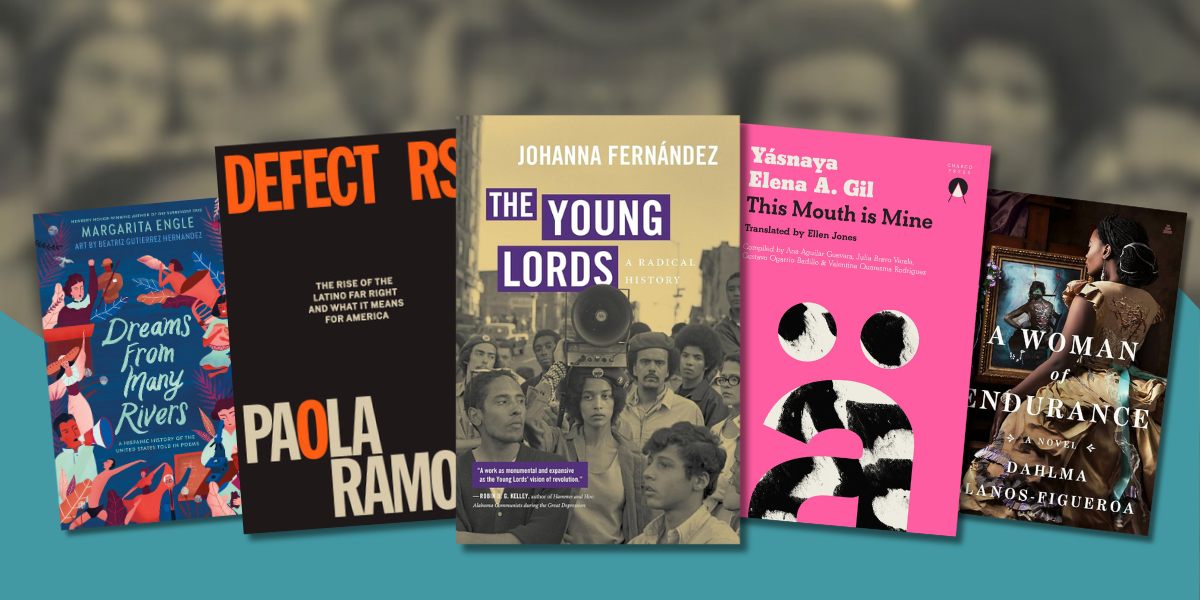
I meet so many Latine adults who don’t know our history (thanks colonialism). I’m talking the story of how we became a multiracial group, how European colonialism could not dampen our rich Indigenous and African cultures, and how we have been racialized and persecuted in the United States. Our schools generally don’t teach us these things, so we have to go out and figure it out for ourselves. As a booklover, I’ve found a lot of answers by reading. So let me share with you eight books that dive into the story of Latinidad – and give us roadmaps for moving forward.
Dreams from Many Rivers: A Hispanic History of the United States Told in Poems by Margarita Engle (2019)
This collection of prose poems for young adults should be read by people of all ages. Maragarita Engle starts our history where it should begin – in Puerto Rico, the first place on United States soil to be colonized. The poems even start from the perspective of the Indigenous Taino, before we get into what the conquistadores were thinking.
Dreams from Many Rivers hits the right balance between telling the stories of Latines who have been on American soil for hundreds of years while also celebrating immigrants who came here in the last century. It also takes us through historical events such as the United States’ acquisition of Mexico in 1848, Latines experiencing discrimination, and our shared fight for civil rights.
Harvest of Empire: The Untold Story of Latinos in America by Juan González (2011, updated in 2022)
Harvest of Empire was the book that made me understand why I didn’t grow up learning my history – Puerto Rico is a colony, after all. Instead of learning about island revolutionaries Pedro Albizu Campos, Lola Rodriguez de Tio, and Lolita Lebron, we studied the American presidents. Thanks, Juan González, for correcting my personal blind spots!
González skillfully connects Latin American history to why people from the region migrate to the United States, showing how the actions of the US government help create the conditions where people must flee their homelands. His book makes the argument that you cannot tell the story of Latines in the States without understanding the past. And don’t worry – you will find a brief overview of the history of your people, no matter where they come from.
The Afro Latin@ Reader: History and Culture in the United States Edited by Miriam Jiménez Román and Juan Flores (2010)
I was already well into my history teaching career when I learned that many of the first Spanish speakers in the United States were from Africa. So any history of Spanish speakers here must include Black perspectives. It’s important to understand that the majority of people who came over on Spanish ships were African – European migration to Latin America did not increase until the 19th century.
The Afro Latin@ Reader features essays on activism, the Afro-Indigenous Garifuna community, and Afro-Latine contributions to salsa and hip hop. Jesus Colon writes about the tension of wanting to help a white woman down the stairs at a railroad station after midnight, but being concerned that she might feel threatened. And Tanya Katerí Hernandez details the consequences of not understanding racial dynamics within the Latine community.
One term you will not find in the index? Slavery. In addressing early history, the book focuses on the many free Africans who made the journey to the Americas.
A Woman of Endurance by Dahlma Llanos-Figueroa (2022)
Certainly, those of us who are white or mestizo should grapple with the fact that most of the African people trafficked to the Americas went to modern-day Latine countries. Afro-Puerto Rican author Dahlma Llanos-Figueroa has given us a book that details the horror of slavery while showing the power of community in A Woman of Endurance.
Llanos-Figueroa bases her work on stories that she heard while growing up with her grandparents in Puerto Rico. This novel tells the story of Pola, an enslaved woman who’s forced to breed other enslaved people. The brutality and hope present in stories of enslavement are not always captured by primary sources, making fiction a powerful window into the often-unheard voices of enslaved people.
This Mouth is Mine by Yásnaya Elena A. Gil (2024)
Many people of Indigenous descent do not consider themselves Latine, but their blood still flows through our veins. Elena A Gil, a Mixe scholar from Oaxaca, Mexico, invites us to consider the consequences of not knowing our Indigenous language and traditions. In This Mouth is Mine, her essays, translated from Spanish, invite us to consider who is left out in building a cohesive nation-state.
In the Time of the Butterflies by Julia Alvarez (1994)
In real life, Julia Alvarez fled the Dominican Republic with her family after her father participated in a failed plot to overthrow dictator Rafael Trujillo in 1960. In the Time of the Butterflies is the story of the Mirabal sisters, Dominican revolutionaries who fought for liberation from Trujillo the same year and were executed for their efforts. The public outcry after their death helped contribute to Trujillo’s assassination one year later.
We would be wise to remember that before Trujillo was assassinated by weapons provided by our CIA, the United States supported his brutal administration. In her book, Alvarez brilliantly portrays the trauma of Trujillo’s victims.
Defectors by Paola Ramos (2024)
Defectors is not explicitly a book on history, but Paola Ramos ties historical figures like Simon Bolívar, considered the George Washington of Latin America, to right-wing Latines in the United States. This reading is essential to understand why Latines voted for Trump in increasing numbers last year.
The Young Lords: A Radical History by Johanna Fernandez (2019)
Johanna Fernandez wrote one of the most readable history books and it’s all fundamental to understanding Latinidad, the Boricua variety. The Young Lords, a Puerto Rican activist group in New York City active in the late 1960s and early 1970s, had a short time together but an outsized impact on our city. This group of men and women took over a local church and shut down a hospital, resulting in practical improvements for our community. Free breakfasts for children, street-cleaning programs, and better hospital conditions make all of our lives better, and Fernandez shows us where our gratitude should go.
