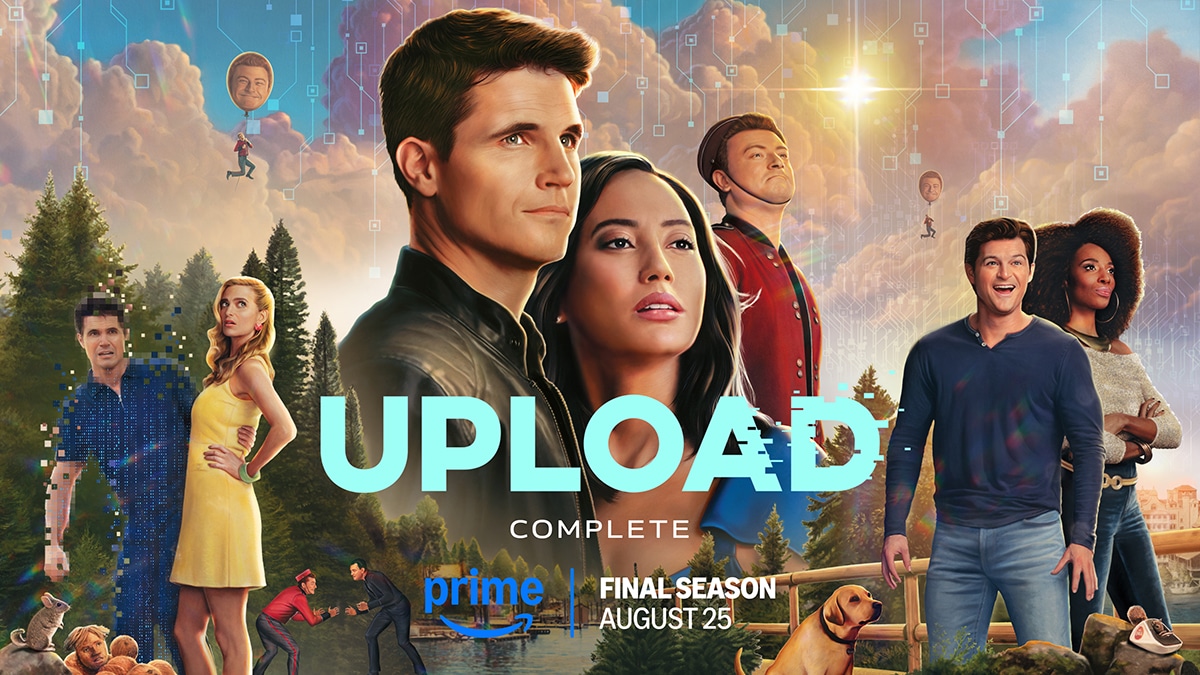
When I first saw Upload in 2020, no one imagined how quickly technology would advance to catch up with its premise. Today, as its fourth and final season premieres, artificial intelligence is already part of our daily lives and beginning to push boundaries, bringing us closer to a future in which death may not be the end, but merely another interface.
Greg Daniels – screenwriter behind Saturday Night Live, The Office, The Simpsons, Parks and Recreation, and King of the Hill – conceived the disturbing and ingenious premise of Upload: in the near future (2033), humans can upload their consciousness to a luxurious digital afterlife. That’s where we meet Nathan (Robbie Amell), a young programmer who, after dying in a car accident, wakes up in Lakeview, a virtual “heaven” where he discovers that being dead doesn’t mean he’s free of problems.
The series satirizes the most absurd and perverse aspects of technology: AI assistants with different bodies to serve your every need and “data plans” that determine whether the deceased will live out their eternity as a millionaire or a digital outcast, depending on what their relatives are willing (or able) to pay.
What seemed like science fiction or outright impossible just a few years ago is already beginning to materialize. In 2025, there are companies offering to create a “digital version” of a deceased loved one, uploading their voice, memories, and personality to an artificial intelligence cloud so the living can continue to talk to them.
The idea is controversial: it is not the real person, there are security risks of manipulation or hacking, and some experts warn that it could prolong grief rather than alleviate it. In the study “Generative Ghosts: Anticipating Benefits and Risks of AI Afterlives” (2025), by Meredith Ringel Morris (DeepMind) and Jed R. Brubaker (University of Colorado Boulder) analyze how AI is starting to blur the line between the living and the dead through “generative ghosts,” which are basically conversational avatars that can replicate, and even evolve, the personality of someone who has passed away. This reality is really similar to what Upload images.
In other words, the technological promises of Upload are no longer scientific hypotheses (at least not in essence). In 2025, companies such as Re;memory and HereAfter AI offer services to build an interactive digital clone after an interview during someone’s lifetime that allows family members to continue talking to them after their death. Other projects, such as Fredbot and Roman, demonstrate that it is possible to revive the voice, linguistic gestures, and even the way of thinking of a loved one from letters or text messages.
But to what degree does this technology accompany grief… or make it endless? That is the big question that Upload addresses for the last time in its fourth season. Nora (Andy Allo) and Ingrid (Allegra Edwards) have been caught between the original Nathan and his digital copy, stretching the grieving process beyond natural limits. Now, Nora faces a complicated depression: she barely leaves the house and spends her days with a virtual reality headset, clinging to the simulation of a boyfriend who no longer sounds like him, because he lacks his memories, his character, and his consciousness. He is just an interactive shell, closer to a video game character than to the person she lost.
Meanwhile, Ingrid, unable to accept Nathan’s death in the real world, clings to the illusion of control and organizes a virtual wedding and honeymoon in which she cannot even manage to be truly present. She spends hours locked in her bathroom, dressed in a virtual reality suit, trying to keep alive a relationship with Nathan’s digital copy, even though the bond exists within a server.
Beyond criticizing how the technology industry could monetize mourning, Upload’s fourth season issues a sharp warning about the dangers of AI – and the humans who control it. In the Prime show, while a hostile AI devours the rest of the system’s intelligences with the approval of its human superiors, the world of Lakeview is on the brink of collapse. But far from trying to fix it, executives rush to point out what is most important to them: these are not real people, they are already dead and so are second-class citizens.
From episode 1 to 29, Upload is clear in how it criticizes tech capitalists: these corporations only think about money. Under the guise of progress, of making all personal experiences fit in the palm of our hands, these technologies do not free us but rather push us toward an existence increasingly controlled by external interests and detached from what is authentically human. In this universe, which is becoming less and less fictional, tech is encroaching on the sacred territory of death. They’re turning the end of life into a postmortem resort with dynamic pricing.
