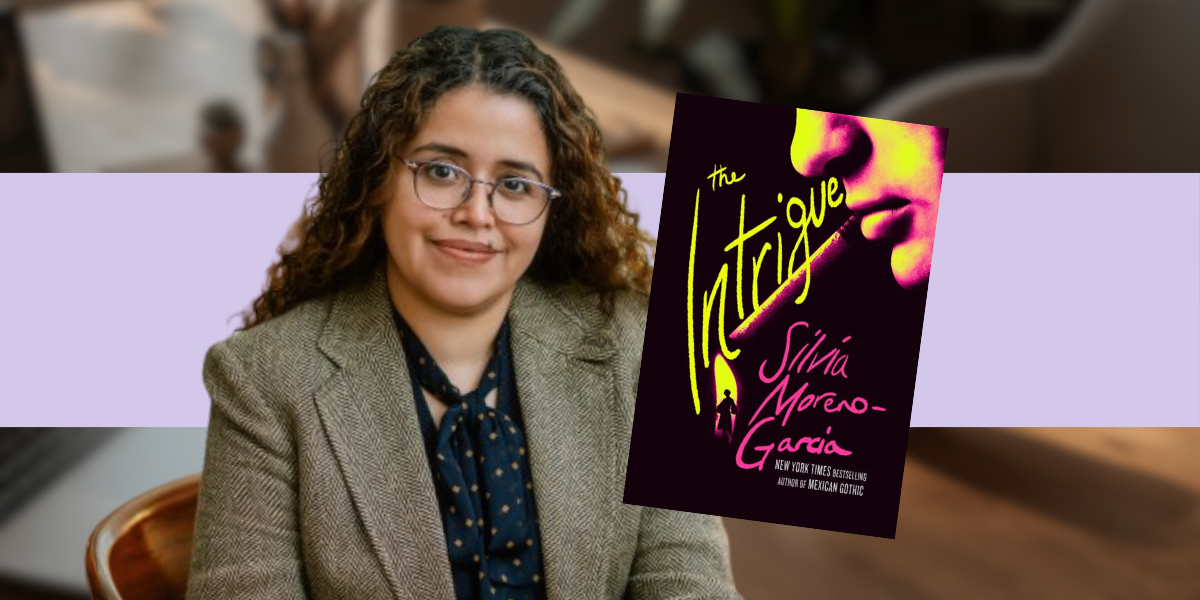
Silvia Moreno-García, the acclaimed Mexican-Canadian author behind hits such as Mexican Gothic and Velvet Was the Night, returns with her latest work: The Intrigue (La Intriga), published by Del Rey. Unlike her previous works, this time the author sets aside supernatural elements and unexplained phenomena to focus strictly on human psychology and social realism.
The Intrigue boldly blends the crime novel, the Mexican “costumbrista” novel, and the con artist drama. The narrative builds around an homme fatale who, driven by financial desperation, plots a calculated romantic scam. However, what begins as a common grift soon transforms into a highly dangerous affair powered by family secrets, hidden motives, and blackmail. Beyond surface greed or the fraud’s intricacies, the novel focuses on how much a cornered individual will sacrifice to ensure their survival in a fractured system.
With its gripping suspense and unhurried pace, the book lays bare the conservative Mexico of the middle of the last century, revealing its provincial contradictions and the complex nuances of human morality. Both new readers and her loyal fans will discover that, in Moreno-García’s writing, contemporary suspense works as a powerful vehicle.
What Is La Intriga About?
The Intrigue follows three characters whose lives intertwine in a labyrinth of deceit and betrayal: Ulises Linares, Inés Inclán, and Perla Hildegarda Inclán. In her twelfth novel, Moreno-García brilliantly paints 1940s Mexico, shifting between the chaotic bustle of the Mexican capital and Veracruz’s misty, mountainous atmosphere.
At the center of it all is Ulises, a con artist suffocating under debt who makes a living through romantic scams. His method involves placing newspaper ads for “lonely hearts” in an effort to empty vulnerable women’s bank accounts. Far from being a ruthless villain, he is a fading trickster, running out of both youth and money.
His luck seems to change when he sets his sights on Perla, the austere and stern owner of a guesthouse in the sleepy, fictional town of Puerco Ahogado. Although Ulises believes her to be a docile, gullible old maid, he soon discovers her chronic distrust and extreme stinginess. Shaped by the losses and hardships of the revolutionary struggle, Perla is willing to do anything to protect her legacy, and she won’t make it easy for him.
Things get even more complicated for Ulises when Inés, Perla’s niece, discovers the plot. Curiously, far from turning him in, the young woman demands half the loot in exchange for her silence. Born of an extramarital affair and trapped in her aunt’s abusive household, she sees Ulises’s plan as her ticket out of a terrible family cage. Or as she puts it, “She’s kept me a prisoner, and I can’t be faulted if I’m trying to tunnel my way out of that house.” From this unexpected blackmail onward, a scam that seemed simple turns into a dangerous game of ambition where who’s the victim and who’s the perpetrator gets completely blurred.
Historical Scars and the “Claroscuros” of Human Morality
The Intrigue is not merely a story of scams, but a profound examination of survival in a Mexico suffocating in puritanism and the echoes of war. Moreno-García brings to light the country’s collective wounds – the scars of the 1910 Revolution, economic instability, social restrictions, and gender inequalities – and turns them into the driving force that pushes his characters toward crime and transgression.
The author’s work takes on a deeper dimension by blending the conventions of crime fiction with the Mexican costumbrista novel – a genre that examines the sociocultural pressures and collective habits of a specific time and place. While the crime genre serves to orchestrate the plot’s dangerous game, the costumbrista approach reveals how extreme conservatism oppressed many, taking a particularly harsh toll on women. Throughout the novel, the Inclán household functions as a microcosm of that radical puritanism – an environment that demands submission, marriage, or sacrifice, crushing any vestige of female independence.
Ultimately, The Intrigue invites us to reflect on ethical relativity, the light and dark sides of human nature, and the cost of individual freedom in a society that suffocates the marginalized. The warning is clear: when one’s environment and family expectations eliminate a dignified future, breaking the rules becomes the only path to survival. This shift is brilliantly exemplified in Inés’s transformation, as she goes from suffering the worst forms of domestic abuse to completely extorting her own family.
The novel’s greatest strength is its ability to transcend the classic crime story to analyze how context can shape ethics.
Masterful Characterization in The Intrigue
This novel masterfully constructs its characters: complex, three-dimensional beings, devoid of classic heroism or caricatured villainy. Through the central triangle, Moreno-García constructs a fascinating portrait of distinctly gray identities, in which power constantly shifts and the real danger stems from structural oppression itself.
Furthermore, Moreno-García’s every detail – from the aftermath of the Revolution and the backdrop of World War II to family traditions, domestic details, and punitive behaviors in Veracruz – lend the narrative remarkable authenticity. Far from using the historical context as mere window dressing, the author meticulously captures everyday life and the monotony of small-town existence so the reader experiences the same urgency to escape as the protagonists.
Should I Read The Intrigue?
Attention fans of noir and Mexican costumbrista novels: you have an unmissable event coming up. If you’re looking for your next literary obsession, The Intrigue is the book for you. With a flawlessly developed plot and historical setting, this novel is a fascinating look into what happens when extreme conservatism, family crises, forbidden desires, and a looming murder all collide.
