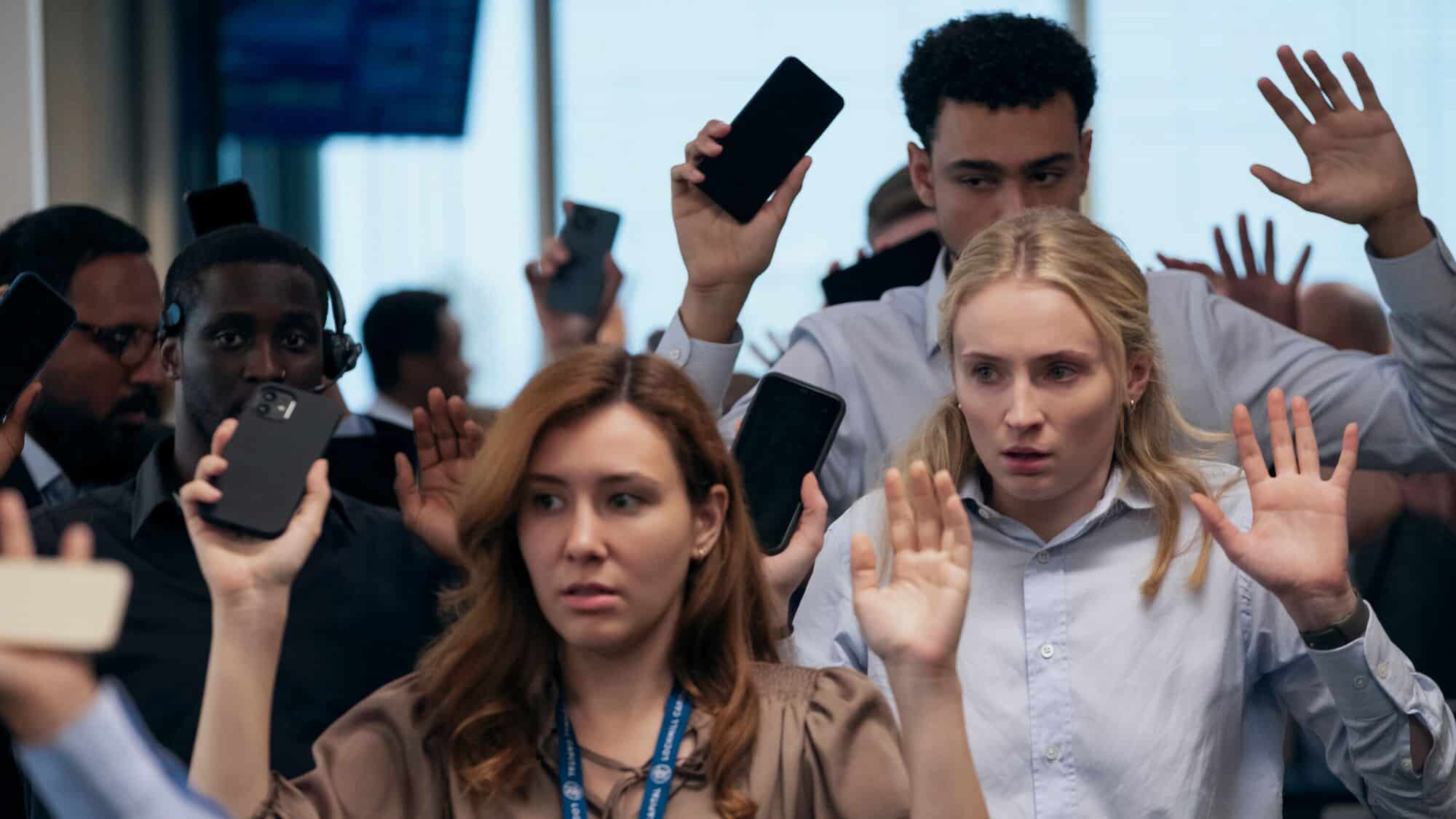
Who would be willing to steal billions from the pensions of ordinary citizens, and for what purpose? That’s the premise of Amazon Prime’s new series, Steal, a thriller that manages to hold your attention minute by minute. If you’re looking for an addictive thriller to start the year, Steal delivers — but its real power lies in the questions it raises about money, trust, and power.
What begins as a routine day at a corporate office spirals into a nightmare when a gang of violent thieves breaks in and forces the employees to obey their demands. Over six episodes, the story follows Zara (Sophie Turner, Game of Thrones), an employee at a pension fund investment firm who finds herself caught in the middle as decisions made by others begin to tear her life apart.
The British thriller about this unprecedented robbery also features Luke (Archie Madekwe, Saltburn), Zara’s best friend at the office, and DCI Rhys (Jacob Fortune-Lloyd, The Great), a detective with a gambling addiction who must discover who is really behind the heist.
The main suspicions fall on the employees themselves, under the hypothesis of an inside job, as the robbers seemed to know every procedure in detail. Although the series constantly points the viewer in different directions, it is not just a matter of misleading the viewer. When the loot is so large, the number of possible suspects multiplies, with varying degrees of responsibility and unequal benefits.
The identity of the mastermind becomes the central obsession driving Zara forward, both out of curiosity and out of a need to divert attention away from herself. Zara knows she is being singled out as a recurring suspect, although she can’t imagine the extent to which she could become the perfect scapegoat.
She is labeled the problematic office worker with a narcissistic mother and a present defined by weekends of excess and a virtually non-existent personal life. However, there is much more to Zara than others perceive. She is someone capable of acting with cold precision when others hesitate, a trait that seems to have developed as a defense mechanism after growing up in a toxic environment.
At a national level, the uncertainty takes on a different scale. Who would dare to empty the pensions of ordinary workers? Definitely not Robin Hood, but it doesn’t seem to be a provocation without a clear objective either. Thefts are not always about money. Behind them often lie broader interests and ambitions that rely on chaos as a way of operating in today’s world, where those who wield weapons are often just the last link in a chain with no real decision-making power — a reality reflected in the immediate financial jitters that follow.
The series goes a step further by showing the level of organization behind the heist. The assailants do not cover their faces; they enter the building dressed as employees. Even so, the cameras are unable to identify them thanks to prosthetics that alter their features and allow them to go unnoticed even in a crowded subway train. So don’t expect Dalí masks or several episodes devoted to recounting the big heist. All the action of the robbery takes place in the first few minutes, and from there, the series plunges headlong into an intense investigation. The result combines the best of the pulse-pounding action of Money Heist with the detective work associated with recent titles such as the brilliant Dept. Q.
Steal comes from crime novelist S.A. Nikias, with Sam Miller (Black Mirror) and Hettie Macdonald (Normal People) directing the episodes. The result is a solid, well-executed, and timely series that mixes tension, social commentary, and entertainment without losing control of the story. Steal succeeds not because it reinvents the thriller, but because it understands exactly what kind of unease modern audiences recognize all too well.
