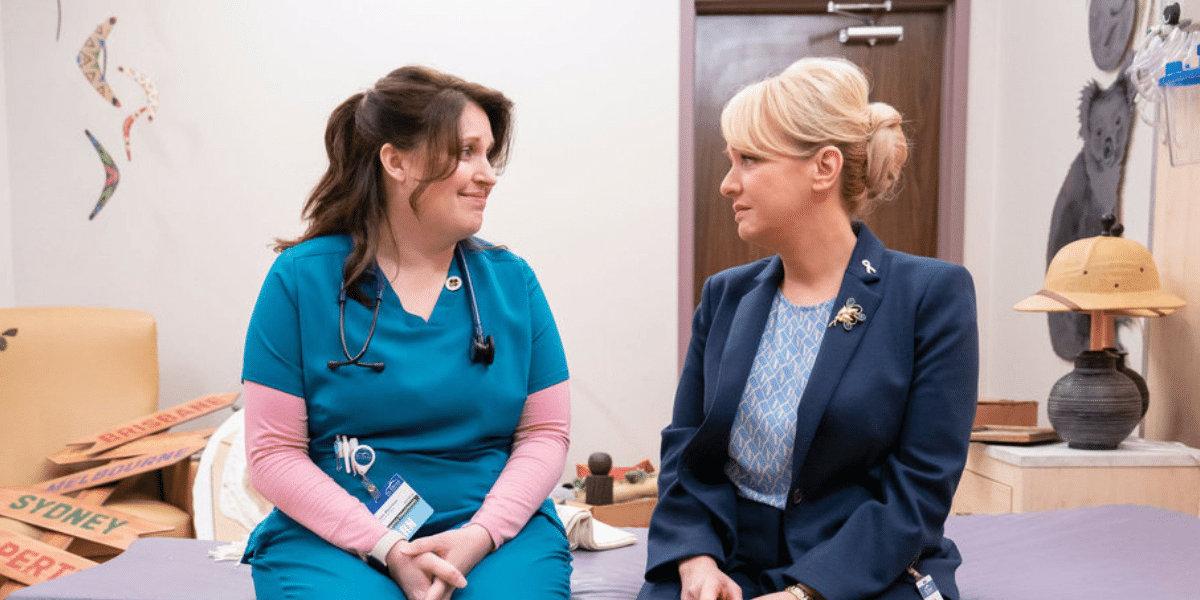
Now in season 2, NBC’s St. Denis Medical quickly captured my attention as a familiar, but fresh and hilarious workplace comedy, when it premiered on late last year. Set in an underfunded hospital in Oregon, the show follows executive director Joyce (Wendi McLendon-Covey) and her crew of doctors, nurses, surgeons, and physicians, all led by supervising nurse Alex (Allison Tolman). Every day, they endure the demanding and thankless parts of nursing: terse patients, breaks and lunches, staff shortage, rundown facilities. But at the end of the day, they remain strong and show up because they do the hard work together.
While the first season felt like a show slowly finding its voice, season 2 hits the ground running with confidence and surety about its characters, conflict points, and identity. To be sure, the personal and professional struggles the characters face seem endless. Patients can be rude if not downright offensive. There’s never enough money for new machines or services or staff to keep up with Joyce’s expectations. Everyone feels constantly overworked and stretched thin.
At the same time, there’s room for our main characters to develop and grow. Bruce (Josh Lawson) is as cocky as ever – even for a surgeon – but my favorite moments with him revealed his vulnerability, fear, and loneliness. When he says he doesn’t want stability or regular companionship, it feels like a lie, thanks to the tone of his voice and the expression on his face. These cues put a chink in the emotional walls he builds to stay distant from romantic conquests and even between himself and the documentary camera crew. I especially love when Alex, who so often gives in to other people’s demands because “it’s easier,” finally sets boundaries with Joyce.
But for me, the best part of this season is watching the complex but hilarious relationships among the staff themselves. If patients can be mean, co-workers can cut right down to the bone, like Chaplain Steve insulting Bruce’s ability to woo someone while they fight over the same female co-worker, Brooke. Or the temporary nurse sub Pam who mocks and belittles every nurse on her floor for how slow they talk or how they fold linens. Even Ron gets in on the action with how he teases Alex and the new nurse Matt (Mekki Leeper) for their softness and naivety.
As someone who now works full-time in a similar workplace situation, I laughed out loud at these moments for their realism and truth. Humor is inevitable when so many different types of people share space together for eight hours a day or more (and in a hospital, it could be for over 24 hours). Colleagues make jokes, feelings can get hurt, and things can be taken too far. But I appreciate that each episode shows how the staff solves their intrapersonal issues, even if it takes them a scenic route to get there.
We also get to see the relationship between Matt and fellow nurse Serena (Kahyun Kim) evolve over the course of the season. Much like Jim and Pam from The Office, the dynamics between them flip – now Serena seems to be the one crushing on Matt. She smiles and looks at him longer than necessary, gets visibly invested, even jealous, when one of his old flames returns to town for a day, and gets embarrassed when she realizes the camera has been documenting her behavior. Their bond is a familiar fixture in the workplace sitcom genre and one I hope reaches a satisfying new peak by the end of the season.
Then, there are tricky spots Alex navigates as a boss that echo stories I’ve heard from past managers. So often, she’s expected to inhabit both roles of subordinate and supervisor, play both teams in the “us vs. them” battle between the administration and regular employees. It’s a fight about privilege and power, loyalty and common enemies.
While it may be Joyce who’s branded as the show’s lead, I like that this season makes a point of focusing on Alex’s internal struggle between what she wants, what her staff needs, what patients deserve, and what Joyce demands of her. Not to mention what’s waiting for her at home with her husband and two kids, who also eat up a lot of her time. In many of her talking head shots, she’s exhausted and frustrated, unsure of what to do next. She’s the heart of the hospital, holding up everyone else’s weight much like a mother in a traditional family sitcom. But St. Denis Medica isn’t interested in keeping her there. Rather, we see her begin to reclaim some of the power she’s given away, which ultimately makes for healthier dynamics for everyone else, too.
To be honest, I’ve never loved the idea of a “work family,” because it’s an expression that tries to romanticize the fact that under a capitalist system, we often see our co-workers more than our actual families and friends on any given day. But I love how season 2 of St. Denis Medical takes what we’ve seen before and runs with it in its own direction. Compared to Season 1, the show has only grown stronger in its unique depiction of professional life and the interesting people we inevitably find ourselves working with.
