
When I Was Octomom: The Natalie Suleman Story premiered on Lifetime in March—alongside a six-part docuseries Confessions of Octomom — I didn’t press play. Even though the trailers for I Was Octomom: The Natalie Suleman Story caught my eye, I scrolled past them. I told myself I’d circle back. The truth is, four months ago, I wasn’t ready to revisit the story I had always been quietly haunted by: how was she surviving motherhood?
Now, months later and in a different headspace, I finally sat down to watch I Was Octomom: The Natalie Suleman Story—and I have thoughts.
It’s not that I wasn’t interested. It’s that I wasn’t ready.
Then, one night not long ago, Hulu served it up again—algorithmic serendipity, maybe, or maybe it was just the right time. And I pressed play.
What followed was less a rewatch of a public scandal than a revisiting of my own history, and an unexpected reckoning with how much I misunderstood, not just about Natalie Suleman, but about myself.
I still remember the headlines: Octomom gives birth to eight babies. It was 2009. I had been out of the Navy for a couple years, trying to find my footing in a civilian life that didn’t quite fit yet. I was pregnant — my son would be born in May of that year — and navigating a complex web of grief, change, and fear. The father wasn’t my late husband, and that alone came with enough emotional weight. And there she was, everywhere: Natalie Suleman.
But something didn’t sit right even then. The story felt too clean, too sensational. No one cared about the full picture — they just needed a new woman to vilify. Viral before “going viral” was even a phrase. Her face was everywhere. Talk shows. Tabloids. Prime-time specials. The judgment was swift and brutal. Eight babies? On purpose? And she already had six? She must be crazy. She must be irresponsible. She must be something—anything to make us feel better about our discomfort with a woman who broke all the rules.
I Was Octomom finally let Natalie speak for herself. Through confessional interviews and dramatized flashbacks, the film doesn’t just rehash her “rise and fall.” It dismantles the idea that she was ever in control of the narrative to begin with.
I was fascinated, but not out of cruelty. I asked the same questions many did: Why would anyone sign up for that? How could she possibly survive it? How could any of them? What I didn’t ask — what most of us didn’t ask — was what happened to her? Who failed her? And what does it say about us that we cheered as she was devoured?
This new dramatized biography doesn’t just retell Natalie’s story. It rewrites the terms of it entirely. Through intimate, confessional interviews and reenactments, the film shows a woman who was never really in control of her own narrative. It shows us how she was manipulated — by her IVF doctor, who convinced her to do more than was ethical or safe. By the hospital that hired her publicist. By a media machine that wanted a moral panic and found the perfect vessel in a single, Lithuanian-Palestinian American, working-class mother with too many kids and too little support.
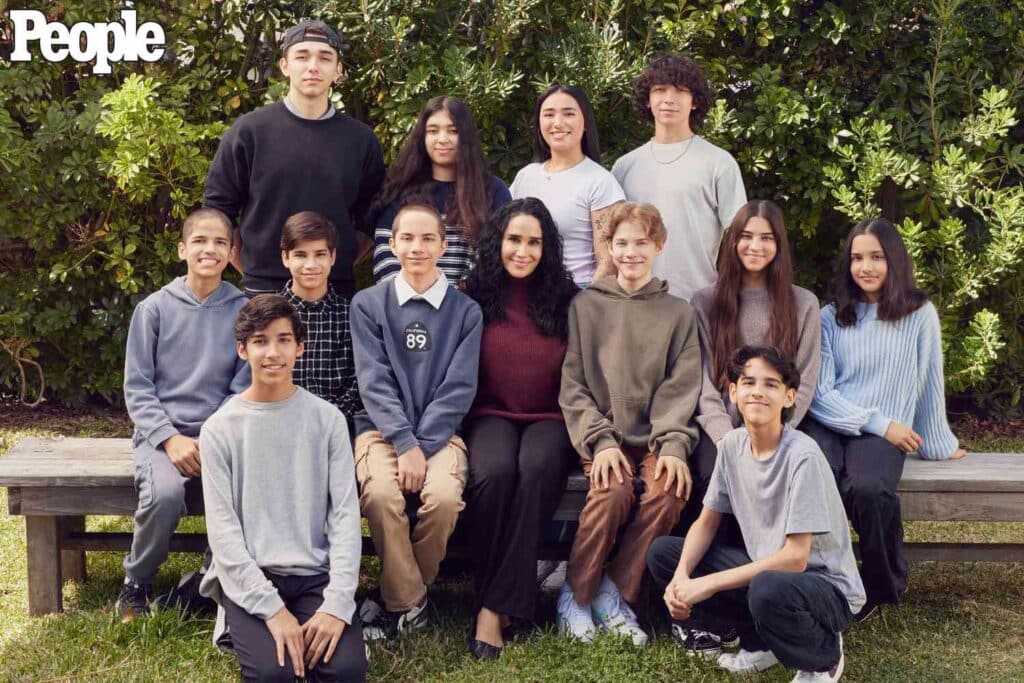
Watching it now — after everything — I saw Natalie not as a media sensational scapegoat character, but as a mirror. And what stared back at me broke my heart.
When I gave birth later that year, I fell apart. I experienced postpartum psychosis. I couldn’t get out of bed. I struggled to connect with my baby. And I remember thinking: How did she do it? Natalie had fourteen children. I had one. And I felt like I was dying. She looked like the perfect mother on TV — composed, maternal, tireless. And I was ashamed of what I couldn’t be. What I didn’t feel.. And that maybe something in me was missing.
But what this film makes painfully, beautifully clear is that Natalie wasn’t okay. She was scared. She was overwhelmed. She was trying to survive while being vilified by an entire country that viewed her womb as a political statement. And like so many of us, she tried to protect the very people who harmed her. She defended her doctor. She smiled for the cameras. She cooperated with the circus because she believed she had to. Because women are taught to absorb blame. To endure shame. To sacrifice until there’s nothing left.
This isn’t just a redemption arc. It’s a testimony. And it’s a warning.
I Was Octomom finally gives Natalie what she was never allowed in 2009: context. Not excuses, but truth. It lets her speak for herself in a world that only wants to speak over her. And it asks us to confront how easily we turn women into headlines. How we punish mothers for doing too much, not enough, or simply existing outside the lines.
We didn’t have language for “mommy shaming” back then. But she was an early test subject. She was the blueprint for what happens when a woman defies our narrow, puritanical expectations of what motherhood should look like — and who deserves to be a mother at all.
So yes, I’m late to the review. But watching it now gave me something I wouldn’t have understood in real time: closure. Not just for Natalie, but for myself. For the young woman I was in 2009, holding a newborn and hiding my tears, wondering why motherhood didn’t feel like magic.
If you haven’t watched I Was Octomom yet, do. Not for the spectacle. Not for nostalgia. But for the questions it forces us to ask about media, medicine, misogyny — and the mothers who survive it all anyway.
It may not be breaking news anymore. But the truth still matters. And it’s never too late to listen.
