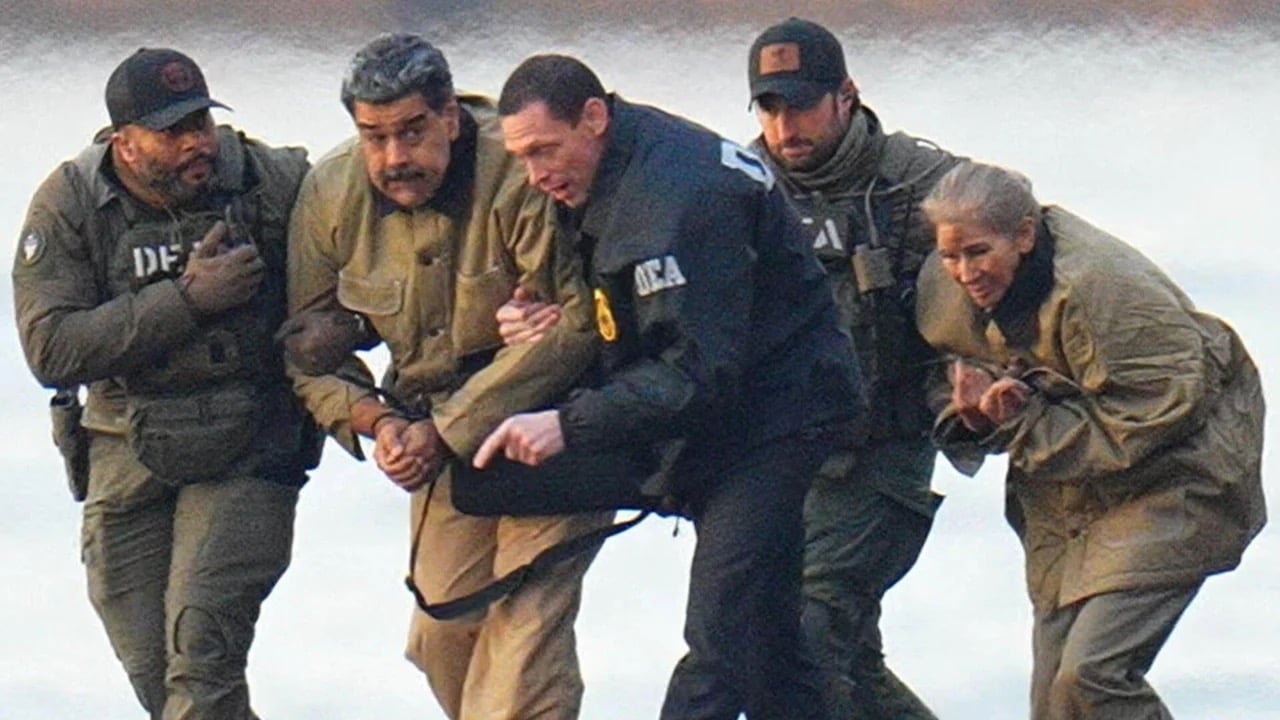
“Extraordinary” and “Audacious” are two words I’ve seen to describe President Donald Trump’s recent actions in Venezuela. But I had a different thought after waking up Saturday morning to the news that the United States military had violated the sovereignty of an independent nation.
This was my thought when I read that the American military had captured Venezuelan President Nicholas Maduro and his wife, Cilia Flores, from Caracas: “What has been will be again, what has been done will be done again. There is nothing new under the sun.” (Book of Ecclesiastes, thousands of years ago.)
After all, it’s not even the first time the United States has forcibly removed a sitting president in Latin America to stand trial in my lifetime. I’m a Latina public historian and social studies teacher who has done extensive work to learn the history that I didn’t get in school.
The central problem is this: most mainstream publications, such as the New York Times and Washington Post, have either ignored the United States’ history of imperialism in Latin America or treated it as a colorful anecdote. In the quest to maintain a veneer of objectivity, they have ignored the context of this and are failing to fulfill their main job of holding our elected officials accountable. (Disclaimer: This analysis only covers the news reported in the first two days after the capture of Maduro.)
LatinaMediaCo exists to help fill in these gaps, but not everyone knows we’re here. That’s why it’s so important that the news that most Americans consume paints an accurate narrative, one that includes the repeated instances of the United States intervening in Latin American affairs through financial support and military means.
This would help us comprehend both the present and the future. On Sunday, Secretary of State Marco Rubio says that the United States government is in charge of policy in Venezuela – a vague statement that leaves open US interference in almost every aspect of Venezuelan government. He has also said that Cuba, Colombia, and Mexico need to worry about American intervention.
If we had a better sense of history, Marco Rubio’s comments would attract much more attention, and possibly protests from Americans who do not want their taxpayer dollars being spent on invading other nations.
News Without History
Instead, the mainstream media is treating these comments like a footnote. Without historical context, this claim might seem ridiculous to the average reader. After all, President Trump was found by the Washington Post to make an average of 50 false or misleading claims in 2020.
We’re rarely taught the truth that Latin American nations never had a chance to rule itself without interference after their independence from Spain and Portugal. Almost immediately after its independence in the early 1800s, the United States used the Monroe Doctrine to proclaim its influence over the region.
The Roosevelt Corollary (1904) went one step further, declaring the right of the United States to use military force to provide order and stability in Latin America.
Cuban history presents a telling example of how this has played out. Most of us know about the failed Bay of Pigs invasion in 1961, in which the United States attempted to overthrow Fidel Castro with the support of Cuban exiles.
Lesser known is the Platt Amendment (1903), in which the United States gave itself the right to “militarily intervene” for the sake of Cuban independence or to “preserve life, property, and individual liberty.” Does this sound a little bit like Trump rationale for removing Maduro?
“We want peace, justice, and liberty for the great people of Venezuela,” Trump said in his Saturday press conference. As online historians have pointed out, the parallels between the language are eerie.
As for United States interference in Colombia, several people recommended that I not tell people I’m from the United States when I visited a decade ago. Panama was part of Colombia until the United States decided they wanted that land for a canal that would make shipping times faster. The only problem was, Colombia wouldn’t go for it. So they emboldened Panamanian separatists to break away from Panama, then leased the land from the new nation.
Mexico knows all about American aggression. They call our “Mexican American War” the “War of Northern Aggression.” The United States believed they were given a divine imperative to expand toward the Pacific Ocean. The only problem was that Mexico owned the land they wanted. President James K. Polk tried to buy the land from Mexico, but the Mexican government wouldn’t even entertain the idea. So he sent troops to Texas in the hopes that they would provoke Mexico into entering the war. It worked like a charm.
Push Factors
All of these actions have directly contributed to why we are here today.
When we destabilize other parts of the world, this drives up immigration. The Mexican Revolution started, in part, because the Mexican government prioritized American interests over the interest of its people. This triggered a massive wave of migration to the United States, and today, Mexicans make up the largest Latino ethnic group in the country.
The Salvadoran Civil War (1980-1992) destabilized the region and sent between 500,000 and one million Salvadoran immigrants fleeing the violence across our border.
The United States is saying that we will run Venezuela until a government to our elected officials’ satisfaction should take charge. At the same time, in November the government changed the legal status of many Venezuelan migrants, rendering about 250,000 people undocumented overnight. Why aren’t more journalists making this connection when they interview elected officials?
What Does Historically Accurate Journalism Look Like?
Good journalism, as Latina Media Co regularly says, would emphasize the voices of Venezuelans on the ground and experts who can help Americans put this into historical context. This is especially important because Latinidad is a multiracial, multiethnic identity that encompasses every part of the political spectrum. For many Venezuelans, the joy or relief at seeing Maduro removed comes from a very real place shaped by years of scarcity, repression, and fear. That response deserves to be acknowledged without condescension.
At the same time, recognizing that reality does not mean that we abandon our critique of US imperialism. We can hold two truths at once: opposition to authoritarian leadership and opposition to foreign intervention that violated national sovereignty. A serious, honest conversation makes room for both perspectives, rather than forcing a false choice between them.
A Sunday broadcast from Democracy Now shows how highlighting the voices of those impacted leads to a fuller story that acknowledges all of these issues.
The broadcast featured Venezuelan reporter Andreína Chávez. She described her waking up at 2 am to “extremely large explosions.” Chavez, rather than dwelling on Trump’s desire to run Venezuela, emphasized the statements of Venezuelan Vice President Delcy González. González, while she has pledged support to Secretary of State Marco Rubio in word, initially told Venezuelans to resist.
“If this was something about capturing a narco-trafficked person, why wouldn’t the government just continue?” Chávez says in the broadcast. “We have a vice president ready to assume power. … (Trump) is saying the United States is going to assign people to control the government, and the first thing he is going to do is take control of the oil industry.”
The broadcast then turns to Venezuelan historian Miguel Tinker Salas, who brings in the history of the United States getting involved in Latin America. Salas is asked to respond to Trump’s claim that Venezuela stole oil that belonged to the United States.
In reality, Americans, Dutch, and British companies who were involved got fully compensated for the oil they extracted, Salas said.
Mainstream media has been following the United States seizure of boats off the Venezuelan coast for months. They have had time to cultivate Venezuelan sources. While they should have these sources already, there is no reason why they can’t start now.
There is nothing new under the sun – except our continued refusal to learn from it.
