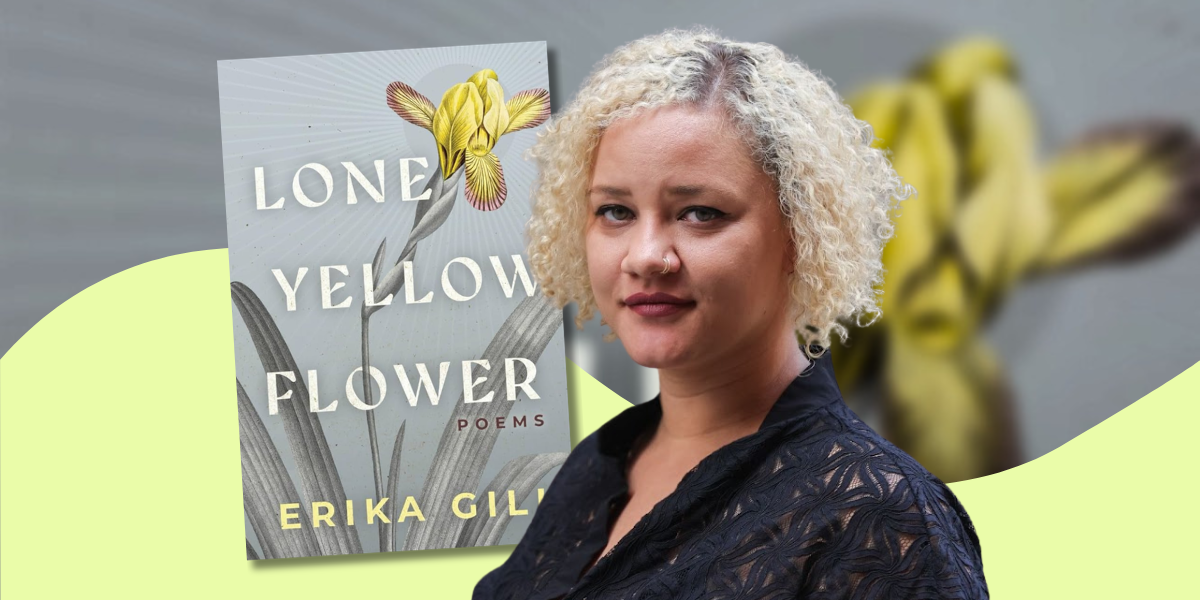
As a poet myself, I can say with certainty that it’s one of the most misunderstood genres. Long thought of as only a genre for specific people – a.k.a. dead white men – the truth is that all forms of writing and art-making can be traced back to poetry and spoken word performance, from children’s books to rap and hip-hop. But as with many mainstream modes of entertainment, it has for far too long been dominated by white-led stories, opening up a need for different voices to bring in underrepresented readers. Which is where Erika Gill and their debut poetry collection, Lone Yellow Flower, comes in.
The book is a stunning portrait of Gill’s interior life and struggle to understand who they are, the world they inhabit, and how they fit into it. Using the metaphor of a flower to showcase growth and change, they touch on topics like grief, colonization, the trauma of history, disability, and queer, Black, and Latine identity. They explore the internal conflicts they face between desire and disappointment, darkness and redemption, presence and emptiness. In these poems, we see Gill struggle for room to breathe in a way that is as striking as it is relatable.
Right away, the collection kicks off strong with the line, “The biggest joke deity ever played on me / was putting my soul into my model body,” which speaks to Gill’s sense of confidence, fun, and humor. They continue the poem by speaking of everything that makes them who they are, from “black power and white guilt” to “dynamite / and leveled mountaintop.”
But it’s the way the poem ends that struck a chord in me: “My wounds are not new social ills / they’re old furrows that have festered / It’s been a hundred fifty some-odd years of fallow fields / but my hands hold ghosts that plowed them / and ghosts that owned them / and my hands cannot be put to rest.” This isn’t the only time Gill makes pointed references to the last hundred years of American history that have victimized Black and Latine communities.
Throughout Lone Yellow Flower, Gil uses similarly powerful images to describe themself or at least their perception of who they are. In the poem “Waxing Crescent – Winter,” they “walk tall and fearless and alone.” In “Immutable Forest,” they declare, “I am a hollow / a hungry ghost / consuming all and writing little.” In “What is it Worth?” they ruin just-purchased fruit “in the blender, anxious to extract / the best of all things from them, from you” as an act of loving selfishness. And in “Song in the Key of Why?,” they urge the reader to remember, that despite them trying to become a better person, “you could still guess / if you wanted, if you’d try / you’d still see the darkness there.”
I am struck by these images because I too have thought of myself that way, seeing only the worst of me. I recognize that darkness, that feeling that if only another person could see it, they wouldn’t love me anymore. These statements come across as confessions or diary entries, allowing the reader to inhabit the poet’s mind, including their flaws in self-perception – and their growth.
For about halfway through the collection, there’s a shift in tone and language. Early on in the book, for example, Gill describes their anger as “warm venison and mashed potatoes / lukewarm / gamy and hard to chew / leaden in your stomach / underseasoned, disappointing,” for even their emotions are inadequate. Later, however, in “Lilacs in the Alley,” they say, “My heart, like my habitat / has grown, and I consider / there is room and reason for / opening myself up,” showcasing and celebrating their emotional change and growth.
Undoubtedly, Gill still has anger and grief – about the weight of the world and history on their shoulders, memories long past, love found and lost – but in the second half of the book, there is power, like the line “if poetry will make him leave / it had better be mine” in the poem “Void.” Finally, they end the collection with “it is the rule of empires that / endings are beginnings / destruction can be beautiful / beauty can break you…beauty holds so little value / in the true course of things,” tying their identity back to colonization and country-building.
I had much to think about when I finished the book – I was changed, thinking differently about how I’ve navigated the world in my own marginalized body. Introspective and otherworldly, Lone Yellow Flower is a stunning masterclass in how to completely mine and excavate the self, breaking it apart with the hope that it will come back together, better and stronger than before. I loved it and it is like nothing else I’ve ever read.
