In college, learning about the Chicano movement was a privilege that helped me begin to understand the world around me, in all its complications. Even coming from a predominantly Mexican-American hometown, I didn’t know anything about the movement and the terminology that fueled so much change in the late 1960s and early 1970s. Now, at a time when fascist leaders are working to keep the histories of marginalized people hidden, it feels especially potent to see the Sundance 2026 documentary American Pachuco: The Legend of Luis Valdez. The PBS film uses a beloved cultural figure as a means to educate a general audience about the Chicané struggle in America, even if the documentary just scratches the surface.
If you’re familiar with Zoot Suit or La Bamba, then you know the work of Luis Valdez. Valdez wrote and directed the iconic stage play and both films, which are his two most-remembered works. American Pachuco delays talking about these two works until the end of the documentary, instead using its runtime to walk us through Valdez’s life growing up the son of migrant farm workers and the basic tenets of Chicanismo.
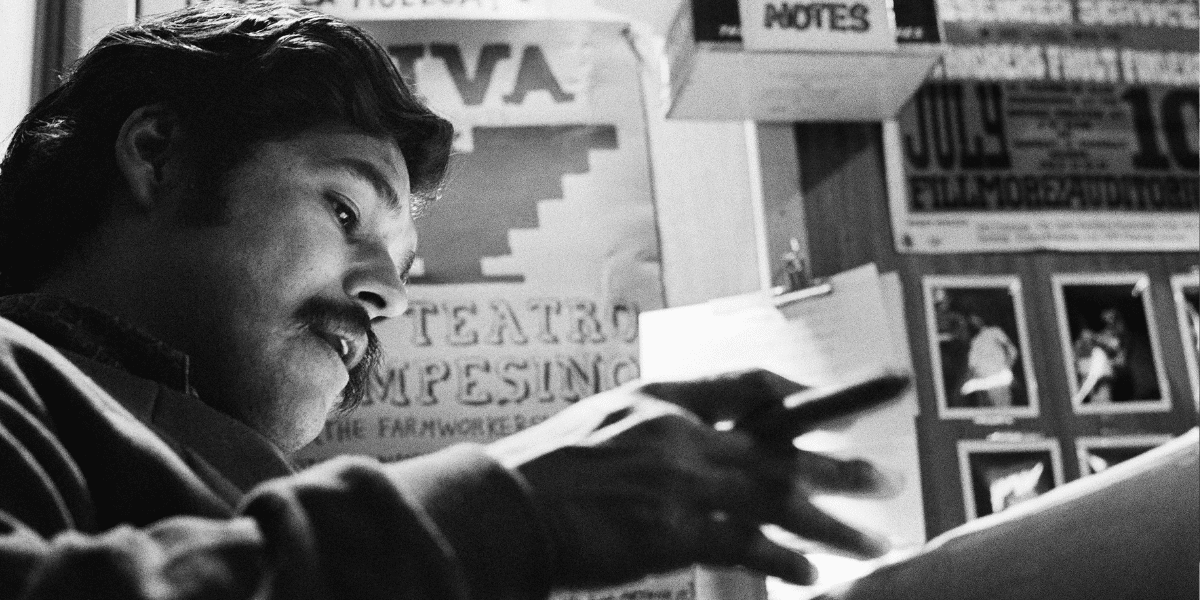
Through the use of archival footage, talking head interviews with family members and colleagues, and the return of the “El Pachuco” character from Zoot Suit as a narrator, director David Alvarado paints a portrait of Valdez’s early life and intertwines it with Mexican-American history. We watch Valdez’s early work founding El Teatro Campesino to support Cesar Chavez. Valdez’s theater blossoms into a powerful use of creativity, skewering capitalism and racism for the farmworkers on the picket line before morphing into an independent troupe. Alvarado’s narrative is all well-constructed, compellingly crafted documentary work – that is, until El Pachuco chimes in.
While it’s nice to hear the rough, warmly familiar cadence of Edward James Olmos (who also appears as an interview subject), the way Alvarado deploys him can feel redundant. El Pachuco, it seems like, is only there to offer asides that repeat what the last subject has already outlined or dive slightly deeper into a subject that has been raised.
At one point, El Pachuco explains mestizaje as “The product of what happened when the colonizers took our women.” This phrasing neatly gets to the heart of the problems with American Pachuco and Chicanismo as an identity and a movement: women as passive objects that machismo claims to possess. The focus on indigeneity here also fails to account for Black Mexicans, gender non-conforming Mexicans, and trans Mexicans that don’t neatly fall into the ideological binaries set up by Chicanismo. It’s a small moment, but it illuminates the tension that goes otherwise unspoken throughout the documentary.
It all feels very Mexican-American History 101, and that’s not necessarily a bad thing! Our histories are still so poorly known and understood that highlighting moments like the Zoot Suit Riots or the work of Cesar Chavez feels vital, especially now. At the same time, I can’t help but crave some nuance, some acknowledgement of where we are now.
As for Luis Valdez, I also wish we’d gotten more information about his later works and what writing and creating means for him now. It would have been poignant to hear Valdez’s thoughts on art in the face of so much xenophobia and fascism, and how or if it’s affected his creative work.
Still, even if there’s not room for more nuance in a 90-minute documentary, at least American Pachuco: The Legend of Luis Valdez can help people begin to learn about Chicano history, a past the Trump administration is trying to hide by pressuring schools to not teach it, and one that’s something worth celebrating, carnales.
