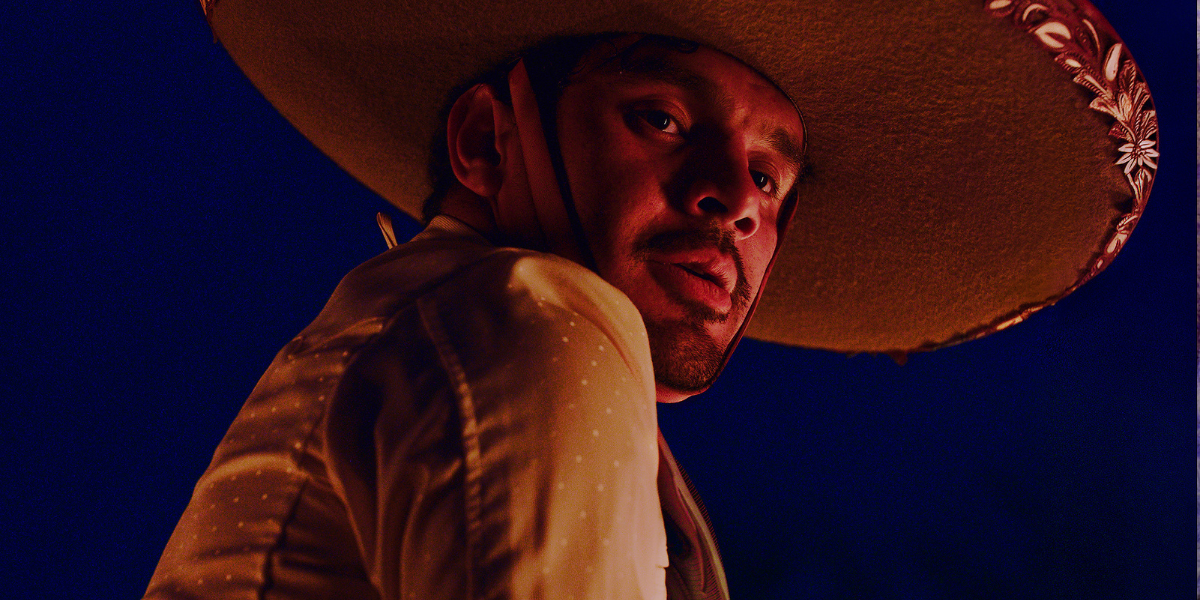
Gone are the traditional talking-head interviews of documentary days of yore, and in are beers split with your subjects! Jaripeo candidly foregrounds subversion, shots, and sexy gay cowboys, and it soars because of it.
Blending the visual artistry of Efraín Mojica and the poeticism of Rebecca Zweig, this 2026 Sundance selection is a dazzling collaboration honoring the queer machismo of Mexican rodeos. “Display” is a keyword, as co-directors Mojica and Zweig continuously emphasize the performance of it all, from Mojica’s schoolyard days of “dust[ing] off the boots we never really wore” to the drag stylings of La Madre-Hada, to (of course) the subtle cruising of manly bullriders. Clearly, the jaripeo is a playground of theatrical stylings. Mojica and Zweig intimately document its flirty dance of virility and playfulness as it finds its home in Michoacán.
The kinship between the directors and the subjects stands out, as Mojica speaks to old friends about their personal worries and hopes for the documentary. “I’m showing them [Mojica’s parents] on the big screen… the world’s largest coming out,” they say. Even subjects whom Mojica does not know personally recognize them, and the use of Super 8 film further texturizes the doc, giving it a sense of camaraderie, like home videos made amongst family.
But Jaripeo also creates distance by presenting its subjects in vignettes, offering touching portraits of queer folk in Michoacán. Sometimes, this space works, allowing the audience to breeze through the dreamlike sequences unburdened. Other times, you can’t help but want a bit more beyond the bedazzled chaps. At only 70 minutes long, the film’s briskness occasionally thwarts you from reaching across the screen to hold these stories a bit closer. But like a brief ride on a gyrating bull, Jaripeo manages to pack a punch, even if it is on to the next too soon.
Throughout the film, we hear the strong but understated voice of the jaripeos announcer, who, at the end, finally reveals his name to be Charlie. While it’s uncertain whether Charlie is the sole person at the mic, his omnipresent voice narratively charges already spirited images captured by cinematographers Josué Eber Morales and Gerardo Guerr. Think uniformed riders in Los Fresnos lined up to pray before they spring into action. He concludes his remarks by thanking the audience, thanking God, and encouraging dancing, a keen sermon of its own that carries the jaripeos’ essence.
Multicolored strobes elucidate the liberatory act of dancing for these gay cowboys. And even an absence of light becomes a vehicle for embrace, not because men kissing and hugging in shadow and silhouette are secretive, but because they are aesthetically moving and enticing. Sunlight bursts through in nearly every scene, cascading upon ceramic tiles and kitchen interiors. Viewers will come to see about a horse named Dulce, and become smitten by how masculinity can be graceful, a horse circling a backlit cowboy, their mutual glory on full display.
Jaripeo also notably accents liquor and its troubling, dualistic advantages and disadvantages. The image of a crisp can of Model on Super 8 or the shot of “the two drunks” walking away from a vulnerable conversation in a Casablanca finale style is visually magnetic, showing how alcohol clearly fosters connection and invigorates the party. At the same time, these men frequently mention how the cowboys need to be drunk in order to “be gay,” how they depend on liquid courage to be themselves.
Yet, when a stirring monologue about traditions and still valuing your home even if it is imperfect is followed by a humble “Aye, no se,” and the swig of a flask. And then the person behind the camera replies with “Give me some of that,” you can’t help but smile. Such is the power of Jaripeo.
