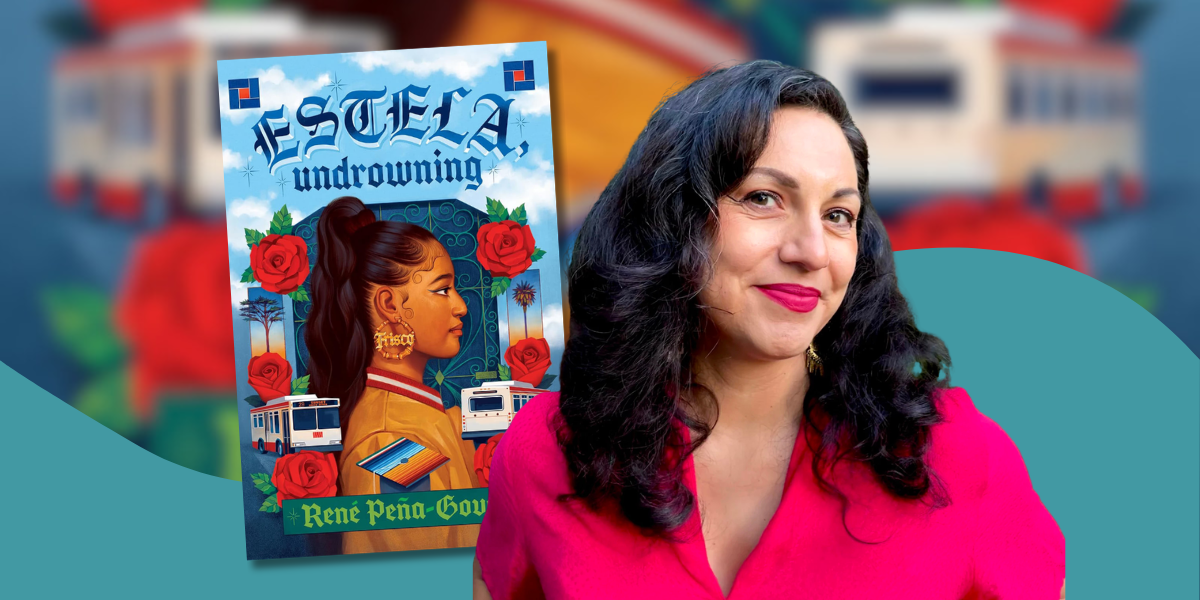
There’s officially a new Latina author to watch – René Peña-Govea, a teacher-librarian and the debut author of Estela, Undrowning. Set in San Francisco, the novel follows Estela Morales, a senior in high school who just wants to graduate and go to her dream school, UC Berkeley.
Only she gets caught up in trouble when she places second in a Latinx poetry contest behind a non-Latinx student, escalating her family’s possible eviction from their home and microaggressions against her fellow classmates of color. Through Estela’s eyes – and original poetry composed on the spot in her mind and journal – the story showcases the NoCal city’s BIPOC communities,which are very rarely depicted in media. And the novel also tackles broader issues of gentrification, white supremacy, justice, privilege, and identity.
“I’m from the southeast part of San Francisco that’s more Black, brown, and working-class,: Peña-Govea told Latina Media Co. “I wanted to highlight that this is a part of San Francisco that doesn’t get a lot of attention and tourists don’t go to, which trickles down to how our schools are resourced. It’s a love letter to this side of the city that’s very segregated between east and west, paying homage to where my students live and the businesses and institutions that are holding it down for people of color, artists, and activists on this side of San Francisco.”
Drafting during the early years of the pandemic, Peña-Govea originally conceived the story with Estela as a pregnant teen, since she was working at a school for pregnant and parenting teens at the time. Then she thought it’d be a pandemic love story. But through every iteration, she kept the semi-autobiographical elements of Estela firm within the narrative – as a Latina teenage girl with anxiety, hopes, and dreams of bettering herself and her community.
It was only when she incorporated the plot point of the poetry contest and started mixing poetry with the prose that Peña-Govea figured out Estela’s final character arc and separated her from the writer’s own life experiences. In fact, it was a “wish-fulfillment” moment to allow Estela to be braver and more courageous than the author, uplifting the spirit of today’s youth activism and social justice efforts through art.
Throughout Estela, Undrowning, poetry is a powerful and effective way for Estela to voice her worries and anxieties, reflect on her experiences, and reclaim her autonomy in a world where a young person of color has very little. On the bus, at school, in the middle of her Spanish class, at home during breakfast – she talks herself out of submitting to the poetry contest, only to push forward and do it anyway. She fights her feelings for her classmate and Spanish tutor, Rogelio. She panics about being forced to leave her home. As we move through her world, we experience her every thought, observation, and question, inviting us to echo her emotional state.
“The poems were moments of intense reflection on Estela’s part,” Peña-Govea explained. “When she was feeling something she had never felt before or wanting to wrestle with, when things were almost too heightened to be articulated in this logical way, poems were her way of processing those big emotions or those big events in her life. I wanted to demonstrate how art is a form of healing and resistance, that it could be a tool for people who are struggling with anxiety or other mental or emotional challenges.”
In another nod to youth power, Peña-Govea also based the student activism in Estela, Undrowning on her own alma mater. During the 2020-2021 school year, students were fighting to change high school admissions practices to be more inclusive, which turned into a citywide debate about diversity, privilege, and identity.
Much in the same way, Estela’s friends start grassroots social justice efforts. They circulate petitions to support affirmative action, which other characters claim is anti-Asian, echoing debates prior to the 2023 Supreme Court decision striking down the policy in college admissions processes (which have only gone on to hurt Black and Latinx student populations). They launch protests when a poster promoting a Black student poetry contest is defaced. Estela makes some mistakes along the way, including briefly engaging in a microaggressive behavior she herself strives to fight against. But as a whole, the teen characters unite across racial, ethnic, and class lines, proving the power of the individual as much as the collective.
Estela, Undrowning is a vibrant and necessary response to modern questions of identity, belonging, and justice. Though it may not have all the answers or solutions, it’s inspiring to follow Estela’s last year of high school, while she tries to understand who she is, who her true allies are, and her place in the world. It highlights the value of community in all its pitfalls while also naming it as a source of strength.
Peña-Govea added, “In every movement that’s ever been successful, alliances between seemingly disparate groups is what makes a movement successful and is what ultimately creates change.”
