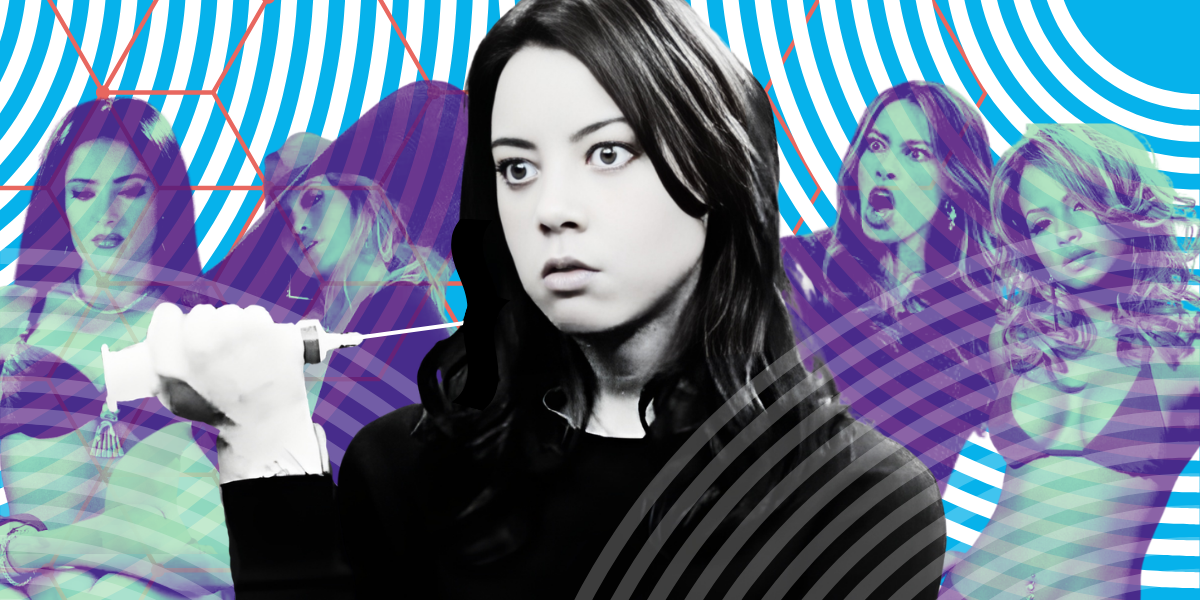
For a long time, Latina femininity has followed a familiar script: Be warm. Be expressive. Be socially fluent. In this traditional cultural lexicon, a Latina’s brightness isn’t just a trait, it’s a performance. We are expected to be the sun, never the shadow.
There is an unspoken assumption that our lives should look like a telenovela: saturated colors, heightened emotion, and a kind of theatrical warmth that never really rests. That to be Latina, is to be spicy. But lately, a different expression of Latinidad has been quietly gaining visibility. One that leans toward restraint, depth, and a moodier aesthetic that refuses to perform sweetness on demand.
The New Archetype of Stillness
It’s a shift moving away from the “spicy Latina” trope and toward a more grounded, complex presence. Arguably, it started with Aubrey Plaza as the wickedly dry April Ludgate in the Obama-era hit Parks and Recreation.
But the trend took off in the “Wednesday effect” of Jenna Ortega, whose rise is defined by stillness and a refusal to soften herself for the male or mainstream gaze. It’s in the emotional gravity of Zoe Saldaña and the quiet, ambiguous intensity of Tessa Thompson. These performers aren’t relying on easy likability. They are leaning into presence as power.
This aesthetic subversion travels through sound as well. From the melancholic, dreamy landscapes of Ambar Lucid to the experimental defiance of Xenia Rubinos, Latina artistry is rejecting the mandate to be perpetually upbeat or “tropical.” Even global icons like Anitta have pivoted toward this darkness. In “Boys Don’t Cry,” she swapped the sun-drenched imagery of Rio for a pop-horror universe, using emotional distance as a form of aesthetic control and a break from the “Garota de Ipanema” expectations.
The Right to be Quiet
When Latinas lean toward darker tones – visually, emotionally, or socially – it is rarely about rebellion. It is about alignment and autonomy.
For generations, the expectation that we should be the emotional center of every room has been an exhausting form of labor. Being “solar” requires constant energy. Choosing a darker aesthetic, monochromatic clothes, or a quieter social presence is, in many ways, a reclamation of our energy. It is the right to introversion.
Because the feminine staring of Latinidad is so often synonymous with approachability, this shift is frequently misunderstood as coldness. In truth, we’ve always had this interiority, it simply hasn’t been welcomed or celebrated in media. The “darker aesthetic” isn’t an absence of light – it is the presence of depth. It creates space for a rhythm that is slower, more contained, and more reflective.
The Quiet Evolution
This evolution isn’t just televised; it lives in ordinary, daily choices – The woman who no longer forces a performative smile in photos.
The friend who chooses the depth of solitude over the exhaustion of small talk.
The Latina who wears black because it’s her happy color, her home.
These decisions widen the frame of what our womanhood can look like.
A Personal Note
I have always gravitated toward darker aesthetics and a quieter presence. For years, that made me feel as if I had to constantly justify my identity, as though being Latina required a specific, vibrant palette to be “authentic.” As though I had be “spicy” to be truly Latina.
Seeing more Latinas inhabit this space openly feels like a long-overdue recognition. The same scripts that expect endless warmth from us often expect emotional generosity without limits. But we are beginning to redraw those lines, creating room for boundaries, stillness, and the beautiful complexity of the shadow.
