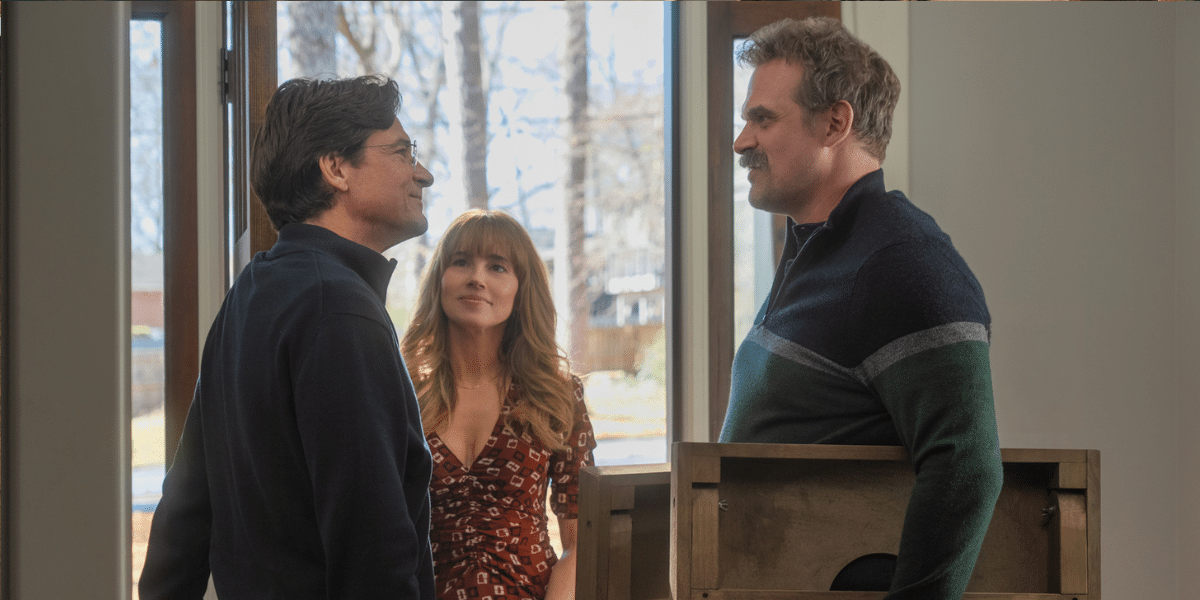
There are two ways to read the title of DTF St. Louis.
The obvious interpretation is crude, a joke that sounds like it belongs on a dating app or scribbled into the margins of a frat house notebook. But the HBO dark comedy quickly reveals that the real subject of the show is something far stranger: what happens when boredom, desire, and middle-aged dissatisfaction collide in a perfectly ordinary American suburb.
The premise is deceptively simple. A love triangle between three adults spirals into something darker, eventually leaving one of them dead. The victim is Floyd Smernitch (David Harbour), a man whose life seems perfectly stable until it very suddenly isn’t.
But DTF St. Louis is not interested in rushing you toward the answer. Lawns are mowed. Weather forecasts are delivered. Marriages continue functioning on autopilot. And somewhere in the middle of all that normalcy, someone dies.
Created by Steven Conrad, the seven-episode series unfolds with a pace that feels almost stubbornly slow. Scenes linger. Silences stretch. Conversations drift in uncomfortable directions. It’s the kind of storytelling that allows the strange little details of suburban life to breathe, and the effect is both funny and unsettling.
At the center of the chaos is Clark Forrest (Jason Bateman), a local weatherman whose quiet demeanor hides something far less stable beneath the surface. Bateman has spent years perfecting a particular style of performance: dry, polite, slightly detached, and just off enough that you’re never entirely sure whether the character is about to crack.
And so, the tone becomes the show’s engine.
Clark begins an affair with Floyd’s wife, Carol (Linda Cardellini). On paper, the situation sounds like the setup for a standard neighborhood scandal. But the show quickly complicates things by asking a deeper question: who, exactly, wanted what?
Carol seems less interested in passion than escape. Clark, on the other hand, becomes something else entirely. Not simply attracted, but fixated. And we all know what tends to happen when obsession enters the room.
What DTF St. Louis explores, often with dark humor, is the strange gravitational pull of male desire. The show pokes at an uncomfortable cultural reality: the way our society often frames male libido as something urgent, unavoidable, biological in its authority. Men must pursue. Men must conquer. Men must be sexually validated at all times.
Now, of course, women are sexual beings too. That’s not the point the show is making. The point is that the story doesn’t start there.
Instead, it starts with a man who becomes convinced that wanting something is the same as deserving it. And once that mental shift happens, his entire world begins to rearrange itself around this single pursuit.
Which brings us back to Floyd Smernitch.
By the time the story opens, Floyd is already dead. The show doesn’t hide that fact. Instead, it invites the audience to wander through the strange emotional maze that led there. Was it Clark? Was it Carol? Could it have been someone else entirely?
Maybe Floyd’s son Richard (Arlan Ruf), whose quiet presence suggests he understands more about the adults around him than anyone realizes.
Or perhaps the truth lies somewhere in the orbit of the investigation, led by Detective Donoghue Homer (the reliably excellent Richard Jenkins), and special crimes officer Jodie Plumb (Joy Sunday).
Tonally, the series lands in a strange but fascinating place. It’s technically a thriller, but it behaves more like a character study wrapped in a mystery. The humor is dry, almost painfully polite, the kind of comedy that creeps in through awkward pauses and quietly devastating lines.
Bateman, in particular, thrives in this environment. His version of Clark is the kind of man who can deliver a perfectly friendly sentence while quietly unraveling underneath it.
And that’s where the show’s real tension lives.
By the time the truth finally surfaces, the show seems less interested in assigning blame than in examining the strange emotional machinery that made the outcome possible in the first place. Which raises the unsettling possibility that the real mystery isn’t who killed Floyd Smernitch.
It’s why it took so long.
