When Carnival first arrived in the Americas with the Portuguese, it was known as entrudo and consisted of spontaneous street gatherings around town. They were unorganized and included pranks – like throwing dirt, soot, or even urine at passersby.
Well into the 19th century, something called cordões was born. These were more organized – the space where groups gathered was delimited by a cord, hence the name – but still unruly and violent. There were even accidental deaths.
The press loved to hate them.
In the early 20th century, media and particularly newspapers used divisive language to talk about the party that was then becoming known as “Carnival.” On one hand, you have the “lowbrow” cordões, where the working class (who were mostly people of color) went to create “barbaric chaos.” On the other hand, you have the “highbrow” version of the party, a Carnival shaped by the European traditions of Nice and Venice, the customs white Brazilians aspired to emulate.
Then everything changed in 1930.
Getúlio Vargas came to power with the 30s Revolution. As part of his Estado Novo nationalist government, he began a cultural integration project. What he needed for it was a uniting cause and influential voices on his side.
The first step was making the local, unorganized party into an official event. In 1935, the government officially recognized the Escolas de Samba, which organized the cordões, as part of Rio de Janeiro’s Carnival. With these new credentials, Carnival began to illicit a different story.
The same newspapers that once called the street parties “barbaric,” now praised their capacity for diversity and how they unified the classes.
In addition to legitimizing the parties, Vargas also used radio to turn Carnival into a symbol of national unity. The format was new, but the low price of buying your own device and the fact that you didn’t need to know how to read made it the perfect method to spread the word of Carnival across the country.
Radio Nacional, a station promoted by the government, began to transmit Samba-de-Estácio, with “cleaned-up” lyrics of the sambas created by Rio’s Black musicians. They were also the first to broadcast the parades.
Carnival coverage was so successful that by the mid-1930s, media outlets decided to directly support the carnavalescos. Brazilian media began promoting the competitions and parades, even sending journalists to be part of the judging committees.
The relationship between media and Carnival keeps evolving, with a big change in 1960, when television arrived in Brazil. Radio gave people the dream of Carnival, TV brought the spectacle.
Up to that point, local people ran the Escolas de Samba, cordões still organized the parades, and most of the attendees were from Rio de Janeiro. Broadcasting Carnival live led to an increasingly larger production scale.
If the world is going to watch us, we can’t look cheap! So, costume designers and artisans from Theatro Municipal do Rio de Janeiro and Escola Nacional de Belas Artes became the ones who assembled the outfits and floats. With the flashy costumes and grand samba-enredos reaching far and wide, more and more people began to travel to Rio to attend the event. The simple cords separating the crowd from the performers were no longer enough. Soon, organizers set up bleachers and started charging for tickets.
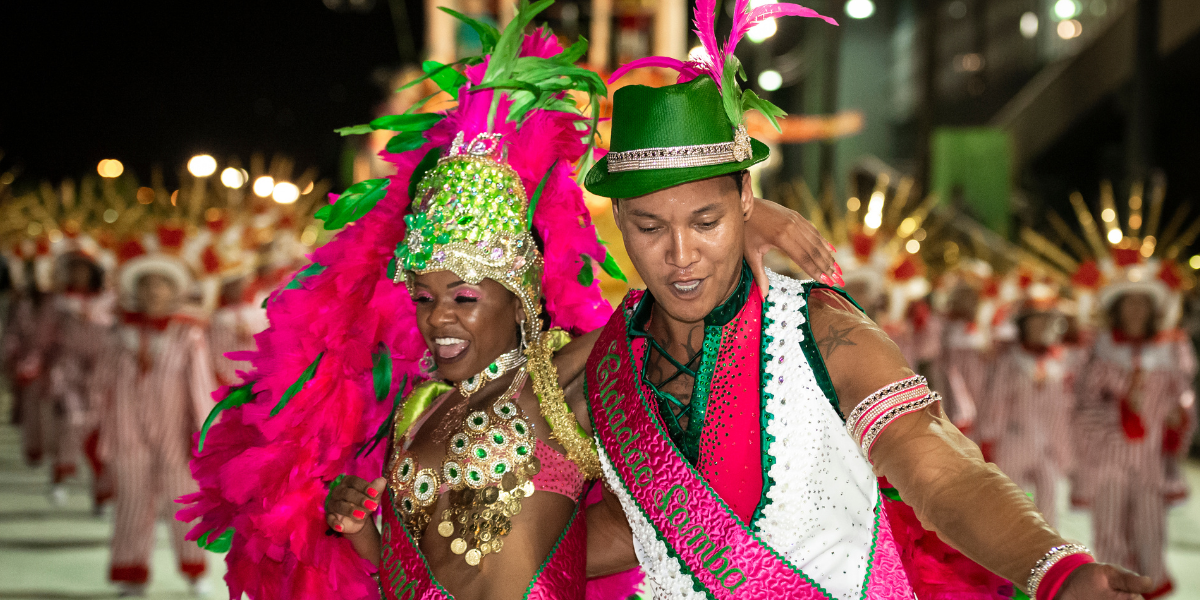
In 1975, color came to television, and soon, schools were using glitter, feathers, and all the hues of the rainbow for their costumes, instead of just their official colors.
The same media that once had bashed the party was now responsible for transforming it into the biggest, most profitable event in Brazil.
And the interesting thing is that this symbiotic relationship continues to this day. You would think that with the arrival of the internet and the rise of social media, media outlets would become irrelevant to an event so widely attended.
However, big media has adapted. Grupo Globe, the largest media group in Brazil, still holds the rights to broadcast live the Escolas de Samba’s parades. And while Grupo Globo still has a regular television feed, they also have an online stream with expert commentators and influencers who speak to younger audiences.
Almost four centuries after its arrival, Carnival has in fact become one of the largest parties in the world – thanks to its long and complicated history with the media. The same event the local press once called “barbaric,” now amasses millions of spectators – and the profits that go with such a big event.
