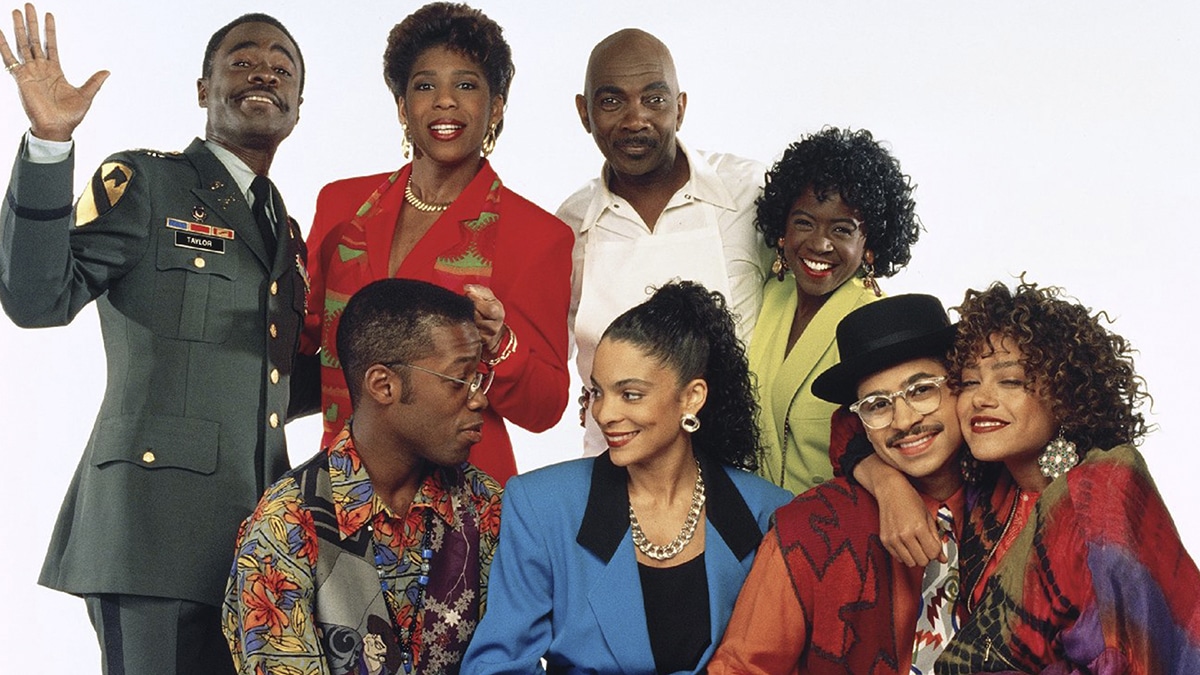
All you need to do is look around, and you’ll see that the 1990s have been back in a major way (shout out to E-40 and his album, In A Major Way, which dropped in 1995). Twenty-year-olds look like they’re shopping at Contempo Casuals (if I see one more girl in a black top and baggy light-wash jeans!), the music is either peak 90s or sampled from the decade (nothing will ever beat 90s R&B and rap), and everyone is aching for the days when we lived more in real life than online (also, remember when you could slam your flip phone shut to hang up on someone?! Epic.). So of course, I’m nostalgic for the 90s shows I watched growing up, and nothing can compare to the ones that personified Black excellence.
The nineties are inspirational for Gen Z, but pure nostalgia for Millennials, Gen X, and older generations. I graduated high school in 1998, which makes me a Gen Xer/Xennial. While I watched popular Anglo-led TV shows like 90210 and Saved by the Bell, it was the African-American-led ones that made Latinxs like me feel more connected to what we saw on the small screen (particularly for Afro-Latinxs, who were able to see their race represented on TV, even when their culture(s) may not have been). From the humor to the life experiences to the topics to the style, Black shows in the 90s held it down for us, giving a television experience that felt more like home. Thank you. Here are some of the amazing Black television shows that I watched on the regular during the 90s, and that I love to rewatch whenever they’re playing.
Living Single (1993-1998)
I remember walking into the senior lounge in high school and hearing people talking about what happened on Friends. I usually didn’t know what they were talking about, because my TV friends were the ladies and gentlemen of Living Single (I HAD to sing the theme song of Living Single out loud while writing this). For the initiated, the show follows a group of friends who all live in a Brooklyn brownstone. Whether it was Khadijah running her own Hip-Hop magazine, Regine’s amazing style, Maxine’s hilarious sarcasm and verbal sparring with Kyle (while being a lawyer!), or Synclaire and Overton’s love story, this show was well-rounded, hilarious, cool, and full of love.
The Fresh Prince of Bel-Air (1990-1996)
Another show theme song that I can perform word for word, The Fresh Prince of Bel-Air was a 90s megahit. It stars Will Smith, way before the controversy, as a West Philly teen who moves to Bel-Air to live with his extended family. The Fresh Prince allowed BIPOC to see themselves on the small screen, living the glamorous life in tony Bel-Air and as inner-city teens, witnessing the balance that Will had to strike living between two worlds. The show tackled important issues, made you laugh, and gave major fashion inspiration with Hilary’s wardrobe. Probably the best part of The Fresh Prince of Bel-Air that many of us didn’t know until later? One of its stars is Latina! Yes, the equally fashionable Ashley Banks was played by Afro-Panamanian Tatyana Ali.
In Living Color (1990-1994)
There are some shows that you have to revisit as an adult to get their full impact and message. In Living Color is one of these shows. Sure, Saturday Night Live is a (funny) institution, but In Living Color delivered social commentary in a way that POC could relate to. It was news and pop culture, how we saw it. It called out racism, corruption, hypocrisy, and whatever else it wanted to without pelos en la lengua, and it gave voice to millions who were silenced for so long. It also created mega stars from its cast, giving Jennifer Lopez her start as a Fly Girl with dance moves choreographed by Rosie Perez.
The Arsenio Hall Show (1989-1994 +2013-2014)
A lot of art that came out in the 90s was groundbreaking and trailblazing. It was a decade of Black excellence, and Arsenio Hall made history as “the first Black man to host and produce his own late-night talk show.” The Aresenio Hall Show was where Bill Clinton clinched the youth vote by playing the saxophone. It was where Eddie Murphy and Michael Jackson shared the stage and gave each other awards. And where Mariah Carey made her national television debut. It was a young breath of fresh air in a system where old white men held court for decades. It’s definitely worth revisiting now as an adult to take in the interviews and see the dope performances.
Family Matters (1989-1998)
A lot of TV shows the facets and intricacies of whiteness, while showing stereotypical and limited depictions of everyone else. At best, these shows are completely inaccurate – at worst, they’re incredibly harmful. Thankfully, Black shows in the 90s started to, well, show BIPOC in all their cool and not-so-cool moments. Yes, I’m talking about the major hit, Family Matters. It was a heart-warming and funny family story that showed the world that being a nerd isn’t just an Anglo thing. Steve Urkel is one of the most popular dorks of all time, wearing his high-waisted pants with suspenders and glasses, snorting when he laughed, and turning being clumsy into an Olympic sport. And he is Black.
A Different World (1987-1993)
Growing up in the ‘80s and ‘90s, I watched so many different shows, including some that I didn’t fully understand the importance of. For me, A Different World is majorly one of these TV shows. I caught episodes here and there as a kid, and thought it was cool, but decided to rewatch it as an adult. A spin-off of The Cosby Show (which also celebrated Black excellence until Bill Cosby had to go and mess things up), A Different World showed BIPOC something they weren’t seeing on the small screen (or the silver one for that matter) – intelligent, driven, ambitious, and diverse Black students getting a college education. University can bring together people from different races, socioeconomic backgrounds, beliefs, sexualities, identities, and more. It’s a place where young adults forge their own paths. We got to witness this reality via A Different World, and as a result, it became a reality for so many BIPOC who were inspired by it to pursue higher education. Finally, we can’t forget the legendary fashion – talk about iconic.
