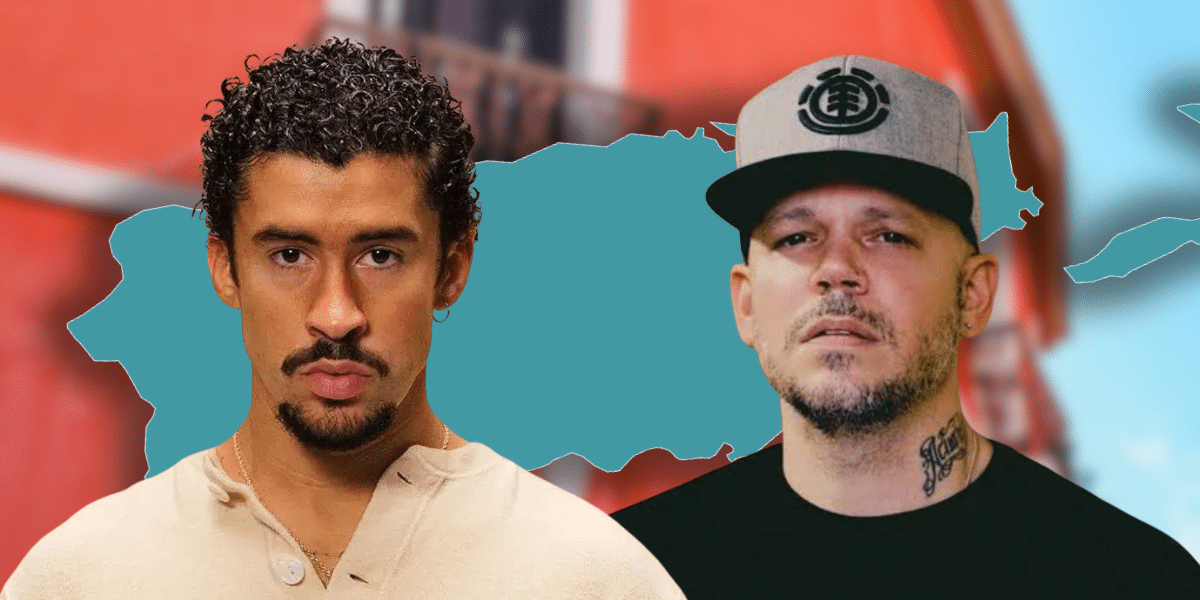
When René “Residente” Pérez Joglar and Bad Bunny announced Porto Rico, an epic Caribbean western about the 1897 Intentona de Yauco uprising against Spanish colonial rule, major U.S. media outlets responded exactly as expected. The headlines celebrated the pairing. The coverage praised the scale of the production. Profiles highlighted Bad Bunny’s growing cinematic résumé and Residente’s feature directorial debut.
What much of that coverage has not meaningfully examined is the political controversy surrounding where this film may – or may not – be made.
Bad Bunny and Residente are not casual investors in the island’s image. They have repeatedly used their platforms to demand accountability from local government to spotlight corruption, protest austerity measures, and defend Puerto Rican dignity. They have funneled resources back into local communities. Their insistence on filming at home is not branding – its commitment.
According to journalist Rafael Lenin, Puerto Rico’s government declined to support the production, increasing the likelihood that filming will relocate to the Dominican Republic. If that occurs, it will be a symbolic shift.
The Intentona de Yauco was one of the final organized revolts against Spanish rule before the United States invaded Puerto Rico in 1898. Rebel leader José Maldonado Román, known as Águila Blanca, refused to accept imperial inevitability. This story challenges the simplified narrative often taught in U.S. contexts, which frames Puerto Rico’s shift from Spanish colony to U.S. territory as a straightforward transfer of authority rather than a moment shaped by Puerto Rican resistance and a broader reconfiguration of empire.
A film centered on that moment is not neutral entertainment. It is historical intervention.
That is precisely why it matters where Porto Rico is filmed.
Puerto Rico’s current governor Jennifer González-Colón maintains visible alignment with President Donald Trump (and he’s no Bad Bunny fan). That alignment exists within a broader pro-statehood political framework that presents federal proximity as the island’s pathway to economic stability.
Let’s layer those realities together for a moment.
A sitting U.S. president who has demonstrated hostility toward one of the film’s central artists. A Puerto Rican governor closely aligned with that president. A film about anti-colonial revolt. Two artists who have consistently criticized corruption, austerity measures, and federal overreach on the island. And now, a reported withdrawal of governmental support that may force the production to leave Puerto Rican soil.
No conspiracy theory is necessary. Structural literacy is enough.
At the same time, the broader U.S. media landscape has largely confined its coverage to the celebrity dimension of the announcement. After all, the United States consumes Puerto Rican culture enthusiastically. Our music, our artists, our aesthetic innovation, our athletic brilliance — these are embraced, monetized, and amplified.
But when discussions shift toward colonial status, federal oversight, debt restructuring, or political autonomy, the volume lowers.
This is racial capitalism in practice.
The relocation of Porto Rico – if it occurs – would represent a lot of lost jobs and cross-sector opportunity. But the economic dimension, while serious, is not the deepest issue. The deeper issue is narrative sovereignty. Colonial systems do not merely control land and taxation. They shape memory. They influence which histories are amplified and which are softened. They encourage cultural pride in food, music, and folklore while discouraging sustained interrogation of power structures.
The Intentona de Yauco was a declaration that colonial rule was not inevitable. It was an organized attempt to sever imperial control. A film revisiting that revolt invites audiences to reconsider Puerto Rico not as a passive recipient of colonial governance but as an island with a documented tradition of resistance and that framing carries contemporary implications.
In my research on Colonial Stockholm Syndrome, I examine how colonized populations can internalize loyalty to systems that constrain their autonomy. It is not a matter of ignorance or weakness. It is a survival adaptation within asymmetrical power relationships. But survival strategies can calcify into ideological commitments.
If Bad Bunny and Residente can’t film in the Borikén, the irony will be sharp. A film about resistance filmed off-island because local leadership declined to back it, exporting its economic benefits and displacing its project of historical reclamation. The implicit message is clear: even our rebellions must travel elsewhere to survive.
The story of Águila Blanca is not simply about 1897. It is about how resistance is remembered – or diluted. It is about whether Puerto Rico is comfortable confronting the unfinished dimensions of its colonial status. It is about whether economic dependency shapes cultural decision-making.
If Bad Bunny and Residente have to take their production elsewhere, the story will still reach audiences. But something will have shifted. The island that produced the revolt, the artists, and the historical memory will have been sidelined in the telling of its own rebellion. That outcome would not erase Puerto Rican resistance. But it would reinforce a familiar pattern: cultural brilliance exported, political tension minimized, colonial realities left undisturbed.
History does not repeat itself in identical form. It evolves, it adapts, and it wears new costumes. The question is not whether Puerto Rico can produce global stars. It has proven that repeatedly. The question is whether it can claim and protect its own narratives when those narratives challenge comfort. Because once we outsource our rebellions, we risk outsourcing our agency.
And that is not simply a film industry issue.
It’s a colonial one.
