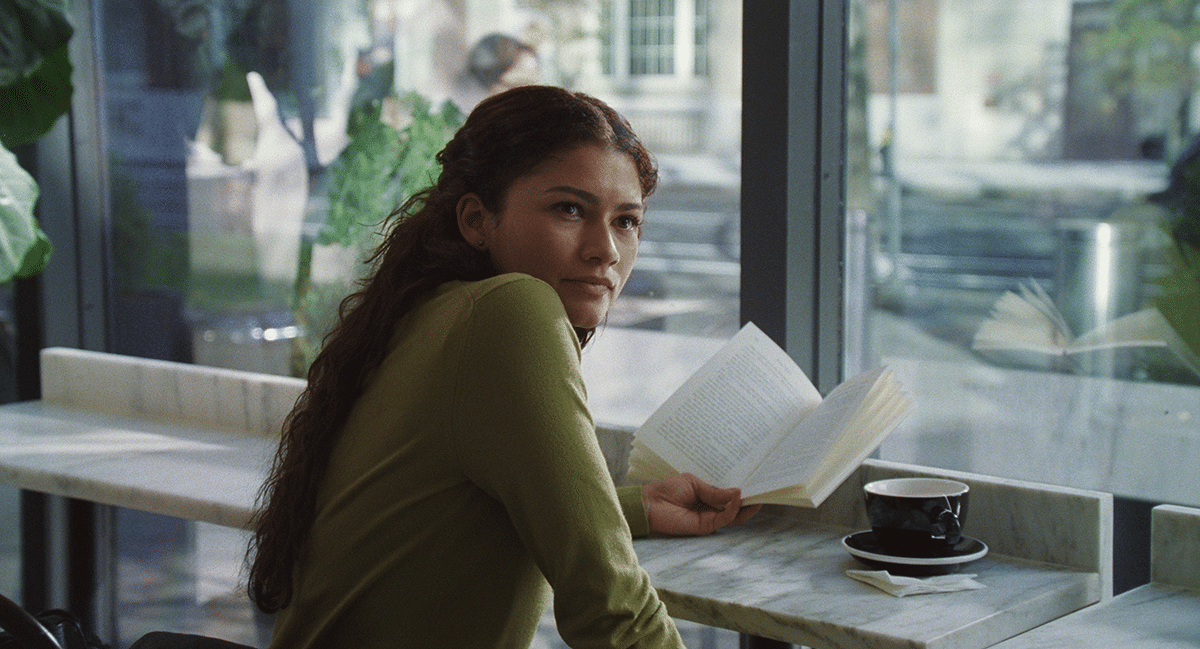
This is not a defense of violence. It’s a question about reaction – its size, strength, and tenor. Watching A24’s The Drama, the new film starring Zendaya and Robert Pattinson, I found myself less interested in deciding which character did something “worse,” and more focused on how differently people responded to their actions. Because the film isn’t really about violence, it’s about perception. And perception, as we know, is rarely neutral.
Spoilers ahead.
The movie hinges on a shocking revelation: Zendaya’s character, Emma, confesses that, as a teenager, she once planned a school shooting. She never followed through, but the admission alone shifts the entire tone of the film. She remembers being highly depressed due to bullying from her classmates. Suddenly, her fiancé Charlie (Robert Pattinson), her friends, and even the audience begin to see her differently, as someone dangerous, unpredictable, and potentially threatening.
What struck me, though, was how The Drama quietly contrasts Emma’s experience with other characters who have committed actual harm and receive much more grace. From the moment she confesses, Emma is no longer allowed complexity. Her depression, the bullying she endured, and the fact that she never followed through are quickly overshadowed by fear. The people around her begin to reinterpret her past through this new lens, questioning her stability, her intentions, and even her capacity for violence. In contrast, Charlie openly admits to cyberbullying someone to the point that the victim had to leave town, but the moment passes without fundamentally changing how he’s perceived.
Rachel’s confession is even more disturbing: she recounts locking a disabled child in a closet in the middle of the woods, then deliberately misleading the father while he desperately searched for his son. She laughs as she explains how she lied, even recalling how the father directly asked her if she knew where the child was, and she still denied it. The story ends not with consequences, but with her own disbelief that the incident never “got back to her.” Both admissions involve real harm, real victims, and real outcomes, yet neither character is suddenly perceived as dangerous in the way Emma is. Surprise: she’s white American.
And yet, within the film, those confessions land differently. It’s uncomfortable, but it doesn’t transform how people see these two white characters. Meanwhile, the Black female protagonist – who never actually hurt anyone – becomes someone everyone must now “watch.”
That dynamic feels painfully familiar.
Because outside of the film, we see it all the time.
We see it in how mass shootings are covered. When the perpetrator is white, headlines often search for context: mental health, isolation, bullying, family background. We’re invited to understand. Sometimes even to empathize.
But when the person is Black, Latino, or Muslim, the framing shifts. The conversation turns toward threat, danger, and warning signs. The individual becomes symbolic, not just a person, but a representation of fear.
Consider the case of Dylann Roof, the white supremacist who murdered nine Black churchgoers at Emanuel AME Church in Charleston, South Carolina, in 2015. After his arrest, police officers bought him Burger King because he said he was hungry, according to Shelby Police Chief Jeff Ledford and reporting from multiple outlets, including The Charlotte Observer and Snopes.
And it’s not just anecdotal – a 2018 study published in Justice Quarterly by researchers Scott W. Duxbury, Laura C. Frizzell, and Sadé L. Lindsay found that white mass shooters were more likely to be framed as mentally ill or sympathetic, while Black and Latino perpetrators were more likely to be framed as violent threats.
In other words, empathy isn’t distributed equally.
According to multiple databases, including Statista and FBI-based studies, between 1982 and 2026, about 55% of mass shootings were committed by white perpetrators, Black perpetrators accounted for about 17%, and Latino perpetrators accounted for roughly 8%.
Yet public fear doesn’t reflect those proportions.
Instead, when a perpetrator is undocumented or an immigrant, the conversation quickly shifts to immigration policy and national threat.
Again, this is not about excusing violence. Violence is violence.
But who the public allows to retain their humanity after doing something (or thinking something) terrible – well, that too often exposes racist fault lines.
And that’s what The Drama quietly exposes.
The film doesn’t lecture the audience about race. It doesn’t explicitly spell out its social commentary. Instead, it creates discomfort. It lets you notice how quickly perceptions change, how one confession becomes identity, while another becomes just a mistake.
Even beyond the film, this uneven suspicion is something many of us recognize.
Who’s seen as harmless?
Who’s a potential threat?
Who gets forgiven?
Who gets remembered for their worst moment?
For racialized audiences, these questions aren’t abstract. They’re part of everyday life. Whether it’s walking into a store and feeling watched or being labeled “aggressive” for just expressing frustration.
That’s why The Drama feels more relevant than it initially appears. On the surface, it’s about relationships, confession, and trust. But underneath, it’s asking something bigger: How do we judge who is worthy of sympathy? Are we judging harm or are we judging who we think is capable of harm?
Because sometimes, the difference between being forgiven and being feared has less to do with what you did… and more to do with who you are.
The Drama doesn’t answer that question.
It just makes it impossible to ignore.
