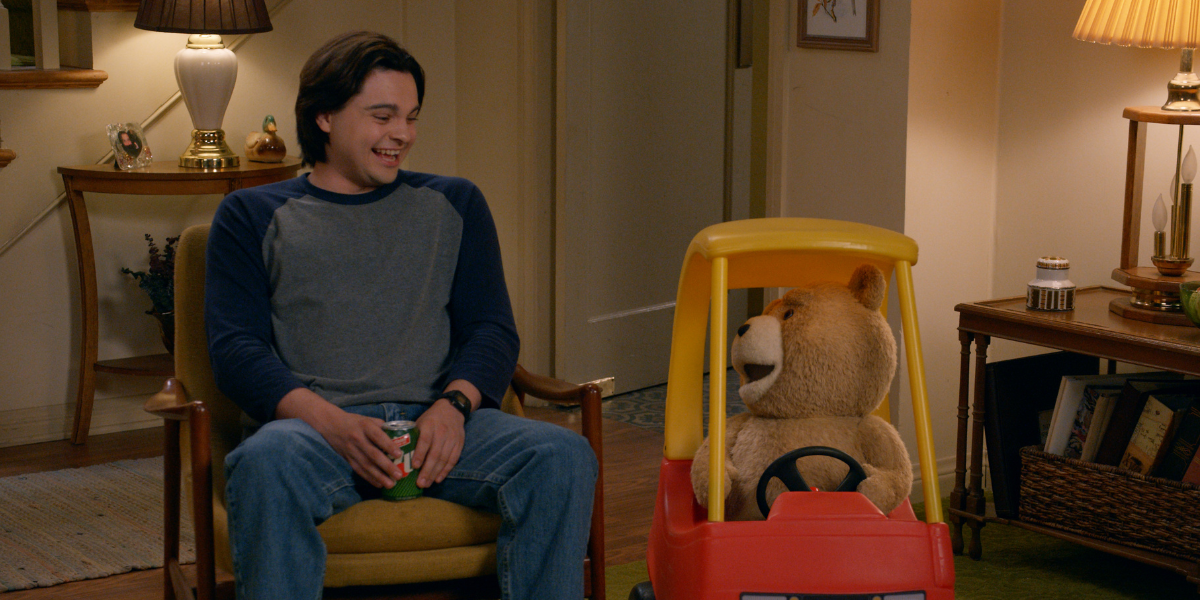
There are few things in this world more reliable than a Seth MacFarlane production. You will get crude humor. You will get offensive jokes that land just close enough to the truth to sting. And somewhere, buried beneath the chaos, you will get a strange, inconvenient kind of heart. Ted Season 2 delivers exactly that – and then quietly disappears, like a Boston ghost with a bong and unresolved emotional issues.
Set in the early ’90s, the series continues its prequel arc between childhood wish fulfillment and adult dysfunction, following Ted (MacFarlane) and his human counterpart John Bennett (Max Burkholder) as they stumble through adolescence in Framingham, Massachusetts. The premise remains absurd: a sentient teddy bear navigating high school. The execution, however, is something far more precise. It is a time capsule disguised as a dick joke.
And what a time capsule it is.
The show leans hard into its signature chaos – weed, sex jokes, teenage stupidity – but underneath the noise is something more observant, almost anthropological. This isn’t just a story about a foul-mouthed plush toy. It’s about a household frozen between eras.
Matty Bennett (Scott Grimes) is the kind of father who loves his family while embodying the exact cultural contradictions that made that love exhausting. A Vietnam veteran, a paranoid conservative, and a man who treats domestic labor as both invisible and expected, he operates as a relic. His wife, Susan (Alanna Ubach), is soft-spoken, endlessly accommodating, and quietly absorbing the weight of everyone else’s mess. And Ubach plays her with surgical precision.
There’s something almost mythological about how she disappears into every role she touches. Here, she becomes the ghost of late-20th-century womanhood – trapped somewhere between the promise of second-wave feminism and the reality of still being expected to clean up after men who think rinsing a plate is a personality flaw. You keep waiting for her to snap, to deliver a monologue that burns the house down like the character she played in Waiting. The fact that she doesn’t is the point.
Then there’s Blaire (Giorgia Whigham), the show’s built-in disruption. Smart, politically aware, and unapologetically fluid, she is less a character and more a temporal glitch – a 21st-century consciousness dropped into a 1993 living room. She calls things out. She pushes back. And still, she can’t quite override the gravitational pull of the household’s dysfunction.
Because that’s the joke. And also not the joke.
MacFarlane has always understood that absurdity works best when it’s orbiting something real. Ted is crass, yes – but it’s also about how chaos becomes normalized when no one is accountable for it. The boys – Ted and John – are less rebellious than they are… predictable. Give them freedom and they will create disaster. Remove structure and they will test the limits of how gross they can be. It’s less coming-of-age and more coming-of-what-happens-when-no-one-is-watching.
And yet, it’s funny. Painfully funny.
There’s a particular kind of humor here that feels like being stuck in a bathroom in the ’90s, reading the back of a shampoo bottle because there was nothing else to do. Boredom as a cultural condition. Imagination as survival. The show captures that strange, analog emptiness – before constant distraction, before algorithmic dopamine – and fills it with profanity and poor decisions.
It shouldn’t work but it absolutely does.
Which makes the cancellation sting even more.
Despite strong viewership and a built-in fanbase from the original films, Season 2 arrives with an expiration date already stamped on it. At roughly $8 million per episode, Ted’s existence is, ironically, too expensive to justify. The same character who began as a miracle of childhood imagination is now a casualty of production budgets.
There’s something almost poetic about that.
In an era where studios are increasingly willing to replace labor with automation, it’s notable – almost radical – that Ted remained a fully realized, performance-driven character rather than a hollow, AI-generated puppet. The cost of keeping him real is precisely what made him unsustainable.
So no Season 3. No college arc for John. No further descent into Ted’s morally questionable adulthood. Just… done.
And maybe that’s fitting.
Ted was never meant to grow up cleanly. He was always a contradiction – profane but sincere, chaotic but loyal, offensive but strangely honest. A teddy bear who acts like an asshole, but somehow still functions as the emotional center of the room. Not because he’s good, but because he’s real in the way people actually are – messy, inconsistent, occasionally unbearable.
We don’t lose characters like that cleanly. They just stop showing up.
Still, it’s hard not to want more. Another season. Another spiral. Another round of jokes that make you laugh and then immediately question your own morality.
We’ll take what we can get.
Maybe another film. Maybe an animated pivot. Maybe just reruns and the lingering realization that, for a brief moment, one of the sharpest cultural commentaries on masculinity, family, and generational tension came from a talking teddy bear with a drug problem.
Not bad for a wish gone wrong.
