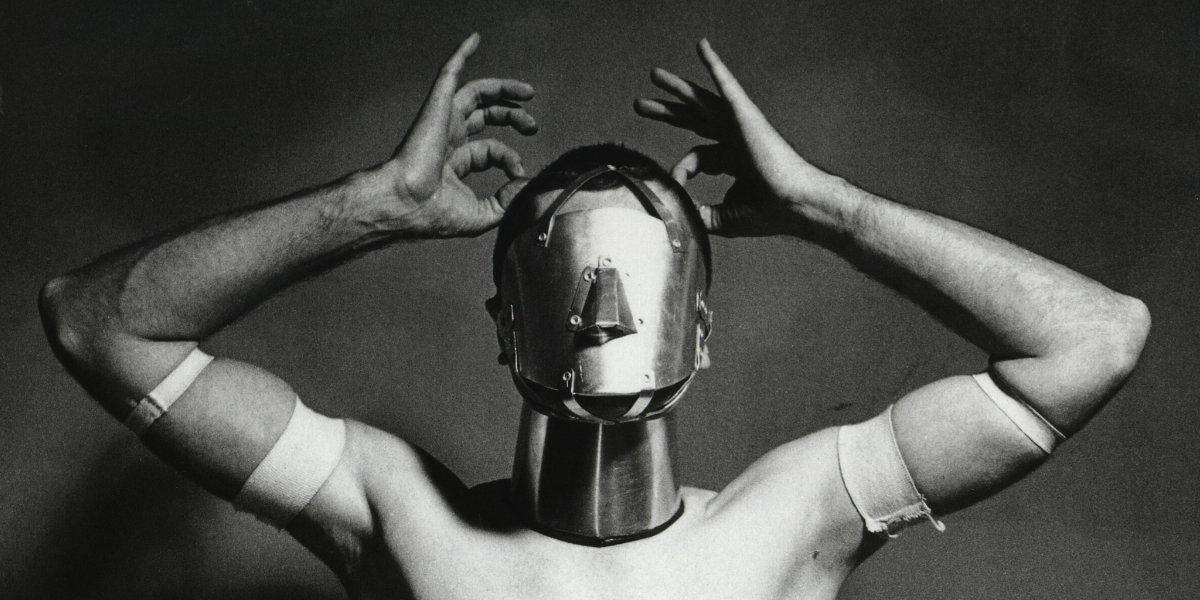
Some documentaries ask us to observe. A Body to Live In asks us to feel.
Director Angelo Madsen’s film is not an easy watch, nor does it attempt to be. The documentary immerses viewers in the radical life and work of Fakir Musafar, born Roland Loomis. He’s a controversial figure often credited with shaping what became known as the “Modern Primitives” movement. Through rare archival footage, intimate audio recordings, and reflections from artists who lived through the same cultural upheavals, the film is more than biography. It’s a meditation on the body as a site of devotion, defiance, and transformation.
But the deeper achievement of A Body to Live In is that it refuses to flatten Musafar into either saint or villain. Instead, it holds the tension between the two.
From its opening moments, the film establishes the body as a laboratory for transcendence. We see a young Musafar cinching a leather belt tightly around his waist, experimenting with restriction, endurance, and sensation. What might appear shocking at first reveals itself as the seed of a lifelong inquiry: how far can the body go before pain transforms into something else entirely?
For Musafar, that “something else” was spiritual.
Throughout the film, artists describe how body modification practices such as piercing, suspension, branding, and ritualized endurance can be pathways to altered states of consciousness. These practices blur the line between sexuality and spirituality, between the erotic and the divine.
It is precisely this territory, the liminal space where sacred ritual and erotic experience intersect, that makes the documentary so compelling. In many ways, the film is a cultural archaeology of queer embodiment in the late twentieth century. The voices gathered here, including performance artist Annie Sprinkle and body artist Ron Athey, remind us that underground performance scenes of the 1970s and 80s were not merely about shock value. They were about survival.
During the AIDS crisis, when queer bodies were stigmatized, pathologized, and erased, reclaiming the body as sacred became a radical act. Pain, ritual, and spectacle functioned as forms of community building. Suspension ceremonies and piercing rituals were not simply acts of endurance but acts of solidarity.
Madsen’s documentary unfolds almost like an intergenerational conversation, weaving Musafar’s archive of more than one hundred hours of footage with the reflections of artists who inherited or challenged his legacy.
Yet A Body to Live In earns its critical weight because it refuses to stop at admiration.
For all the film’s fascination with Musafar’s philosophy of bodily transcendence, it confronts the complicated cultural terrain beneath it. Many of the practices Musafar popularized were inspired by Indigenous and non-Western traditions that long predate his work.
The film acknowledges this history directly, raising an uncomfortable but necessary question: what happens when sacred cultural practices become aestheticized by outsiders?
Musafar himself was explicit about his influences. He studied materials and practices from around the world. He adopted the name Fakir Musafar, a hybrid drawn from Hindu and Sufi mysticism, suggesting a wandering seeker capable of feats of endurance. The name itself reportedly emerged from a Ripley’s Believe It or Not! comic strip depicting a Persian shaman who performed body piercings.
In other words, the origin story of the “Modern Primitives” movement begins with a white American man constructing a spiritual identity from fragments of cultures that were not his own. The film acknowledges that Musafar’s work opened a door. But it also shows how that door placed him at the center of a movement built from practices that existed long before him.
And that is where the discomfort lives.
The issue is not simply influence. Cultural exchange has always been part of artistic evolution. The problem lies in how those exchanges are framed. The same acts that once marked Indigenous people as primitive suddenly became avant-garde when performed by a white American artist.
That is the uneasy inheritance the film gestures toward. And it raises questions that extend beyond Musafar himself. Who gets to transform sacred cultural practices into personal expression? When does artistic inspiration become cultural extraction? Why are some bodies framed as spiritual explorers while others are framed as primitive curiosities? Why does the same act become ritual in one context and barbarism in another?
These are not simple questions, but they are necessary ones.
Today piercings, tattoos, and body modification have become mainstream aesthetic choices. What once existed in dimly lit clubs and ritual spaces now appears in shopping malls and Instagram feeds. Yet the spiritual dimension Musafar insisted upon has largely faded from view.
Madsen’s documentary sits squarely inside that contradiction. It celebrates the queer and artistic communities that forged radical understandings of the body while interrogating the colonial echoes embedded within those transformations.
By the film’s end, Musafar appears less like a singular revolutionary and more like a prism through which we can examine a much larger cultural story: the human longing to transcend the limits of flesh, and the complicated histories we inherit when we attempt to do so.
A Body to Live In is therefore not simply a documentary about one artist. It is a film about the questions that arise when bodies become battlegrounds for identity, spirituality, and cultural ownership. And sometimes the most honest films are the ones willing to let those questions remain unresolved.
