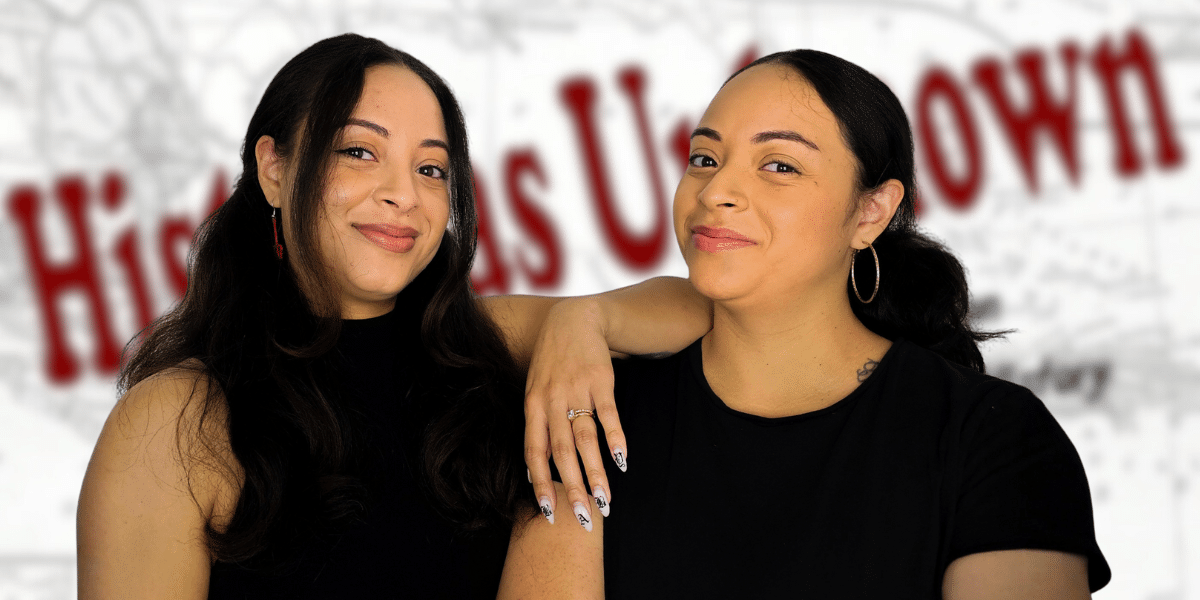
Latine history was at the forefront of Historias Unknown podcast hosts and twin sisters Cristina Lumague’s and Carmen Hernandez’s childhood. They attended an elementary school named after Chicano activist Dolores Huerta. Their teachers there emphasized culture, taught them about the history of hip hop, and always celebrated Cinco de Mayo and Mexican Independence Day.
With this background, someone might expect their podcast’s five-part series on Cesar Chavez to be a sentimental tribute to the workers’ rights activist who has almost 35 schools named after him in their home state of California. But that’s not all you’ll find in the episodes of Historias Unknown.
The series also pointed out his misogyny and exclusion of most women in leadership roles. This extended to his home life as well – despite having eight children, Chavez bragged about not knowing how to change a diaper.
Lumague and Hernandez received comments on social media accusing them of “doing the white man’s job” by criticizing one of the most visible Chicano men in history.
For Lumague, telling a complete story is more important than creating heroes.
“People have nuanced lives,” Lumague told Latina Media Co. “I had to get out of my phase where I (was) fatphobic – I was in the military, these things were ingrained in me. I love learning all the fascinating nuances of people.”
Historias Unknown, which has aired since 2022, covers serious topics in Latin American history with hope and humor. The idea came about when they collaborated on a Women’s History Month podcast for Lumague’s paranormal history podcast, Espooky Tales.
Lumague said she had to beg Hernandez to join her – but now the two women share the load of researching topics. Each episode is an interview format, with one twin sharing their latest “obsession” in historical events.
The women educate on serious topics – going beyond “typical” events like Hispanic Heritage Month and Mexican Independence Day. “The Shady History of Nestle in Latin America” covers the deaths of babies in Latin America due to Nestle’s promotion of defective formula throughout the global South. They discuss the history of lynching people of Mexican descent in the United States. They cover doctors experimenting with untested birth control on Puerto Rican women – all while one twin talks through a sore throat.
The women warn that people who don’t think casual conversation is appropriate for dark topics will be disappointed by the podcast. The twins’ lifelong rapport shines through the discussions – sarcasm flies and you might think that they’re dropping casual chisme about a neighbor rather than talking about influential figures.
Hernandez and Lumague enjoy getting caught up in their topics. They will find an interesting anecdote from history, then realize they need to learn more after doing some initial research. This approach leads to some highlights that might seem random at first: Did you know that Puerto Rican nationalist Lolita Lebrón got pneumonia as a little girl from falling into a gutter for example?
(Obviously, the hosts tie it all back to history, as Lumague speculates that Lebrón’s illness could be the reason she spent so much time reading, which eventually led the revolutionary to storm the United States Capitol in 1954 with three other Puerto Rican nationalists.)
The hosts always try to leave each episode with a bit of hope, usually through the way the marginalized fight back. “In every story of oppression, there’s a story of resistance and community,” Hernandez reminded.
For both Hernandez and Lumague, the standout episodes involve family. They recently spoke to historian Haley Cohen Gilliland about her recent book, A Flower Traveled In My Blood. The episode covers the 1976 takeover of Argentina by a military junta, maintaining power for seven years with the support of the United States and the acquiescence of much of the public. The regime kidnaps hundreds of pregnant women, then gives their children to other families. The grandmothers of the children – the mothers are believed dead – formed a group called the Abuelas de Plaza de Mayo to find the missing babies.
“They’re still fighting – they fought a violent dictatorship, and they got reunited with a lot of their grandchildren,” Hernandez said. “No matter how hard something is, they get things done, they find justice.”
With their Mexican and Salvadoran heritage, the sisters make an effort to encompass the diversity of the Latine experience, relying on creators such as journalist Dash Harris Machado for Afro-Latine perspectives. And that yields results. When they were working on a series on the US invasion of Panama, most of the official sources didn’t mention that a primarily Black neighborhood was the most impacted.
“It just goes to show how ignored, deliberately, the Afro-Latino experience in history is,” Hernandez said. “And that we need to take special attention to learn about that.”
Most recently, the women started a series on the history of the US/Mexico border, based on the book Migra! A History of U.S. Border Patrol by Kelly Lytle Hernandez. Growing up in a household with an undocumented parent, the sisters have seen the way that U.S. immigration law makes building a life in the States challenging for migrants, regardless of which party is in power.
Still, Lumague said, they recognize that more people in the U.S. are feeling the always-present fear undocumented families live with – and this shared state makes learning about history as important as ever.
“I think more people are learning,” Lumague said, “that we should have always been learning about these things.”

Historias Unknown can be streamed on all major podcast platforms.
