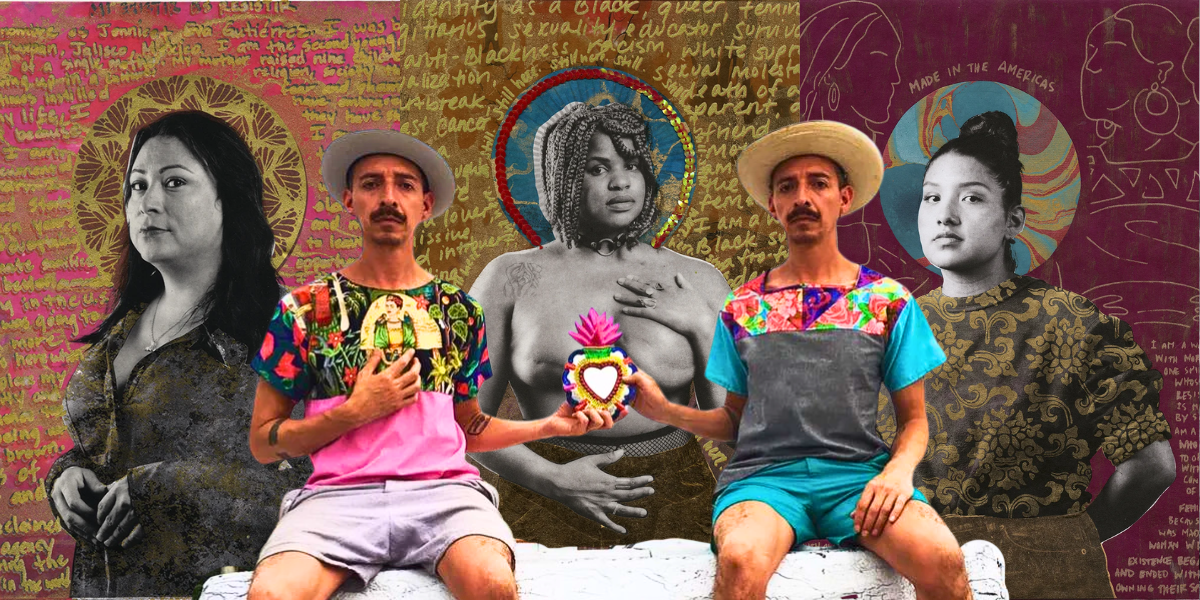
A trip to see Gabriel Garcia Roman in his studio is also a visit to his self-curated gallery. One wall is lined with carefully hung rows of wooden frames in a stunning grid. A viewer can easily get lost inside the maze of the faces of women, men, and children. At the corner of the room is a translucent mannequin with a metal crown resting on its shoulders. Two tables are at its sides: one has a vibrant woven sarape draped over its surface, and the other has a plastic cloth with a pattern of La Virgen De Guadalupe. The window looks out into the tree-lined street of Harlem.
And just to be clear – Roman’s studio is a revolutionary act of love for himself and his communities to have a permanent display of his work without the permission or authority of the mainstream art world.
Because the frames he displays are from Roman’s Queer Icons series – portraits of LGBTQ+ people, that he has worked on for over a decade.
Roman is a queer Latinx photographer and artist from Chicago. His upbringing visible in his use of colors and techniques, which now include poetry, autobiographical writing, and embroidery in addition to grayscale photography, screenprinting, and gold leafing.
Roman’s parents are working-class Mexican immigrants from Zacatecas who raised him Catholic. He took inspiration from the faith’s imagery, using halos to depict LGBTQ+ identities with reverence. His work has been included at the International Center of Photography, the Museum of Contemporary Religious Art, the Leslie-Lohman Museum of Art, and others.
And he’s achieved all this in an art world that still disproportionately favors white guys. A 2022 study showed that minority racial groups make up approximately half of contemporary artists despite comprising 40% of the population. The Bronx Museum of The Arts is a rare example of a space that strives to bring creators from minority backgrounds to the forefront.
Or as Roman told Latina Media Co, “We don’t see many queer Latina representations. My focus is definitely to highlight Latina women.”
And that’s a focus we need because both the art world and art criticism largely misunderstand our community. In earlier commentary about Queer Icons, critics wrote about the subjects as a monolith, and they mostly focused on their sexual identity – and that’s certainly an important part of Roman’s project. “Clothing is really the best way to represent somebody that’s non-binary. I’m looking at a portrait of somebody that definitely goes by them. They are wearing a men’s shirt with a vest,” said Roman in explaining how he frames his subjects, mostly from the waist up.
But the women Roman features in his portraits come from a variety of countries, including Nicaragua, El Salvador, Gambia, and the Philippines. They are Black, Indigenous, Latinx, and Asian queer women. And Roman uses their words – about body image, gender identity, motherhood, and self-acceptance – to accompany their portraits, creating a complex representation of their individual cultural backgrounds and complex lives. When critics focus on just their queerness, they miss so much.
“The reason for the text around the portrait is to amplify their voice and give them an opportunity to write about what they want to speak about. Hands are also very important. I make sure that is included in all the portraits, whether it’s the hand on the belly for the one that’s pregnant,” shared Roman.
Roman emphasizes strength by having his subjects gaze directly into the camera with their shoulders back and head raised. They show their unconventional scars, tattoos, haircuts, and clothing in a world that is still catching up to embrace atypical genders. For Gabriela (2018), for example, Roman features these words from a queer Nicaraguan and Salvadoran artist: “I am a womxn with more than one spirit. I am a womxn who refuses to operate within the confines of my femininity because I was made by womxn whose existence began and ended with owning their spirits.”
Erika (2018) is another memorable portrait. A cancer survivor, Erika shows the healed lines of flesh on her bare breasts where nipples used to be. She displays her mastectomy scars with her arms akimbo. A queer femme, she wrote these words to accompany her portrait, “I am a sister and a Black suburban Afrofuture daydreamer. I am my ancestors. Still here.” In Jennicet (2016), a Mexican trans woman with long hair and makeup shares, “I came to the United States when I was sixteen years old. After years of living in fear and shame, I reclaimed my power. I’m an undocumented and unashamed transgender.” Her hands are positioned in a way that suggests a relaxed and dignified manner.
Roman observed, “Looking at the women on my wall, they’re all about social justice. They don’t work for themselves but for the community. I think about the broader picture. Being around queer women teaches me that we’re not free until we’re all free.”
Roman began his Queer Icons series in 2011 before marriage equality was the law of the land, before Oregon became the first state to offer nonbinary identification cards, and before the Supreme Court ruled that Title VII protects LGBTQ+ workers from employment discrimination. In it, he imagined a future before it arrived, one where queer people of color could be seen as sacred and worthy of public reverence. He highlights how gender, sexuality, race, and ethnicity overlap while mainstream culture still struggles to accept queer rights and think about intersectional feminism.
And Roman didn’t stop with the Queer Icons series – he kept pushing with his Nopal Crowns and Hats project. “Where I’m from in Mexico, the nopal is seen everywhere. It’s really [an] homage to my roots,” said Roman. “Con El Nopal En La Frente,” translated to “A Cactus On Your Forehead,” is a derogatory term Mexicans say to each other when they attempt to hide their ethnicity, especially if a person has prominent indigenous features. Roman’s bejeweled cactus crowns symbolically turn the expression into a symbol of pride.
Next, he’s planning to print archived family photos of his relatives in Chicago onto household decor. The project is inspired by his mother and her maximalist aesthetic. Gabriel Garcia Roman explained, “My mom loved all of those. She had a toaster cozy, a blender cozy, a microwave cozy, and a toilet roll cozy with dolls. I’m really excited to be working on this, to show her the inspiration she’s given me.”
Together, Roman’s portraits and crowns transform identities that have been marginalized into symbols of reverence. On his studio wall, queer women of color refuse to shrink themselves and instead adjust their posture, words, and gaze to show pride and confidence in who they are. They meet the viewer directly – sacred, self-possessed, and impossible to overlook, no matter what the critics say.

Image: Gabriel Garcia Roman self-portrait with three examples from his “Queer Icons” series: Jennicet, Erika, and Gabriela (left to right). Images courtesy of Gabriel Garcia Roman.
