For the longest time, Fabiola Méndez didn’t understand what it meant to be Afro-Boricua. Growing up in a tight-knit, musical family, the 30-year-young creative from Caguas recalls sensing a “love of culture and of motherland” from an early age. But, as often happens, our cultura white washes conversations about race with the trio myth, which says all Boricuas are part Indigenous Taíno, Spanish, and African.
It’s this seemingly harmonious, yet very harmful “perfect mix” narrative that Fabiola Méndez confronts in her 19-minute documentary, Negrura. After George Floyd’s murder, she created the film to parallel conversations about Black Lives Matter in the mainland U.S. with growing discussions on anti-Blackness in Puerto Rico and the Caribbean diaspora more broadly. The Emmy-nominated composer and educator interviewed Afro-Latinx folks from Boston’s Latin Quarter Cultural District, discussing their experiences with identity from childhood to adulthood.
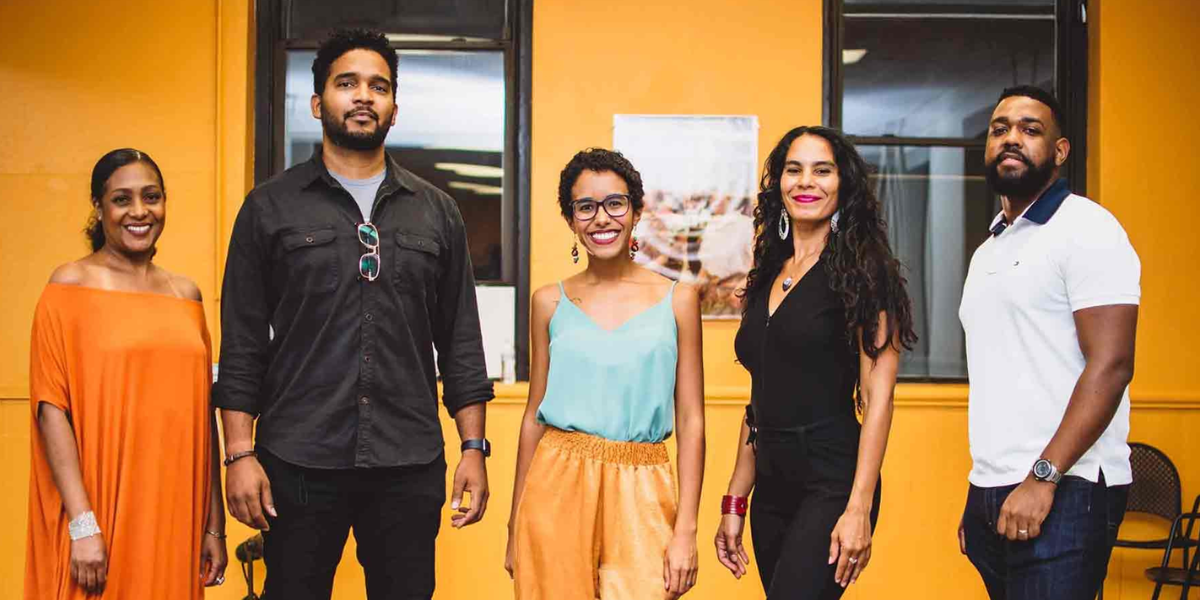
Using the cuatro guitar as a meditative backdrop, Negrura weaves a tapestry of shared painful memories and a (re)claiming of Afrocentricity. In the opening scene, as she strums her beloved instrument, Méndez instructs the four participants (2 femmes and 2 males) to “Look at yourselves, embrace who you are, every part of your body, how each part of your body tells a story of your people, of our people, of our ancestors. De sus historias, sus luchas, sus logros.”
That blank intro fades in to the group standing in front of a mirrored wall in a dance studio. Méndez’s soft voice says in Spanish, “Touch the parts of your body you hated as a child, that people criticized.” Something inside of me broke as I watched how each of the participants lifted their hands to various areas: hair, arms, face. Ending with “what do you see now?” the film concludes with a glimpse of empowerment.
Framed this way, Negrura brings together vulnerable conversations about discrimination and anti-Black racism outside of, and also within, our Afro-Caribbean and Afro-Latinx communities.
As they each shared traumatic childhood stories – like one being told she had pelo malo or another hearing, “tú eres indio, no eres negro” (you’re Indio, not Black) – the conversation flows from the perception of Blackness in their countries of origin versus in the U.S. Méndez said she “used el cuatro to interconnect all those stories with musical interpretations [because] the documentary’s purpose is to create spaces for these conversations. For our stories to be heard.”
Toward the end of the documentary, Méndez and the group revisit their reflections on self. This time, she includes herself. They are no longer together in the studio. They’re each in front of the camera, some pass their fingers across the bridge of their nose, another along their forehead, another along their hair. Méndez caresses her left forearm, with the biggest smile, ending by hugging herself and laughing out loud.
Before producing Negrura, Fabiola Méndez recorded her album Afrorriqueña, a tribute to her Afro-Puerto Rican roots. When Latina Media Co asked what was missing in the conversation surrounding this part of her identity, she shared, “I’d say the first thing is to say it. Something I felt missing for years was the vocabulary to express emotions, aggressions, to be able to concretely define who we are.” She acknowledged that in large part is because in our culture, the three-races narrative seeks to “cancel this part of us, erases the contributions” of our African-ness.
With Afrorriqueña, Méndez explores this side of her identity, highlighting works by Afro-Boricua femme poets, such as Ángela María Dávila, Mayra Santos Febres, and Yara Liceaga-Rojas. “I musicalized poems by women who explore this afrorriqueñidad in their work,” the musician explained.
Fabiola Méndez also discusses an aspect of our negritud sometimes missing from the conversation: lower melanin levels. “In Puerto Rico, there are many skin tones, and there are some people who are visually lighter-skinned, but who have a strong connection to their (our) African heritage.” She concedes that it’s complex, adding, “it doesn’t necessarily have to do with your skin color, but it does have to do with your skin color too, because having darker skin means your experiences are completely different.”
Then there’s the perspective of existing “across the pond,” as she says.
Living in the United States East Coast for the past 12 years offers her another context of what it means to be Black. Seeing how “African-Americans are very clear about their Blackness, their history and their struggles,” she finds it inspiring to realize things are slowly changing in her motherland of Borinquen. For example, we now mostly use the word “negro/negra” without shame. She credits the change to groups on the archipelago hosting honest conversations about our racial heritage in an empowering and uplifting way, while noting “there’s still work to be done.”
Currently, she’s writing the music for the 3rd season of Alma’s Way (produced by Fred Rogers Productions and PBS Kids). Fabiola Méndez is also collaborating with a Puerto Rican playwright on a musical while composing her next album. The celebration of our rich Afro-Rican sabor continues.
